
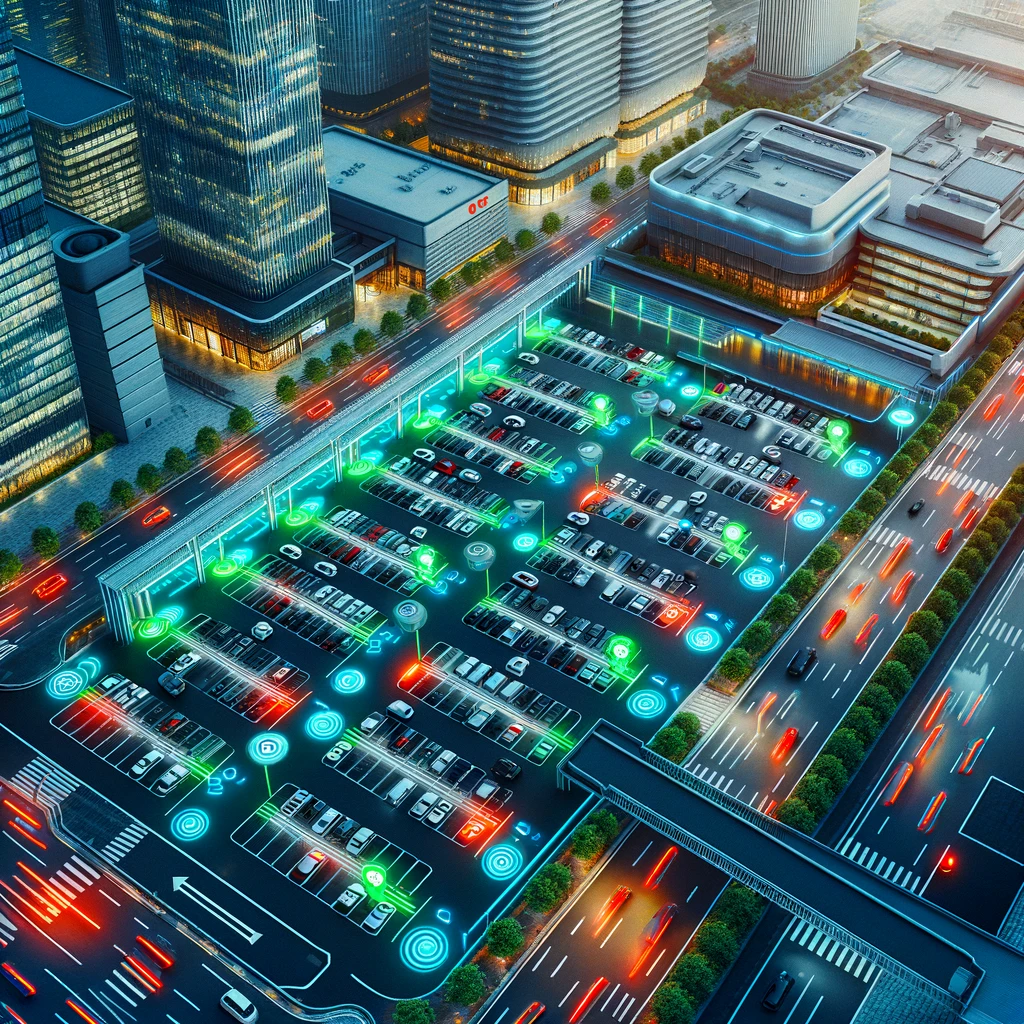
In today’s age, many things are infused with modern technology to improve their operational efficiency. Everything has the ‘smart’ prefix, from phones to watches, to showcase their ability to communicate and function with other networked technologies. But ‘smart’ technology is not just limited to things. Today, governments across the globe are striving to build smart cities.
Smart cities efficiently use information and communication technology to improve their operations. Infusing them with modern technology like artificial intelligence and machine learning helps governments to build datasets of citizen behavior and habits. With the help of these datasets, governments can identify the areas where optimization can be made and work on them to improve the citizens’ quality of life.
One of the major issues that plague the citizens is parking. According to research, it’s estimated that there are 8 parking spots for every car in America. Despite that, finding empty parking spaces in urban areas seems like an impossible task. Fortunately, the rapid advancement of modern technology has allowed planners to implement smart parking systems. Efficient implementation of technology can help vehicle owners find parking spaces without hindrance. It can help citizens to traverse better. Moreover, it can help governments and businesses efficiently use land and maximize revenue.
What is Smart Parking
Smart parking is the efficient use of technology to manage parking spaces. These systems use hardware technology like sensors and cameras to monitor parking spaces. In today’s world, they also use modern applications of artificial intelligence (AI) like machine learning (ML), computer vision, optical character recognition (OCR), natural language processing (NLP), and more to improve the already existing parking spaces. It helps city planners enhance citizens’ parking experience and improve the city’s mobility. Moreover, it also helps them to collect information to use data-driven technologies that can be used to enhance urban planning and other important purposes.
How Smart Cities Can Benefit From Smart Parking Systems
Smart parking systems generate as well as gather massive amounts of data. This data is analyzed to provide vehicle owners with a smooth parking experience. Smart parking systems provide benefits such as gateless parking, online booking, digitized payment, and much more. It negates the need for searching empty parking spaces while driving around. This significantly reduces fuel consumption as well as pollution. It helps parking lot owners to utilize their space better.
Apart from the direct benefits of using a smart parking system, governments can use the collected data for other purposes as well, such as
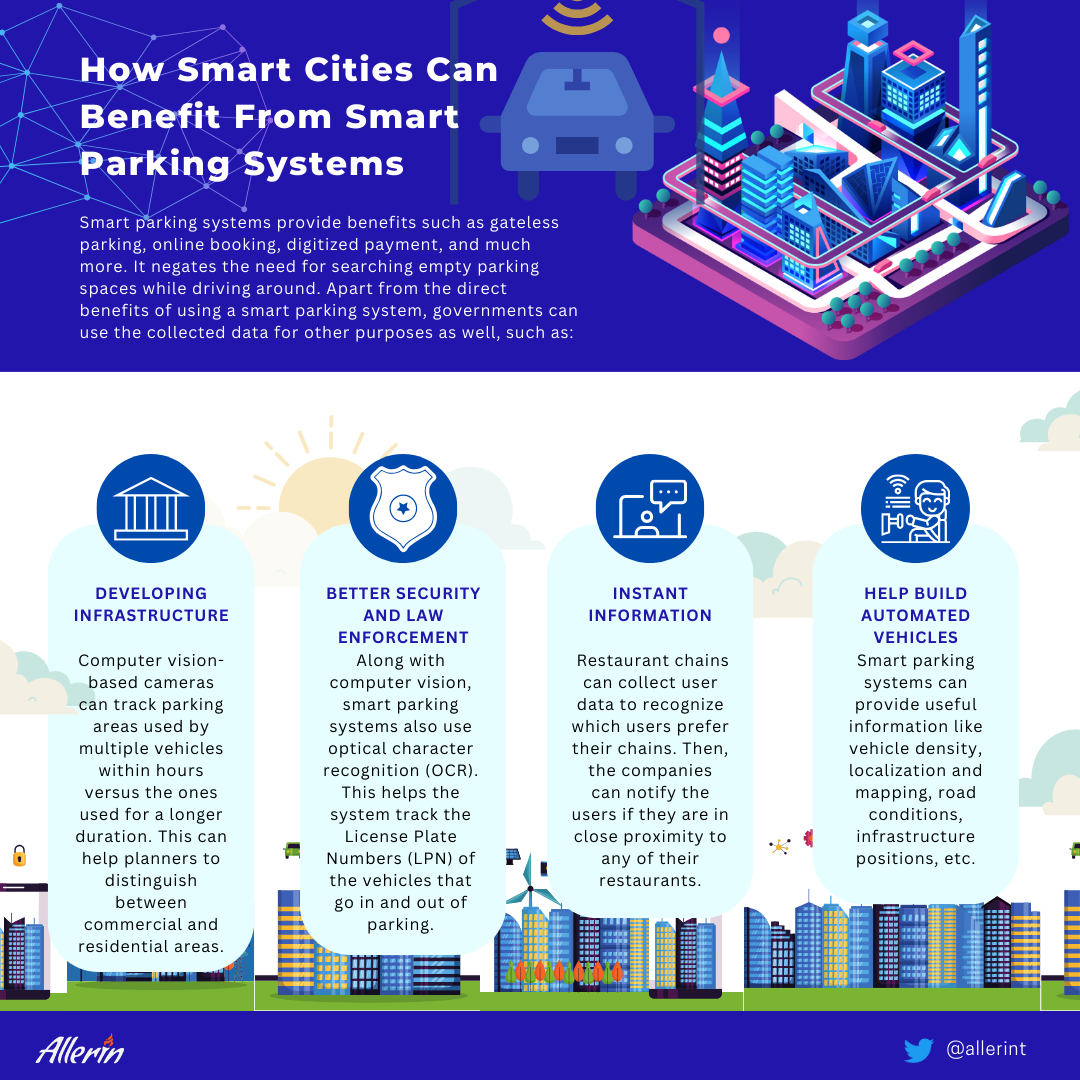
1. Developing Infrastructure
Building civic architecture like hospitals and schools requires a great deal of planning. One of the important factors while building such a structure is location. City planners gather information about the locality to determine whether it needs a specific structure. Moreover, these areas should be easily accessible. In such cases, the government can use the data collected by smart parking systems.
Computer vision is one of the components of a smart parking system. This application of artificial intelligence is used to help computers learn how to view and perceive visuals as humans do. With the help of computer vision, parking systems can identify vehicles and distinguish between them. It can also identify areas that are dense with vehicles. City planners can use this information to learn which areas need certain civic structures.
For instance, computer vision-based cameras can track parking areas used by multiple vehicles within hours versus the ones used for a longer duration. This can help planners to distinguish between commercial and residential areas. Based on this information, planners can identify which areas can benefit from structures like schools, hospitals, etc. According to research, 20% of automobile accidents occur in parking spots. Planners can also determine which areas are accident-prone and take measures to improve them.
2. Better Security and Law Enforcement
Car thievery and other vehicle-related crimes are a major problem in urban cities. Some crimes, like illegal parking in handicapped parking spaces, can cause inconvenience to citizens. Tracking down violators with traditional parking systems, which relied on sensors and basic CCTV cameras, was difficult. However, the government can tackle this problem with the help of AI-based cameras in smart parking systems.
Along with computer vision, smart parking systems also use optical character recognition (OCR). This helps the system track the License Plate Numbers (LPN) of the vehicles that go in and out of parking. The system provides real-time data to law enforcement agencies about frequent violators. This helps enforcement officers to take necessary steps against such violations. Apart from notifying the enforcement officers, these systems also notify the violators to pay fines via digitized methods. Since the license plates are tracked, people are less likely to violate the rules.
3. Instant Information
In today’s world, a smartphone is not only a tool simply to make calls. It is a powerful computing device that helps people in their daily lives. The data collected from parking spaces can be used to provide smartphone users with instant and important information. If a user visits a certain locality frequently, their data is recorded by the parking system. This data can be used by service providers in the same locality to inform the user about their presence.
For instance, restaurant chains can collect user data to recognize which users prefer their chains. Then, the companies can notify the users if they are in close proximity to any of their restaurants. Similarly, users can get instant access to information about the locations of hospitals and other important structures.
4. Help Build Automated Vehicles
Automated cars, also known as self-driving or autonomous cars, are among the latest marvels of modern technology. According to studies, 90% of car crashes occur due to human error. This also includes crashes caused by drunk driving and speeding. Automated cars use complex algorithms to take passengers from one place to another without needing a driver. These cars use multiple technologies like computer vision, machine learning, convolutional neural networks (CNN), and more to identify their surroundings and interact accordingly.
To avoid any accidents in such vehicles, it is crucial to load them with massive amounts of data. Companies can use the data generated from smart parking systems to build such automated vehicles. Smart parking systems can provide useful information like vehicle density, localization and mapping, road conditions, infrastructure positions, etc. It can help automated cars plan their paths, saving more time and avoiding congested roads. Moreover, it can inform the passengers about accidents or other road obstacles beforehand.
What Makes Smart Parking Essential
Parking systems have evolved over a period of time with the growth of technology. Earlier, there was a lack of on-street parking rules. Due to this, the curbs of the road were often full of parked cars. This resulted in congestion of roads. To tackle this problem, city planners introduced off-street parking requirements.
Off-street parking requirements, also known as mandatory parking minimums, are regulations set by local governments. These regulations mention the minimum number of parking spaces developers should include in buildings based on certain factors. These factors change with the structure. For instance, a building should include a set amount of parking spots for every 1,000 sq. ft. If the building is a movie theatre, it should include a parking space per four seats, and so on.
While this system allowed cities to curb on-street parking, it created new problems. Massive areas of land were covered with parking areas. In some cases, parking areas covered more land than the structures themselves. Due to this, the structures had to be built at a considerable distance from each other. Since it was difficult to travel to these structures, which included malls, hospitals, restaurants, etc., citizens had no choice but to rely on cars. This, in turn, increased traffic and the demand for more parking spaces.
To stop this vicious cycle, it is necessary for governments to adopt smart parking systems. This can help the government track empty parking spaces and use that land in efficient ways like:
- Erecting new residential buildings to accommodate people’s living
- Building recreational facilities like public parks and playgrounds to promote health and
- Cultural venues like theatres, museums, art galleries,
- Build bike lanes to increase mobility and promote pollution-free modes of
With the help of smart parking systems, planners can efficiently use parking spaces to beautify cities and increase their accessibility.
Conclusion
Smart cities are the future of urban development. They use data-driven approaches to enhance efficiency, connectivity, sustainability, and overall infrastructure to increase the quality of life of their citizens. Since efficient transportation is one of the major components of smart cities, it is necessary to adopt modern smart parking systems. With their help, smart cities can increase mobility, reduce traffic congestion, and efficiently use land. Moreover, governments can use the data collected from smart parking systems for various useful applications and take the next step in the future.