

Companies will be able to track their assets in real time. They could also improve utilization of the assets to meet demand. It is said that IoT will enable us to predict the required maintenance even without visiting the remote devices. Many organizations are now implementing this concept into reality.
Still, implementing IoT can cause a lot of unique difficulties for potential users. Organizations are faced with several hurdles while adopting IoT in their organizations. In our previous blog, we talked about how IoT is tackling the issue of energy consumption. In this article, we provide you with the several major challenges that impact a broad implementation of the Internet of Things:
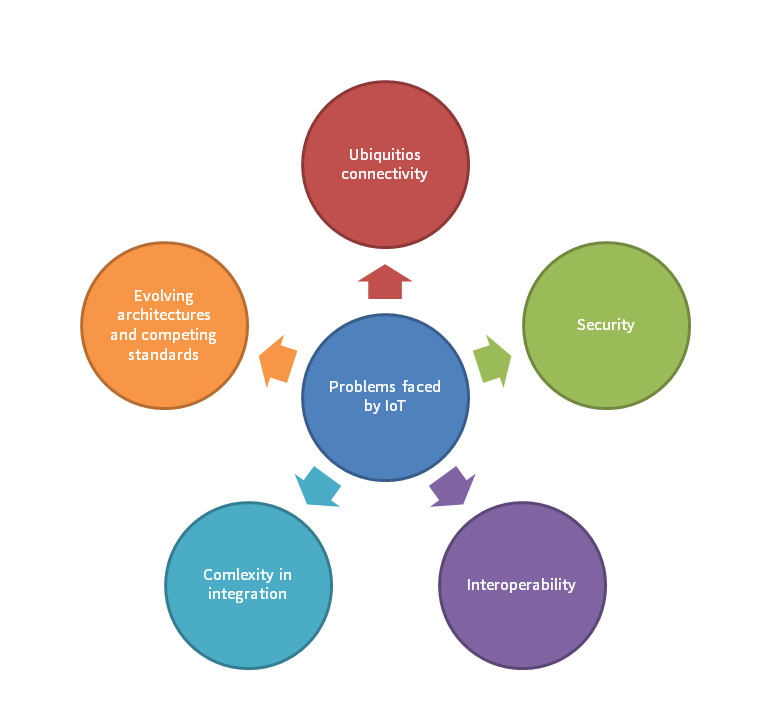
1. Ubiquitous connectivity
Even today, the internet is not available in many areas of the world. This fact is not just relevant to developing countries, but also to several areas in Northern Europe and America where there is no internet coverage. The whole concept of IoT lies on constant and reliable connectivity. Thus, no reliable source of connectivity causes problems in implementing IoT.
2. Security
IoT focuses on connecting more and more devices together. This causes more entry points for malware. Devices that are less expensive have greater risks of getting tampered with. Just focusing on solving technical issues to keep people’s data safe is not enough. We must move further than that. A firm trust must be established in the consumer’s and business user’s mind. Only then will we be able to overcome this hurdle.
3. Interoperability
As many different systems are getting connected through IoT, it has been creating a lot of interoperability challenges. It is becoming difficult to create real cross-domain services that will allow seamless movement of devices and data.
4. Complexity in integration
Today there are multiple platforms, numerous APIs, and protocols available for IoT integration. This causes a confusion around the evolving standards which leads to slow adoption. Slower adoption and unanticipated development resource requirements are causing delays in delivery and additional funding for IoT projects.
5. Evolving architectures and competing standards
As there are a number of competitors in the market today, it is no wonder that there is an ongoing war between these competitors to protect their proprietary systems and set new standards. Every day, multiple standards are evolving based on different requirements determined by device class, power requirements, capabilities, and uses. This presents opportunities for platform vendors to contribute and influence future standards. This causes problems in IoT implementations as too many standards are produced, leading to confusion.
Even though implementing IoT has complications, the convergence of technologies will make IoT implementation much easier and faster. Read more about IoT on Allerin’s blog.