
 With the spread of the digital revolution, leveraging data has become crucial for organizations. Efficient data management has become necessary for the entire data lifecycle — storing, controlling, processing and extracting. Therefore, organizations have started migrating to cloud data warehouses for enhanced data and content management rather than storing it on-premise. Cloud data warehouse migration aims to use the flexibility, scalability and cost-effectiveness of a cloud-based data warehousing solution. It can also enable organizations to integrate easily with other cloud-based services. To tap into the benefits of cloud data warehouses, organizations should use ways that can quicken their migration.
Ways to Accelerate Cloud Data Warehouse Migration for Content and Data Management
Through cloud data warehouse migration, firms can find ways to cut down expenses by reducing the resource allocation needed to store, manage, analyze and process data. To fasten the process of cloud data warehouse migration, the following ways can be implemented:
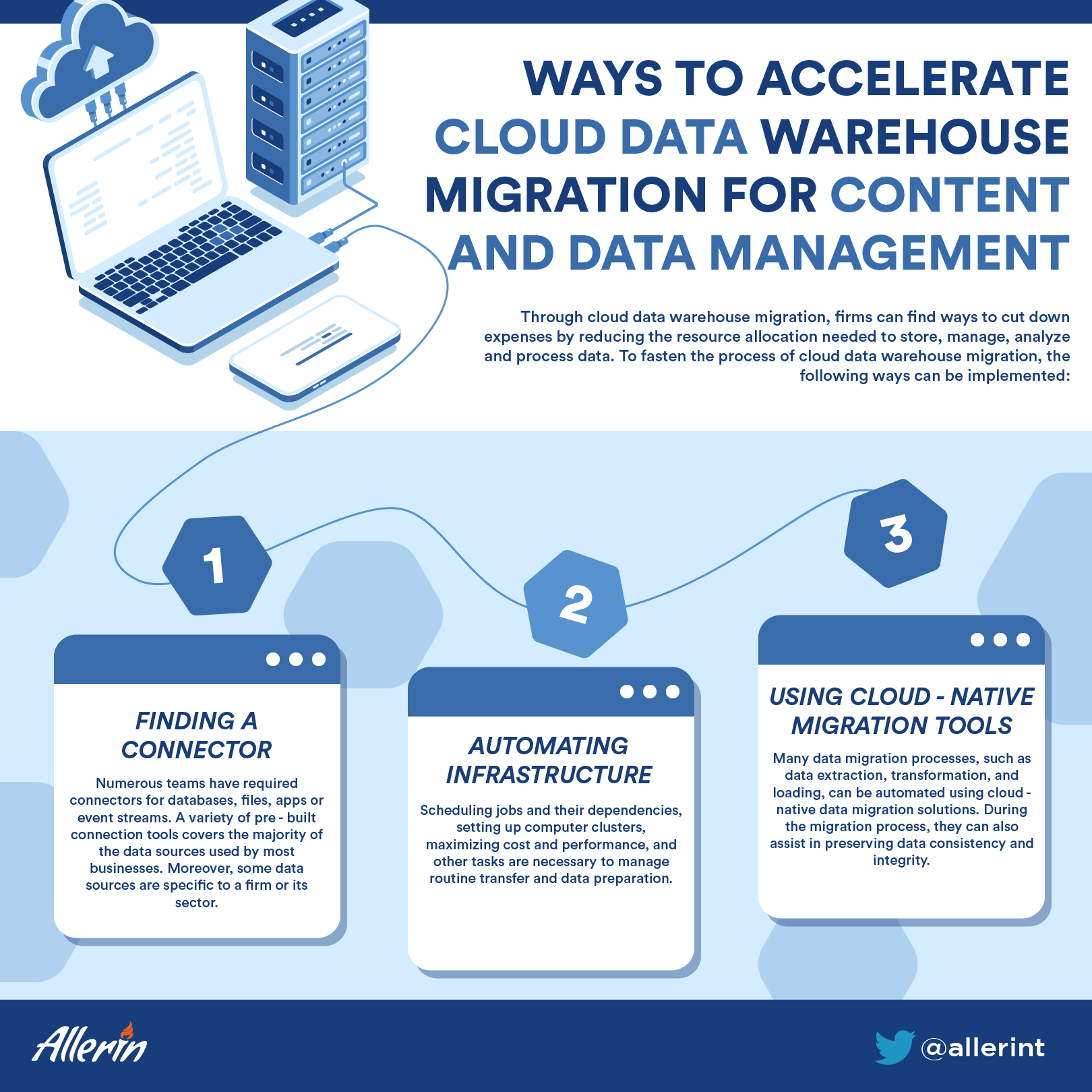
Finding a Connector
Numerous teams have required connectors for databases, files, apps or event streams. A variety of pre-built connection tools covers the majority of the data sources used by most businesses. Moreover, some data sources are specific to a firm or its sector. However, much like with pre-built connectors, you’ll gain from a vendor’s expertise in frameworks and handling unique sources.
Automating Infrastructure
A firm can avoid managing physical servers in a data center by shifting to the cloud, but the IT team might still feel overburdened with infrastructure-related tasks. Scheduling jobs and their dependencies, setting up compute clusters, maximizing cost and performance, and other tasks are necessary to manage routine transfer and data preparation. There are several ways to free up the engineering staff of a company, ranging from fully managed pipeline solutions to open-source orchestrators and serverless choices.
Using Cloud-Native Migration Tools
Many data migration processes, such as data extraction, transformation, and loading, can be automated using cloud-native data migration solutions. During the migration process, they can also assist in preserving data consistency and integrity. Additionally, large data sets can be migrated using several cloud-native data migration solutions leading to a firm’s efficient data and content management.
The technological revolution has brought with it a relentless influx of data. This data and its valuable applicability are now the primary weapons for firms for having the upper hand over their competitors. Therefore an effective content and data management strategy can be streamlined by cloud data warehouse migration. It will allow them to store, protect and process all data sources and drive faster and better decision-making.