In most government AI projects, launch isn’t the finish line, it is the beginning. These systems don’t stand still. They respond to new data, evolving needs, and unpredictable conditions. Yet oversight too often stops after deployment. What agencies need instead is feedback-driven AI governance: a model that pays attention, adjusts with context, and actively responds to what the system is doing in the field.
Why Feedback Slips Through, and Why That’s Risky Now
AI tools are often launched under tight procurement cycles that leave little room for post-deployment planning. Once a system goes live, oversight tends to stall. Ownership blurs between technical, legal, and operational teams, and feedback channels, where they exist, are rarely structured for follow-up.
This matters because AI doesn’t operate in isolation. It responds to changing inputs: user behavior, policy updates, emerging data. What works on day one can quietly falter by day thirty. Without dedicated checks, errors persist and scale, undetected and unaddressed.
Aligning Feedback Loops with Federal AI Guidance
Federal expectations point the same way. Executive Order 13960 (2020), still in effect, calls for transparency, fairness, and continuous monitoring of federal AI. The NIST AI Risk Management Framework defines ongoing cycles of performance assessment and governance (Govern, Map, Measure, Manage). And the bar has risen since: after the 2025 changes to federal AI executive orders, OMB’s M-25-21 now requires agencies to identify and actively manage “high-impact” AI systems, which means monitoring them in production, not just at launch.
So why does feedback still fall short? In practice, contracts focus on procurement deliverables, not management cycles. Oversight roles are often undefined, and teams move on to the next launch. The result is principles on paper but gaps in execution. Real feedback-driven AI governance has to be designed into contracts, schedules, and internal responsibilities.
Core Components of Feedback-Driven AI Governance
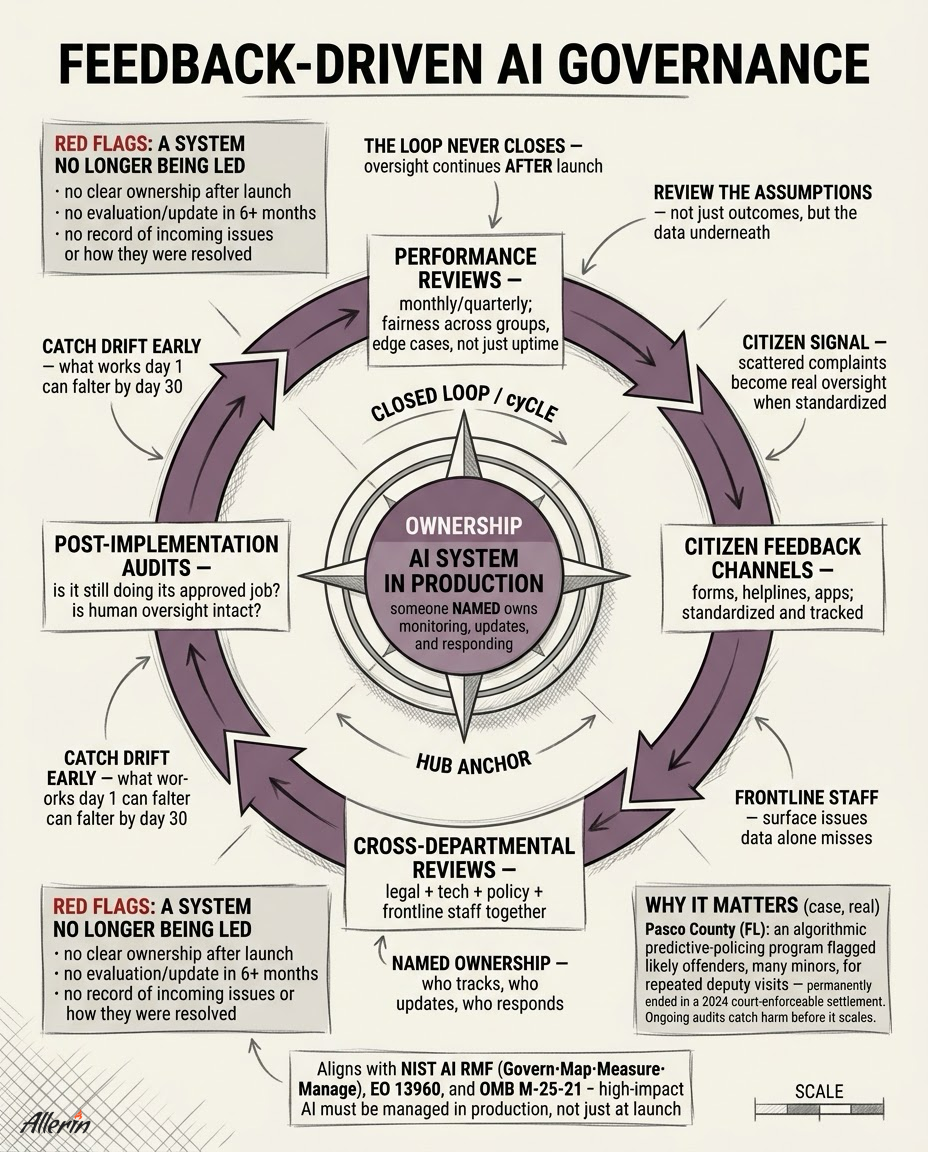
Today’s AI systems are dynamic; they evolve with context, inputs, and feedback. Managing them takes more than watching performance dashboards. It means making space for structured, continuous learning from the field, across four components.
Performance reviews
Schedule regular reviews, monthly or quarterly, to evaluate system behavior. Look beyond technical uptime to real-world impact, accuracy across different groups, and how the model performs in edge cases.
In 2019, researchers found that a widely used healthcare risk algorithm was significantly underestimating the needs of certain demographic groups, because it relied on historical healthcare spending as a proxy for need, an approach that overlooked disparities in access and treatment. Many people who needed care were never flagged. The lesson: review not just outcomes, but the data and assumptions underneath them. The same discipline behind the seven data health checks agencies should run before deployment applies just as forcefully after go-live, because the data feeding a live model shifts long after the launch review is signed off.
Citizen feedback channels
Citizen input should be easy to submit and easier to track. Agencies can use familiar tools, messaging apps, digital forms, or helplines, to gather reports about model decisions, then organize and review them regularly for patterns. Standardizing how feedback is collected and acted on across divisions, rather than letting each team improvise, is what turns scattered complaints into a real oversight signal.
Cross-departmental reviews
No single team sees the whole picture. Legal advisors focus on compliance, technical teams on performance, policy leads on public outcomes. When those perspectives stay isolated, risks slip through. Hold structured check-ins each quarter to spot overlaps, contradictions, or unintended effects early. Include frontline staff who work directly with communities; they often surface issues data alone doesn’t reveal, like misaligned outputs, confusing decisions, or inconsistent experiences.
Post-implementation audits
Audits make sure systems still work as intended and catch the quiet shifts that go unnoticed. Before auditing, ask: Is the system performing its approved function? Are human oversight and review steps still in place?
Florida’s Pasco County offers a sharp example. The sheriff’s office ran an “intelligence-led” predictive-policing program that generated lists of likely offenders, many of them minors, and sent deputies on repeated visits based on algorithmic risk scores. After investigations and a civil-rights lawsuit, the office agreed in late 2024 to permanently end the program in a court-enforceable settlement. It is a clear case for how early, ongoing audits can keep systems aligned with their intended goals and catch harms before they scale. Knowing which metrics actually reveal whether a predictive policing system is working is what separates an audit that catches this early from one that rubber-stamps the dashboard.
Internal Ownership Makes Feedback-Driven AI Governance Real
Another common failure point is unclear ownership. In many agencies, once a system goes live, no single team is responsible for oversight. Procurement ends, vendors exit, and the system drifts into operational limbo. To avoid that, define:
- Who tracks model performance
- Who manages updates or retraining
- Who responds to internal or public concerns
Oversight depends on clarity. Every project should name who is responsible for monitoring, maintaining, and updating the system once it is live.
Making Sense of Feedback at Scale
Not every report or observation flags a real problem, but some carry early warnings worth acting on. Agencies need a way to prioritize and process what comes in, with internal processes to:
- Spot patterns across departments or regions
- Prioritize reports that point to high-impact or repeat issues
- Check alignment between what the AI is doing and what it is meant to do
The goal isn’t to resolve every concern instantly. It is to make sure important signals don’t get buried in the noise.
What Feedback Reveals, and Why It Matters
When feedback becomes part of how systems operate, agencies move from reacting to learning. They build institutional memory, adapt models to shifting laws, norms, and public needs, and earn trust, because communities see their input carries weight. That is also why feedback-driven AI governance sits so close to the work of building public trust in government AI: a visible response to citizen input does more for confidence than any transparency statement.
When feedback is absent, the signs show fast. Three common red flags:
- No clear ownership after launch
- No evaluations or updates for six months or more
- No record of incoming issues, or how they were resolved
Alone, each may seem minor. Together they point to a deeper problem: a live system that is no longer being led.
Build Feedback Into the Way You Govern
Oversight doesn’t mean micromanaging code. It means staying aware of how tools affect people and adjusting when they don’t perform as expected. A place to start:
| Action area | What to implement |
|---|---|
| Performance monitoring | Structured reviews (monthly or quarterly) to evaluate fairness and accuracy |
| Public input | Civic-tech tools (chatbots, forms) to collect and categorize citizen reports |
| Model evaluation | Review AI systems for drift or misuse every 6 to 12 months |
| Team training | Train oversight staff in explainability, auditing, and retraining protocols |
| System ownership | Assign teams responsible for ongoing management and updates |
Agencies that embed feedback into how they manage systems are better prepared to prevent failures and lead with confidence.
Oversight Is an Ongoing Responsibility
Governance doesn’t stop at deployment. It matures through consistent, feedback-driven oversight. Agencies that build their workflows around structured reviews and public input are better positioned to catch early signals, make timely adjustments, and earn lasting public trust. Feedback, embedded into day-to-day operations, becomes more than a safeguard. It becomes a strategic advantage, and building those feedback-driven AI governance cycles is exactly the kind of work we do at Allerin.
Sources: NIST: AI Risk Management Framework · Akin Gump: OMB M-25-21, accelerating federal use of AI (2025) · Reason: Pasco County to end its predictive-policing program (2024 settlement) · Obermeyer et al., Science: bias in a health risk algorithm (2019)