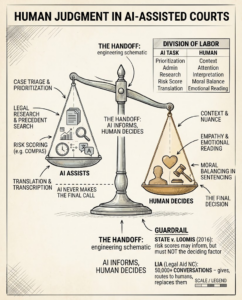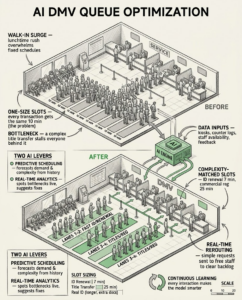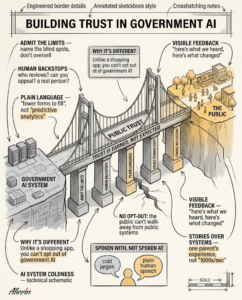
From smart traffic systems to faster benefits processing, governments are turning to AI to make public services work better. The idea is simple: if data can help us predict patterns, where traffic builds up, when hospital ERs overflow, or even where crimes might happen, then maybe we can get ahead of the problem. We can intervene earlier, respond faster, and stretch limited public resources further.
Predictive policing falls into that same category. The goal isn’t to replace police work, it’s to make it more strategic. AI tools look at past crime data and try to forecast where trouble might occur next or who might need help. But here is the catch: when decisions based on that data affect people’s lives, when and where patrols are sent, which neighborhoods are watched more closely, or who gets flagged for extra scrutiny, it stops being a neutral tool. It starts to shape reality. That is where trust becomes a much bigger part of the conversation.
What Does “Working Well” Even Mean?
| Focus area | Why it matters |
|---|---|
| Fairness | Equal treatment for all |
| Accuracy | Fewer false predictions |
| Transparency | Clear, open decision-making |
| Trust | The community feels respected |
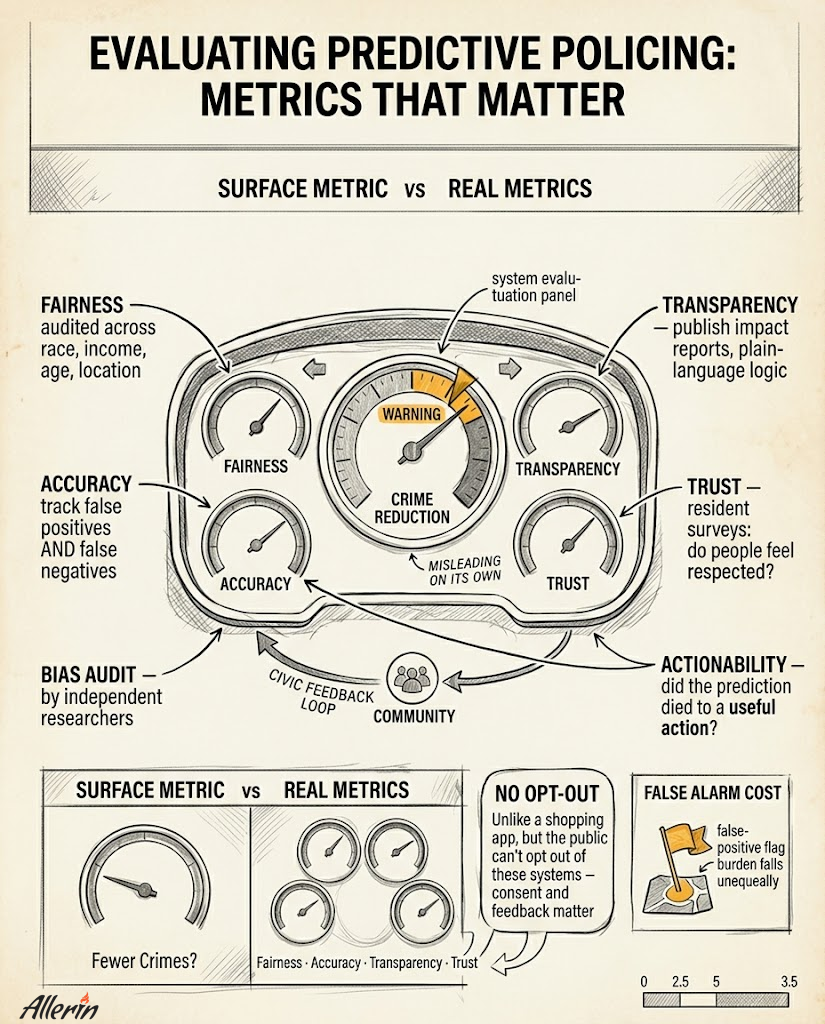
If a city starts using predictive policing, how do we know if it is working? On the surface, we might look for fewer crimes. But crime rates don’t fall in a vacuum. Maybe a new youth program just launched. Maybe the economy improved. Maybe people stopped reporting certain incidents because they felt discouraged or over-policed.
So we need to look at more than raw numbers. One useful question: did this prediction lead to something useful? Did it help an officer intervene before violence happened? Did it lead to community outreach instead of a stop-and-frisk? Metrics like these, what experts call actionability, show whether the system is not just accurate on paper but meaningful in practice. Chicago’s experience shows why this matters. A RAND evaluation of the city’s Strategic Subject List found that people on the list were no less likely to become victims of violence, but were more likely to be arrested, so the tool ended up targeting arrests rather than preventing harm.
False Alarms Come at a Cost
Like any system, AI can get things wrong. It might overestimate risk in one area and miss red flags in another. When that happens in predictive policing, the fallout is real. A neighborhood might feel unfairly targeted. Someone could end up under suspicion based on a flawed pattern rather than actual behavior.
That is why governments need to track false positives and false negatives carefully, not just overall but across race, income, age, and location. If the system makes more mistakes in certain communities, that is not a glitch, it is a problem. And it is one people feel, whether or not they ever see the algorithm behind it. This is well documented. A 2016 study by Lum and Isaac showed that training on biased arrest data can create feedback loops that keep sending patrols back into the same over-policed neighborhoods, and the “Dirty Data, Bad Predictions” analysis documented how systems trained on data from periods of discriminatory or unlawful policing can absorb and repeat those patterns.
Fairness Isn’t a Bonus, It’s the Baseline
For predictive policing to even begin earning public trust, governments need to take bias seriously. That means checking not just whether the system works, but who it works for and who it may be working against.
Regular bias audits, ideally by independent researchers, are a good start. They should ask: are certain groups flagged more often? Are those flags leading to action, or just surveillance? Are the benefits of safety distributed equally, or are the burdens of scrutiny falling on the same neighborhoods again and again?
Transparency Is a Public Right
If people don’t know how a system works, it is hard to trust it. When AI is used in law enforcement, where decisions carry real consequences, transparency becomes non-negotiable.
That doesn’t mean giving away trade secrets. It does mean publishing impact reports, sharing the kinds of data being used, and explaining in plain terms how the system makes decisions. It also means offering community briefings, listening to public concerns, and letting people see the bigger picture.
Governments could even introduce a transparency score, a simple way to show residents how open and accountable the system really is. In this context, clarity isn’t a luxury. It is a responsibility.
It’s Not Just About Reducing Crime, It’s About Building Trust
Crime data is only part of the story. Community relationships, social services, and housing support all play a role in public safety. So even if an AI tool claims to lower crime in a neighborhood, we should still ask: do people feel safer? Do they feel respected? Do they feel heard?
Public trust can be measured too. Cities already run resident satisfaction surveys, and they could add questions specific to policing and AI, especially in communities where these tools are being piloted. If predictive policing makes people feel watched rather than protected, that is not success, it is a warning.
Efficiency Matters, But So Does Consent
Predictive systems can make law enforcement more efficient. They might reduce unnecessary patrols or help departments prioritize limited resources. But unlike AI on a shopping app or a music playlist, people don’t get to opt out of public systems. When an algorithm decides where police show up or who gets flagged, people are part of the system whether they agree to it or not.
That is why feedback loops matter, not just technical ones that refine the algorithm, but civic ones where the public has a voice and governments actually listen. It is not enough for the system to improve itself. It needs to be open to being improved by the people it affects.
Looking Ahead: Smarter Doesn’t Always Mean Fairer
Predictive policing offers potential. But potential alone isn’t enough, not when people’s freedom, safety, and dignity are involved. Some major departments have already pulled back: the Los Angeles Police Department discontinued its person-based program, Operation LASER, in 2019, and its location-based tool, PredPol, in 2020, after audits struggled to show they were working as intended. The systems might be smart, but trust has to be earned, step by step, with metrics that reflect not just performance but fairness, transparency, and human impact.
That means asking harder questions, tracking deeper outcomes, and staying accountable to the people at the heart of it all, not just the code behind the scenes.
We help public agencies build AI systems that are measured on fairness and transparency, not performance alone, with the audits and oversight that earn public trust.
Because in public service, success isn’t just about how well something works. It is about who it works for.
Sources: RAND: evaluation of Chicago’s Strategic Subject List (2016) · Richardson, Schultz & Crawford: Dirty Data, Bad Predictions (NYU Law Review Online, 2019) · Lum & Isaac: To Predict and Serve? (Significance, Royal Statistical Society, 2016) · BuzzFeed News: LAPD ends PredPol (2020)