In public service, what you buy is what you become. That is why AI procurement as policy is the more honest way to describe what happens when an agency signs a contract for an automated system.
An AI system that flags fraud or scores housing applications isn’t just a tool. It becomes part of how institutions operate and how they are understood. In public agencies, even well-meaning choices can lock in values no one intended, leading to opacity, bias, or dependence on a single vendor.
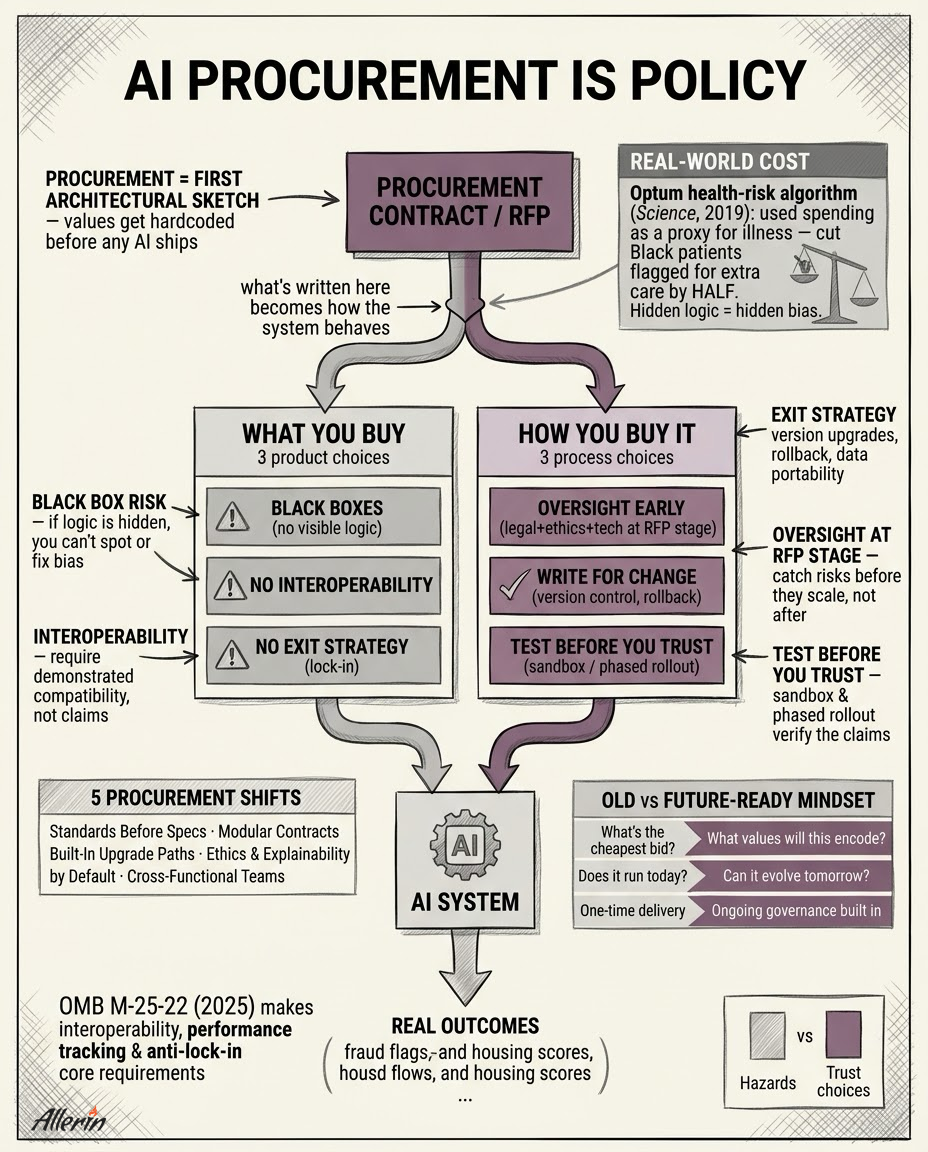
So procurement deserves more scrutiny, not just in what is bought, but in how those decisions are made. Once a system goes live, it rarely stays neutral. It starts to shape policy long before anyone calls it that. To see where those choices take root, you have to start earlier, at the moment when the rules aren’t written in law yet, but in contracts. That view is now federal expectation, too: OMB’s M-25-22 (2025) makes interoperability, performance tracking, and protection against vendor lock-in core requirements of how agencies buy AI.
AI Procurement as Policy: Writing the Rules Before the System Exists
“Good fences make good neighbors,” the saying goes. In tech, good contracts make resilient systems.
Procurement has long been treated as a pre-launch formality, a way to source technology rather than shape it. But with AI, procurement is not just a transaction. It is the first architectural sketch of a system’s long-term behavior. A vague RFP leads to vague outcomes. A thoughtfully built one is where equity, accountability, and explainability get hardcoded before a single line of AI is deployed. What isn’t written in the contract often ends up written in code.
What You Buy: Three Procurement Choices That Shape the System
When governments adopt AI, the product they choose determines more than functionality. It sets the boundaries for fairness, auditability, and adaptation. Three common mistakes carry lasting consequences.
Buying black boxes
Some AI tools deliver answers without showing how they got there: no access to the model’s logic, its training data, or the steps behind a decision. For public agencies, that means they can’t always explain what the system is doing.
A 2019 study in Science by Ziad Obermeyer and colleagues found that a widely used risk algorithm sold by Optum, deployed in U.S. hospitals to flag high-risk patients, systematically underestimated the care needs of Black patients. The model used past healthcare spending as a proxy for illness, and because less has historically been spent on Black patients with the same conditions, it concluded they were healthier than equally sick white patients, cutting the number of Black patients flagged for extra care by more than half. Because the logic was hidden, oversight teams couldn’t easily spot or fix the bias.
How to avoid it: ask vendors to disclose their decision-making framework. Look for systems that provide audit trails and transparency dashboards, and get clear documentation on how outputs are generated. Transparency shouldn’t be optional. It should be part of the specification. Public hiring shows how far that specification has to go, and our breakdown of what algorithmic transparency actually requires in government hiring sets out the disclosures worth writing into a contract.
Overlooking interoperability
AI systems rarely operate in isolation. They need to connect with databases, identity platforms, case-management systems, and compliance tools. If interoperability isn’t a procurement criterion, even advanced solutions underperform.
An unemployment-benefits system with fraud-detection AI might work well in isolation, but without the ability to integrate with identity verification or legacy records, its output can’t be validated, which creates delays, false positives, or manual workarounds.
How to avoid it: ask vendors how their system fits your existing architecture, and require demonstrations of compatibility, not just claims of it. In RFPs, require alignment with open standards like OpenID, ONNX, or OpenAPI.
Committing without exit strategies
Without clear upgrade paths or version control, agencies get locked into a rigid system, unable to adapt, retrain, or switch providers. Over time that limits innovation and raises cost and risk.
One U.S. city deployed an AI surveillance system that worked only with a single vendor’s platform. When it later tried to add independent oversight tools and new analytics, the vendor’s system was incompatible, and moving to an open ecosystem meant either starting over or paying steep custom-development costs.
How to avoid it: look for built-in flexibility. Ask how models will be updated, rolled back, or revalidated over time. Include clauses for version upgrades and data portability, and avoid systems that require a proprietary ecosystem to function.
When Contracts Go Wrong: The Hidden Costs of Procurement Missteps
Procurement decisions shape long-term institutional risk, which is the clearest argument for treating AI procurement as policy. Poor choices lead to deeper consequences.
- Legal and financial fallout. Contracts that don’t account for bias or transparency can trigger legal challenges. Defending an AI decision in court is nearly impossible without an audit trail or explanation mechanism.
- Institutional lock-in. Without modular architecture or clear upgrade paths, agencies get stuck with an outdated system. Retrofitting later often costs more than doing it right the first time and delays change across departments.
- Loss of public confidence. When AI decisions affect citizens and the government can’t explain how or why, confidence suffers. The damage may not be immediate, but over time the perception of opacity weakens credibility, especially when outcomes look unfair or arbitrary. Rebuilding that confidence is slow work, and the practices that hold it together are laid out in our guide to building and keeping public trust in government AI.
How You Do It: The Process That Builds Institutional Memory
The tools matter, but so does the process that gets you there. It is a long-term design choice that shapes the culture of oversight, adaptability, and public responsibility. Three ways to future-proof the process itself:
Bake in ethical and technical oversight early
Don’t wait for post-deployment reviews to surface concerns. Bring legal, ethical, and technical experts in at the RFP stage, so risks are caught before they scale, not after.
Write for the system you haven’t met yet
Good procurement plans for change. Include language on version control, retraining schedules, and rollback procedures. Even stable systems will need to evolve, and your contract should make space for that.
Test before you trust
Before full-scale deployment, require sandbox testing or phased rollouts to verify claims, assess real-world performance, and find hidden integration issues. Much of what surfaces in those tests traces back to the data underneath, which is why teams should run the seven data health checks that belong before any government AI deployment while the contract can still be changed.
New York City offers a cautionary lesson here. In 2018 it became the first jurisdiction in the world to require a review of its automated decision systems (Local Law 49 of 2018), convening an ADS Task Force. But the effort struggled: members couldn’t agree on what even counted as an automated decision system, public engagement was thin, and the 2019 report drew wide criticism for not producing meaningful recommendations. The lesson isn’t that oversight doesn’t matter. It is that structured oversight only works with a clear mandate, shared definitions, and real access to the systems in question, built in from the procurement stage rather than bolted on later.
Designing for the Public Good: Five Procurement Shifts for Long-Term Public Trust
To build a future-ready, people-first AI ecosystem, agencies need to rethink procurement across five dimensions.
| Procurement shift | The bigger impact | How it works in practice |
|---|---|---|
| 1. Standards before specs | Systems can interoperate and evolve | RFPs mandate ONNX/OpenAPI; vendors can be swapped |
| 2. Modular contracts | Allows course correction mid-project | POC, pilot, then production phases |
| 3. Built-in upgrade paths | Avoids lock-in, supports retraining | Version-rollback clauses, retraining SLAs |
| 4. Ethics and explainability by default | Prevents blind adoption and legal risk | Bias testing, audit logs, model transparency |
| 5. Cross-functional teams | Widens oversight across disciplines | Legal, tech, ethics, and policy co-write RFPs |
What a Future-Proof Mindset Looks Like
When procurement reflects long-term governance goals, agencies gain more than software. They gain clarity, flexibility, and legitimacy.
| Old mindset | Future-ready mindset |
|---|---|
| “What’s the cheapest bid?” | “What values will this system encode?” |
| “Does it run today?” | “Can it evolve tomorrow?” |
| “Will it reduce my team’s workload?” | “Will it withstand external scrutiny?” |
| “One-time delivery” | “Ongoing governance built in” |
Treating AI procurement as policy rather than as a financial exercise forces hard questions early, before harm scales, and ensures every dollar pushes the system toward transparency and trust.
The Code You Buy Is the Culture You Build
In matters of public infrastructure, every purchase is a policy decision.
Public-sector AI doesn’t just automate decisions, it codifies values. Every choice about what to buy and how to buy it becomes part of a broader institutional memory. It shapes how government sees its citizens and how citizens experience their government.
So if procurement is where this future begins, let’s not treat it like a back-office formality. Let’s treat it like the front door to democratic responsibility. Because the difference between a fair system and a flawed one isn’t always the code. Sometimes it is the contract, and helping agencies handle AI procurement as policy, with contracts that hold up years later, is exactly the work we do at Allerin.
Sources: Obermeyer et al., Science (2019): racial bias in a health risk algorithm · NYC Automated Decision Systems Task Force report (2019) · AI Now Institute: Shadow Report of the NYC ADS Task Force · OMB M-25-22: Driving Efficient Acquisition of AI