Utility billing errors may seem minor in the grand scheme of government operations. But for federal agencies managing large campuses, facilities, or distributed field offices, small inaccuracies can quickly snowball into significant financial and administrative burdens. AI meter reading offers a way to catch those errors at the source, before a bill is ever issued.
Agencies face a broad range of issues from smart-meter misconfigurations: incorrect starting readings, mismatched tariff codes, even wrong meter IDs that produce inaccurate bills from day one. Multiplied across thousands of meters, these errors create a chain of billing disputes, service complaints, and time-consuming investigations that take weeks to resolve. The volume is real: California’s Public Utilities Commission fielded 18,262 energy utility consumer contacts in 2024 and returned $4.38 million to energy customers, with many refunds traced back to incorrect billing.
With advances in AI and image recognition, agencies can now remove much of this risk and establish an intelligent, automated workflow for utility meter readings and validation.
Where AI Meter Reading Fits in Utility Operations
For U.S. government agencies managing public utilities, the mandate is clear: ensure reliable revenue collection while improving citizen experience and minimizing operating costs. The rules already push in that direction. DOE’s federal metering guidance tells agencies to use advanced meters that deliver data at least daily and measure consumption at least hourly, to the maximum extent practicable. A persistent obstacle is the foundational process of meter reading itself.
Traditional methods, often manual or estimated, are prone to inaccuracies that cascade into billing errors, citizen disputes, and revenue leakage. Many public buildings still rely on legacy analog meters, where readings are captured by field technicians or reported by residents. Smart meters have gained real ground, reaching about 119 million installations, or 72% of U.S. electric meters, in 2022, but the data often still has to be keyed into internal systems, creating multiple points of failure. In many cases:
- Initial readings are entered by hand during installation, leading to incorrect day counts, serial numbers, or readings.
- Tariff plans are assigned incorrectly.
- Smart-meter data is transcribed into backend systems manually or through outdated integrations.
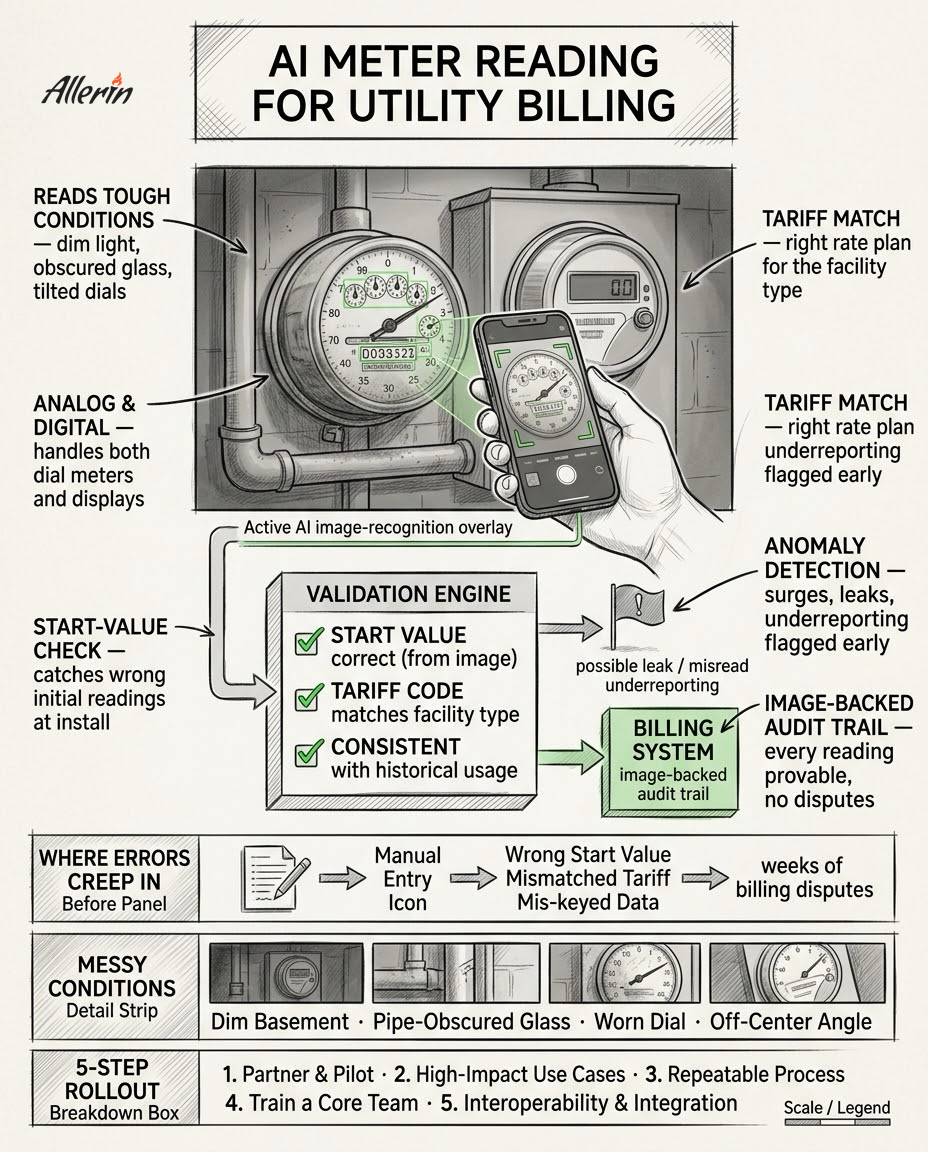
Add the complexity of managing meters across geographies, in hard-to-access or high-security areas, and you get a fragmented, costly workflow that is vulnerable to mistakes. AI systems can extract readings from analog or digital meters in real time and run intelligent checks so the data matches expected parameters, such as:
- The actual starting value (from an image)
- The correct tariff-rate category
- Consistency with historical usage
AI offers a straightforward, powerful path to better billing accuracy, simpler operations, and greater public trust. These systems can read meters even in challenging conditions like dim lighting, obscured glass, or awkward angles. That closes the loop between field installation and backend billing, reducing errors and the need for repeat site visits.
What AI meter reading adds to the process:
- Extracts readings from analog or digital meters in real time
- Validates against expected values and historical patterns
- Detects anomalies like sudden surges or underreporting
- Works in dim light, at awkward angles, and with obscured meters
Building Momentum for AI-Based Meter Reading
The technology is maturing, but rolling it out well, especially within the layered realities of public-sector workflows, takes more than flipping a switch. It requires thoughtful partnerships, targeted pilots, and clear operational foundations. By adopting in phases and aligning with existing practices, agencies can build confidence, deliver early wins, and lay the groundwork for large-scale impact.
1. Partner first, pilot smart
Before full deployment, agencies can partner with local utilities or technology providers to test AI meter reading in low-risk settings. Start by capturing meter images during installations or routine inspections, then process them in the cloud to:
- Extract and store the correct initial reading
- Validate the tariff assigned based on facility type
- Flag mismatches or missing metadata before billing begins
This lets teams assess accuracy, test integration with existing systems, and understand change-management needs without the pressure of full-scale adoption.
2. Start with high-impact use cases
Target facilities with consistent usage patterns and known issues, like public housing units with frequent billing disputes or office campuses with many manually read meters. These often suffer from:
- Overbilling from incorrect meter start values
- Underbilling from missed or delayed readings
- Conflicts over which tariff plan applies
AI can address these by automating real-time image capture and reading extraction, tariff matching based on facility use, and anomaly detection for inconsistent usage. From there, the model can expand to more complex cases, like remote locations or facilities undergoing meter upgrades.
3. Develop repeatable processes and clear documentation
Even with automation, strong processes matter. Document:
- How and when meter images are captured (during installation, monthly checks)
- How AI verifies the image against system data (start-reading validation, tariff-code match)
- What happens when a reading is flagged or unreadable (automatic re-capture request)
- How image-backed readings are stored for audit trails
That creates a repeatable, transparent workflow that simplifies compliance and audits.
4. Train a core team before scaling up
You don’t need to train the whole field workforce overnight. Start with key staff involved in billing setup, site audits, or dispute resolution, and train them to capture meter images on mobile devices, interpret AI output like flagged anomalies, and take corrective action on system feedback. This team becomes the first line of defense against billing errors and a central resource as adoption expands.
5. Focus on interoperability and integration
Choose platforms that:
- Offer API-based integration with billing and facilities-management software
- Automatically push validated readings and alerts into existing dashboards
- Support role-based access to image-backed records for review and compliance
Making the workflow interoperable lets agencies reduce manual data transfers, monitor abnormal usage proactively, and build trust through transparent, verifiable records. Metering data trapped in a system that billing and facilities teams cannot reach is the same problem agencies hit everywhere else, which is why breaking down government data silos tends to decide whether an automation project pays off.
Designed for the Real World
Unlike older OCR or barcode scanners, today’s AI image recognition is built to work in messy real-world conditions:
- Dimly lit basements or equipment closets
- Meters partly obscured by pipes or panels
- Devices that are worn down or poorly maintained
- Both analog dials and digital displays, even when tilted or off-center
This reliability matters in public buildings where meter placement isn’t optimized for visibility or access. It keeps data capture consistent and high-quality across varied environments.
A Strategic Asset for Modern Utility Management
With reliable data on hand, agencies can do more than bill accurately. They can:
- Spot consumption anomalies early, like leaks, surges, or underreporting
- Improve forecasting and budgeting
- Prioritize maintenance or upgrades based on usage patterns
- Strengthen audit trails with image-backed verification
- Reduce reliance on house visits and physical inspections
Accurate consumption data also feeds planning work well beyond the billing office. Agencies already use real-time data to reimagine urban planning with AI, and meter-level readings are one of the few continuous signals they own about how buildings actually behave.
This aligns with broader federal goals of digitizing infrastructure management and optimizing resource use across public facilities. It is the same shift behind the case for using AI to fix waste management failures: measured data replacing fixed schedules and guesswork.
It is time to stop accepting utility billing problems as a given. With the right tools, agencies can eliminate disputes before they begin. AI meter reading is a cost-saving, compliance-strengthening way to add intelligence to infrastructure management. Whether you start with one facility or 500, you can roll it out in a controlled, measurable way to catch errors early, validate bills automatically, and cut administrative overhead. That is the kind of practical, accuracy-first public-sector AI we help agencies deploy at Allerin.
Sources: U.S. Energy Information Administration: about 119 million AMI installations, 72% of U.S. electric meters (2022) · U.S. Department of Energy: Federal Building Metering Guidance requires advanced meters reporting at least daily (2022) · California Public Utilities Commission: 18,262 energy consumer contacts and $4.38 million refunded to energy customers (2024) · U.S. Department of Energy FEMP: metering requirements for federal buildings under the Energy Policy Act of 2005