Industries across the world use water for various factors. Globally around 19% of withdrawing water is for industrial purposes. The excess use of water by industries, various other sectors and climate change has given rise to a water crisis. The need to necessitate sustainability in the use of water has become imperative, and one way to do it is through digitalization in water utilities.
The use of advanced digital technology in the water industry cannot begin if the extraction of insightful and valuable data to accelerate decision-making from the massive amount of data is not available. Therefore, data collection and unbiased interpretation are essential as it concerns the entire water cycle. It helps to provide real-time analytics and predictions about the various uses of water in different supply chain touch points. It also offers proactive recommendations to help companies generate strategies useful for sustainability.
How Digitalization in Water Utilities Enables Sustainability
The deployment of digitalization in water utilities has brought with it profound benefits, such as
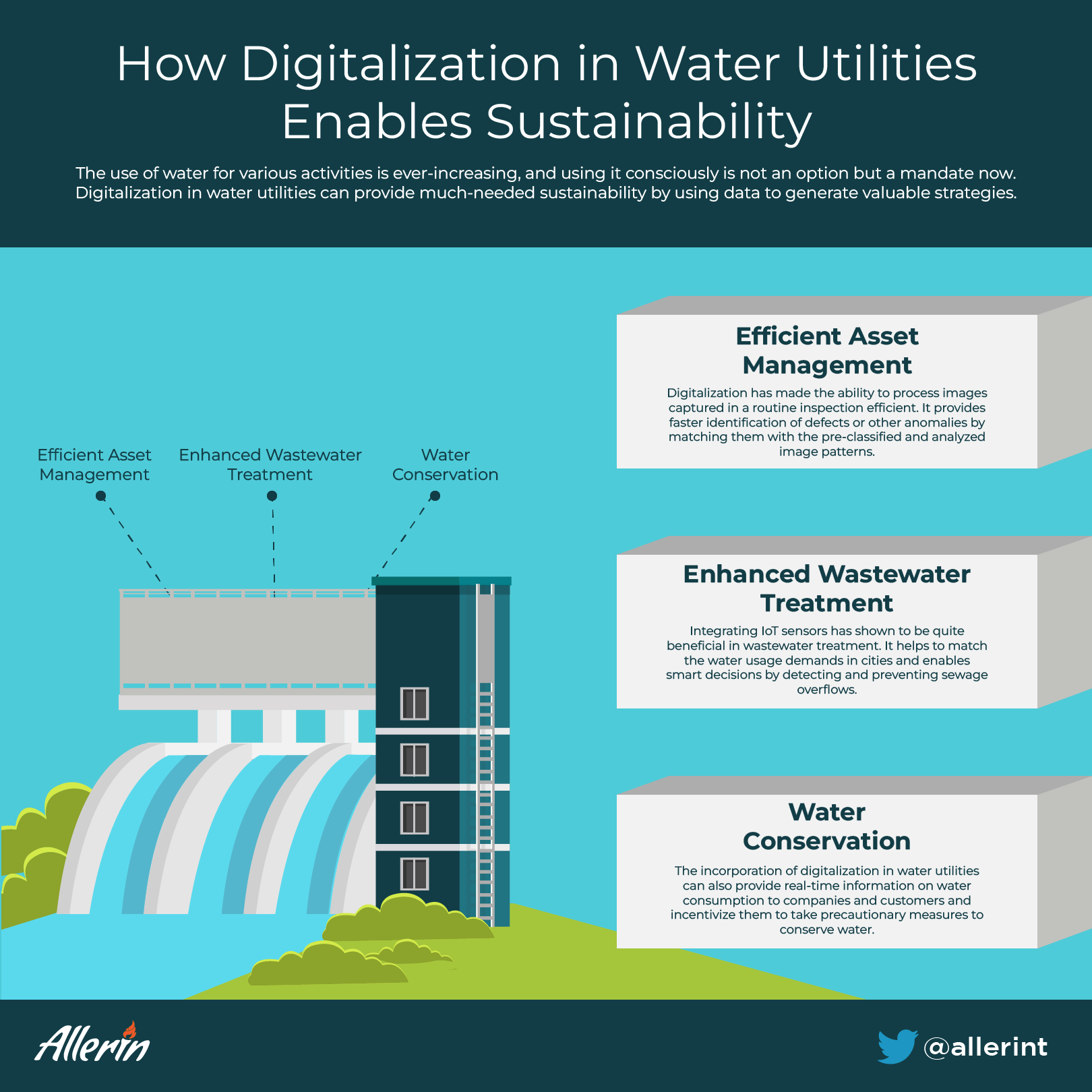
1. Efficient Asset Management
Digitalization has made the ability to process images captured in a routine inspection efficient. It provides faster identification of defects or other anomalies by matching them with the pre-classified and analyzed image patterns. Companies can further make use of data-driven information to create stringent plans of action.
2. Enhanced Wastewater Treatment
Integrating IoT sensors has shown to be quite beneficial in wastewater treatment. It helps to match the water usage demands in cities and enables smart decisions by detecting and preventing sewage overflows. It also gives access to real-time data on the level and quality of water and creates alerts where immediate action is required.
3. Water Conservation
The incorporation of digitalization in water utilities can also provide real-time information on water consumption to companies and customers and incentivize them to take precautionary measures to conserve water. This will lead to a reduction in the wastage of water by a considerable margin.
The creation of a sustainable water future requires the incorporation of digitalization in water utilities. Using advanced technology to process massive amounts of data quicker will provide users with the essential information to build strategies helpful in the conservation of water. More flexible water systems and operations that can predict, examine and adapt to the changing environment are necessary as they will provide a better quality of water for consumers.