Unemployment Insurance (UI) has long been a critical support for American workers facing job loss. But during economic upheaval, like the COVID-19 pandemic, the system faces not only a surge in demand but an explosion in fraud, and unemployment fraud detection built for a normal year collapses under that pressure.
How much was actually stolen depends on who is counting. The U.S. Government Accountability Office estimated in September 2023 (report GAO-23-106696) that pandemic UI fraud was likely between $100 billion and $135 billion, roughly 11 to 15 percent of all UI benefits paid, a figure the House Ways and Means Committee noted had doubled from GAO’s earlier estimate. The Department of Labor’s Office of Inspector General counts more narrowly and reports nearly $47 billion in potentially fraudulent UI benefits paid from March 2020 to April 2022 across six high-risk categories, including claims filed with the Social Security numbers of deceased people and federal prisoners. Whatever the final number, fraudsters exploited outdated systems and inconsistent identity checks to file false claims at scale, draining funds meant for people in real need.
The challenge now facing state workforce agencies is how to detect fraud quickly without delaying legitimate claims or requiring an infrastructure overhaul. Machine learning offers a workable path.
The Scope of the Problem: Volume, Velocity, and Vulnerability
Fraud schemes have grown more complex, from synthetic identity use to organized claim farming under different names and SSNs. Most unemployment fraud detection in production today still runs on static business rules designed to catch known threats rather than evolving patterns.
The stakes are higher now that generative AI has entered the picture. Fraudsters use it to mass-produce synthetic identities, fabricate supporting documents, and even deepfake verification selfies, turning what used to be manual fraud into something closer to an automated pipeline. That makes rules-based detection alone increasingly outmatched.
California shows what that costs. The California State Auditor found that the Employment Development Department paid roughly $810 million to about 45,000 claimants whose information matched incarcerated individuals, and paid about $10.4 billion from March to December 2020 on some 597,000 claims it later determined could be fraudulent because it could not verify who the claimants were. Similar patterns emerged in other states, where fraud rings used compromised personal data and networked behavior to exploit overwhelmed systems.
The individual cases show the same mechanics at smaller scale. In March 2023, a Georgia man was sentenced for a scheme that drew $3.3 million from five state workforce agencies. He and a co-conspirator filed more than 200 claims using the identities of about 124 unwitting people, had the resulting debit cards mailed to addresses and mailboxes they controlled, and pulled the cash out at ATMs before the states caught up.
The reality is that many state systems, built decades ago and still reliant on batch processing, lack the agility to detect this in real time. Manual audits and case reviews can’t keep pace with the volume, especially under emergency conditions.
How Machine Learning Sharpens Unemployment Fraud Detection
Machine learning makes it possible to detect fraud with speed and precision, even in high-volume environments. These models analyze patterns across vast datasets, flagging behavior that, while not always explicitly fraudulent, deviates sharply from the norm or mirrors past fraud.
Clustering techniques
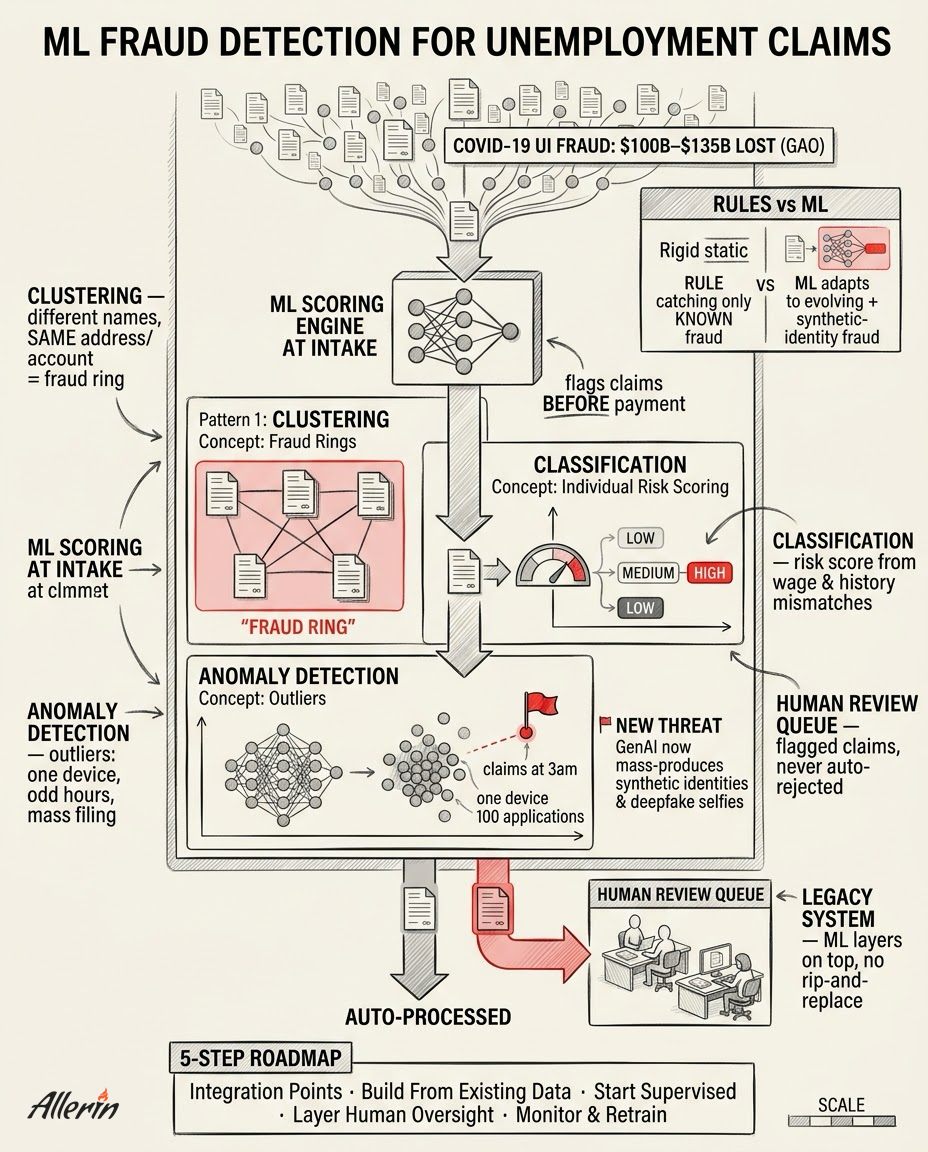
Clustering is particularly effective at exposing coordinated fraud. When multiple claims are submitted under different names but share contact details, bank accounts, or addresses, they can be grouped as a likely fraud cluster. This surfaces connections that look innocuous in isolation but are suspicious together, revealing organized schemes that would slip through case-by-case reviews.
Classification models
Classification models assess each claim’s risk profile against historical data. They weigh features like employment-history mismatches, inconsistencies in reported wages, or irregular claim amounts to generate a risk score. Claims above a set threshold get routed to a verification queue for human review, giving decision-makers data-driven insight into where fraud is likely and how to allocate investigators.
Anomaly detection
Anomaly detection adds another layer. Instead of relying on predefined fraud markers, it highlights claims that fall far outside expected behavior: a surge of applications from one location, repeated use of a single device, or claims filed at unusual hours. These outliers are early warning signs that help agencies act before large-scale fraud materializes.
All of these techniques can be embedded in a state’s existing claims architecture. Cloud-based ML services and middleware integrations let agencies add fraud scoring without disrupting operations or retraining the workforce from scratch.
A Practical Roadmap for State Agencies
Unemployment fraud detection does not require a multi-year modernization program first. Machine learning can be deployed quickly and incrementally, and a phased approach maximizes its impact.
| Step | Focus area |
|---|---|
| Prioritize integration points | Add ML scoring at digital intake touchpoints |
| Build from existing data | Use historical claims and audit records |
| Start with supervised models | Begin with interpretable, low-complexity tools |
| Layer human oversight | Route high-risk claims to skilled reviewers |
| Monitor, retrain, and adapt | Refresh models and track KPIs regularly |
Prioritize integration points
The most practical entry point is the application intake stage, where digital claims are first submitted. That is the cleanest interception point, before a claim reaches payment queues or case management, and it is where the agency has full control of the data pipeline.
Many state agencies already use modern, cloud-accessible portals for submissions. These can be enhanced with middleware that routes incoming applications through fraud-scoring algorithms in real time. A state could integrate an ML scoring API that flags high-risk claims before they reach adjudicators, a frictionless deployment that doesn’t disrupt eligibility workflows. To make it work, IT and fraud teams should map the data flow from form submission to approval and decide exactly where the scoring model sits. Piloting at a single intake module is a low-risk, high-impact test bed. Intake is also where AI-driven eligibility verification in social welfare programs pays off twice over, since identity and eligibility checks draw on the same claimant data the fraud model needs.
Build from existing data
Most agencies already have rich datasets from prior audits, confirmed fraud investigations, and historical claims, even if those datasets are incomplete or fragmented. Once structured, that data is invaluable for training. Instead of starting from scratch, agencies should consolidate labeled datasets across departments: previously flagged claims, reported identity thefts, adjudication notes, and audit logs. That consolidation is usually the hard part, and it is why breaking down government data silos tends to be the first real prerequisite for any fraud model worth trusting. Even five years of history from a single program can surface repeat patterns, like the same SSNs appearing across counties or identical employer IDs tied to unrelated applicants. Agencies can partner with universities or private analysts to clean, normalize, and annotate the data, and sensitive information can be masked or tokenized to protect privacy without hurting model performance.
Start with supervised models
Supervised models like logistic regression, decision trees, or random forests are a practical entry point for fraud classification. Government settings favor them for two reasons: they are fast to train, and their decision logic is transparent, which suits environments that require auditability and public accountability.
A supervised model can score each claim on inputs like the number of claims from the same IP, inconsistencies in declared wages, anomalies in employment periods, or flagged SSNs from past cases, then classify each as low, medium, or high risk. Agencies can deploy these incrementally, first to assist rather than replace adjudicators. A claims supervisor might get a daily report highlighting the top 5% of claims by fraud-risk score for pre-payment review. That triage adds real value without fully automated decision-making.
Layer human oversight
Even the most accurate model will misclassify some cases, so human oversight is not just a safeguard. It is a strategic component. High-risk claims should go to experienced caseworkers who can verify suspicious applications with context and judgment a machine can’t replicate.
In practice, that means reconfiguring workflows so flagged claims are neither auto-approved nor auto-rejected, but diverted to a fast-track review queue. A claims examiner might work from an augmented interface that shows the fraud score, the top reasons for it, and a comparison to similar past flagged claims. This also builds internal trust: fraud units become partners with AI, not bystanders to automation. Their feedback should continuously refine the models, closing the loop between detection, adjudication, and learning.
Monitor, retrain, and adapt
Fraud tactics evolve, especially once perpetrators know algorithms are in use. Static models, however accurate at launch, degrade over time, so treat them as living tools, not one-time deployments. Set KPIs like detection precision, false-positive rate, and time saved per investigator, and monitor them monthly. Retrain on fresh claim data quarterly or twice a year, folding in new fraud typologies, geographic shifts, and seasonal anomalies. Retraining doesn’t have to be complex; many cloud providers can trigger model refreshes automatically as new data arrives. Agencies should also create cross-functional “fraud ops” squads, blending IT, analytics, and case management, to own model health as an ongoing function rather than a project.
Ensuring Accountability in Automation
Machine learning works best paired with transparency and human oversight. Agencies must ensure flagged claims receive timely, documented review, and false positives must be handled carefully, especially when vulnerable populations are involved. Explainable AI methods make it easier for staff to understand why a claim was flagged, improving consistency and confidence. Periodic audits and fairness reviews should be standard practice to protect claimants’ rights and uphold public trust. Agencies that treat building public trust in government AI as a design requirement rather than a communications problem tend to face far less resistance when the model starts denying claims.
Agencies that put machine learning behind unemployment fraud detection gain speed, accuracy, and greater operational resilience. Detection becomes more proactive, investigations more targeted, and the unemployment system more secure, without rebuilding from the ground up. That balance of automation and accountability is exactly what we help public agencies design at Allerin.
Sources: House Ways and Means Committee: GAO doubled its pandemic UI fraud estimate to $100 billion to $135 billion (2023) · U.S. Department of Labor Office of Inspector General: nearly $47 billion in potentially fraudulent UI benefits paid March 2020 to April 2022 · California State Auditor: EDD paid about $810 million on claims matching incarcerated individuals and $10.4 billion on possibly fraudulent claims (2021) · U.S. Department of Justice: sentencing in a $3.3 million five-state UI fraud scheme (2023)