Step into the server room of many critical government agencies today and you can almost feel it: the low, persistent hum of machinery from a bygone era, the flicker of a green-screen monitor, a tangible echo of the 1980s. This is the technological bedrock that millions of Americans depend on for Social Security, veteran benefits, disaster relief, and more. For leaders in public service, that sound isn’t nostalgia. It is the sound of mounting risk, and it is why government legacy system modernization has moved to the top of the agenda.
The prevailing wisdom has long been, “If it isn’t broken, don’t fix it.” The fear is understandable. Upgrading a complex, decades-old system, the very digital heart of a public service, can feel like performing open-heart surgery on a marathon runner mid-race. One wrong move could disrupt payments to seniors, delay support for veterans, or grind a state’s motor-vehicle services to a halt. The potential for public fallout is immense, and the political cost immeasurable.
That fear creates a dangerous illusion of stability. The truth is that not modernizing is the most perilous path. These legacy systems are the digital equivalent of a crumbling bridge: they may still carry traffic today, but structural failure is not a matter of if, but when.
And the pressure is rising for a new reason. Agencies now want to put AI to work on benefits processing, fraud detection, and service delivery, but you cannot run modern AI on a brittle, undocumented mainframe that no one dares touch. Government legacy system modernization is the precondition for everything that comes next. The shift agencies need is from the paralyzing fear of a “rip and replace” catastrophe to the strategic confidence of a phased, meticulously planned “digital heart transplant.”
The True Cost of Inaction Is a Crumbling Foundation
Before we explore the surgical precision of modern upgrades, we have to diagnose the illness. Legacy systems, often written in languages like COBOL that few new developers learn, pose three existential threats to public service delivery.
Pervasive security risk
Old systems weren’t built for today’s hyper-connected world. They lack the security protocols of modern architecture, which makes them prime targets for actors seeking to steal data or disrupt services. Each unpatched vulnerability is an open door inviting a crisis. For agency leaders, the question is not just data integrity, but maintaining the public’s trust.
Operational brittleness
These monolithic systems are fragile. A single hardware failure or a bug in a line of archaic code can trigger a catastrophic domino effect and widespread outages. Worse, the specialized knowledge needed to maintain them is disappearing with a retiring workforce, the so-called “silver tsunami.” We are approaching a moment when the people who truly understand these systems will no longer be in the building.
Erosion of public trust
Citizens can manage their finances, order groceries, and book travel from a smartphone in seconds. When they hit a clunky, paper-based, or inaccessible government process, the contrast is jarring. It signals that government is slow, inefficient, and out of touch, and that experience gap erodes public confidence in our institutions.
Why Phased Government Legacy System Modernization Works
The myth of modernization is that it must be a single, terrifying leap. The reality is a series of deliberate, controlled steps. Think of it not as demolishing a building and starting over, but as renovating a historic landmark room by room while it stays open to the public. The key is a phased approach that prioritizes stability and delivers incremental value.
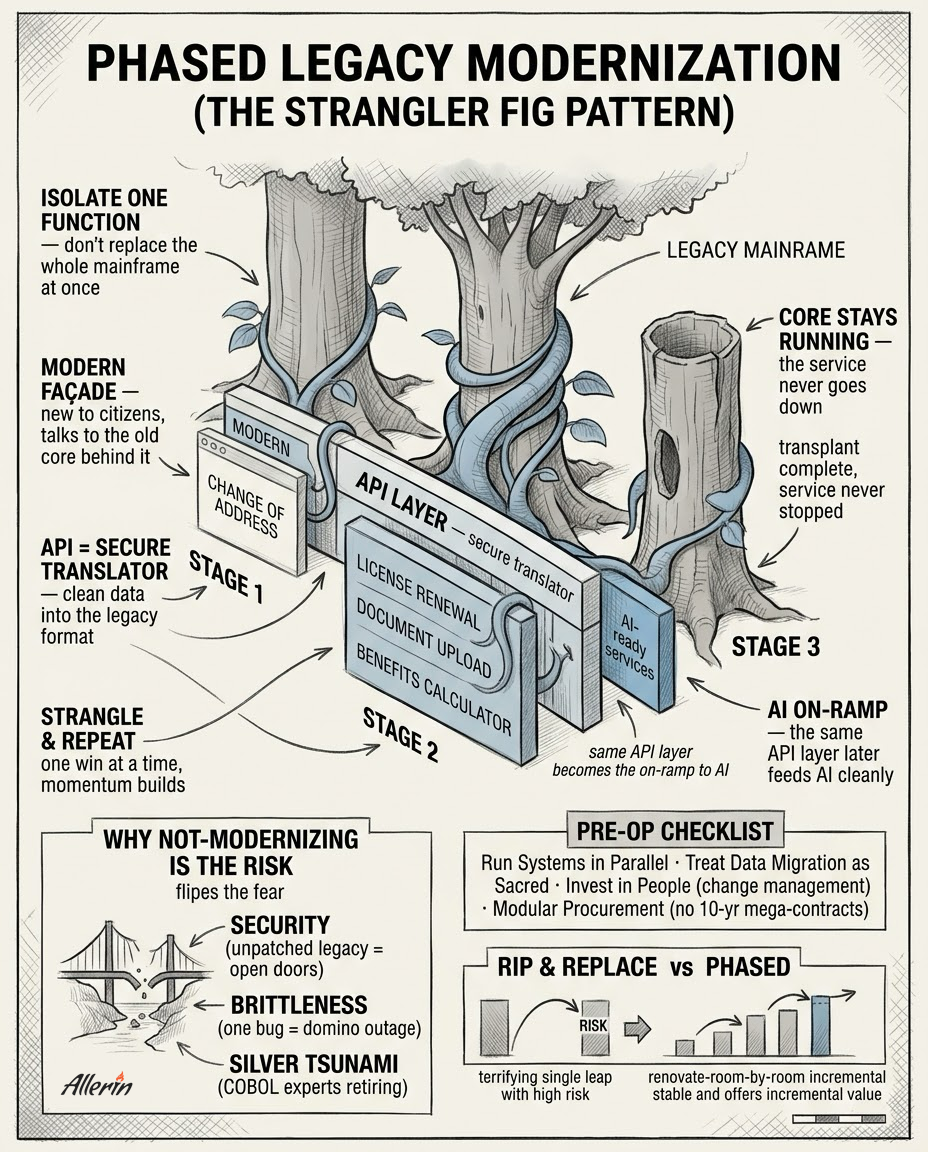
The most successful version of this is known as the Strangler Fig Pattern. Picture a fig vine on an old tree. It starts small, wrapping around the trunk, then grows stronger and puts down new roots until it supports itself entirely and the old tree inside can wither away, unnoticed.
Here is how that translates to a system upgrade.
Identify and isolate a function
Don’t try to replace the entire benefits-processing mainframe at once. Start with a single high-value function. For a DMV, that might be “Change of Address,” and the same logic applies to the appointment and wait-time problems agencies face, where AI-driven queue optimization at the DMV shows how much a narrowly scoped service can improve before anyone touches the core. For a benefits agency, the initial “Application Intake.”
Build a modern service around it
Create a new, user-friendly digital service for just that one function. This service acts as a façade. To citizens it looks and feels brand-new. On the backend, it is designed to communicate securely with the old legacy system.
Establish secure connections (the power of APIs)
What lets the new and old coexist is the Application Programming Interface, or API, a secure digital translator. When a citizen submits a new address through the modern portal, the API takes that clean, structured data and delivers it to the legacy mainframe in the exact format it understands. The core system of record stays untouched and stable while the user experience improves immediately. That same API layer is what later lets AI services consume the data cleanly, which is why this pattern is also the on-ramp to an AI-ready architecture, and why it is one of the most practical routes to breaking down the data silos that keep agency records trapped in separate systems.
Redirect, stabilize, and repeat
Once the new “Change of Address” service runs smoothly, retire the old paper form or clunky interface for that task. You have “strangled” one piece of the old system, delivered a tangible win, built momentum, and learned valuable lessons. Then you move to the next function: “License Renewal,” “Benefits Calculator,” “Document Upload,” and repeat.
Over time, more functions move to the new services, the legacy system is progressively hollowed out until it no longer performs critical work, and it can be safely decommissioned. The transplant is complete, and the patient kept beating throughout.
Risk Mitigation: The Pre-Operative Checklist
Even routine surgery requires immense preparation. Government legacy system modernization asks for the same discipline, which means a relentless focus on risk mitigation.
Run systems in parallel
For a critical period, run the new module and the old process at the same time. A parallel run lets you compare outputs and confirm the new system performs flawlessly before you switch off the old one. It is a belt-and-suspenders approach, essential for anything involving financial transactions.
Treat data migration as a sacred duty
Your data is the agency’s lifeblood. A migration strategy isn’t just about moving data; it is about cleaning, validating, and securing it. Plan and test it months in advance, treating the data with the care a curator gives a priceless archive. Running a set of data health checks before you deploy AI is the fastest way to find out whether the records you are about to migrate can actually carry the workloads you plan to build on top of them.
Invest in your people
The most common point of failure isn’t technology, it is people. Put a real change-management plan in place. Train staff, win buy-in by involving them in the design, and celebrate the “digital champions” who embrace the new way of working. Their expertise is invaluable and their engagement is non-negotiable.
Embrace modular procurement
The era of massive ten-year single-vendor contracts should be over. Those monolithic agreements increase risk and lock agencies into proprietary technology. Adopt agile, modular procurement instead: award smaller contracts for specific pieces, which widens competition, increases flexibility, and lets you course-correct if one component goes off track.
What Government Legacy System Modernization Looks Like in Practice
Picture a veteran logging into a clean, user-friendly portal instead of sifting through stacks of paper forms. Behind the scenes, that submission flows through modern APIs into the agency’s decades-old adjudication engine. No manual typing, no misfiled documents: each application, with its uploaded transcripts and supporting evidence, arrives error-free. What once took weeks of back-and-forth now resolves in days, easing financial anxiety for veterans and building confidence in the agency. The clean split between the new portal’s interface and the legacy core makes the case for fully modernizing the backend later.
Or consider a sudden rush of housing-aid requests after a major hurricane. Instead of the old intake system buckling under load, a new cloud-native frontend scales up resources in real time and back down when demand drops. Applicants complete eligibility checks instantly, while approved requests flow into the unchanged legacy disbursement platform to issue payments. Pairing a flexible modern intake layer with a proven financial engine keeps operations running even under extreme pressure.
A Mandate for Leadership
Modernizing government’s digital infrastructure is not fundamentally a technological challenge. It is a leadership one. It doesn’t require you to become a software engineer. It requires you to see past the immediate risks to the long-term mission of public service.
The low hum of those old servers is not the sound of stability. It is a ticking clock. The future of government service delivery won’t be defined by monolithic, rigid structures, but by agile, resilient, human-centered systems, and increasingly by whether those systems can support AI at all. Approached as a phased, surgical exercise, with risk mitigation as your mantra and the citizen experience at the center, government legacy system modernization stops being a threat to service continuity and becomes the thing that protects it. Designing that path, from brittle legacy core to modern, AI-capable architecture, is exactly the work we do at Allerin.