

Ever since the cellular network came into existence, up until today, the underlying technology of the standard has indeed come a long way. Going into a flashback, the history of the wireless cellular technology starts from 1G back in 1979, followed by 2G, 3G, 4G, continuing on to the research for 5G to provide improved features over the older generations. The alphabet ‘G’ on the home screen of your smartphone indicates the strength of the Internet you use. Every new generation is better than the older one. For example, the maximum speed offered by 1G is 2.4 kbps, while the maximum speed of 2G is 50 kbps. Later, 3G replaced 2G, which provided an estimated speed of 2mbps. 3G was later replaced by 4G, although we still saw that 3G was prevalent in many areas. 4G, which most of us use today, offers speed upto 1 Gbps when the phone is at a stationary position.
Fast forward to today, the wireless cellular technology is taking a step forward to provide us with faster data rates, lower latency, and better battery consumption than the 4G network. The technology is enhancing to a version higher than the 4G network, that is, the 5G technology. While it might sound unbelievable to us, but 5G promises to offer speed upto 20 Gbps. Big players in the tech space have started their R&D program, which indicates that soon the 5G technology will roll out to become a reality of our lives.
However, as this wireless network version is still in its investigating phase, realizing how beneficial the 5G technology will be in comparison to 4G, is difficult. The exact scenario cannot be predicted until we actually start using the technology. We hope 5G is better and far more improved than 4G, but it can be the other way round too. Technologies bring in incredible opportunities, but also create a host of concerns, sometimes. Once fully developed, it becomes very difficult to alter or modify the technological features, which is why every minute information should be taken into consideration before professionals deploy it for use. After a lot of research, we identified that there are a few concerns around the 5G technology too, let’s call them the 5G challenges. The 5G challenges might impede the network to provide a cost-conscious, speedy, and scalable service, as promised. Likely to hit the mainstream by the year 2020, we hope that the technology solves the 5G challenges mentioned below by then.
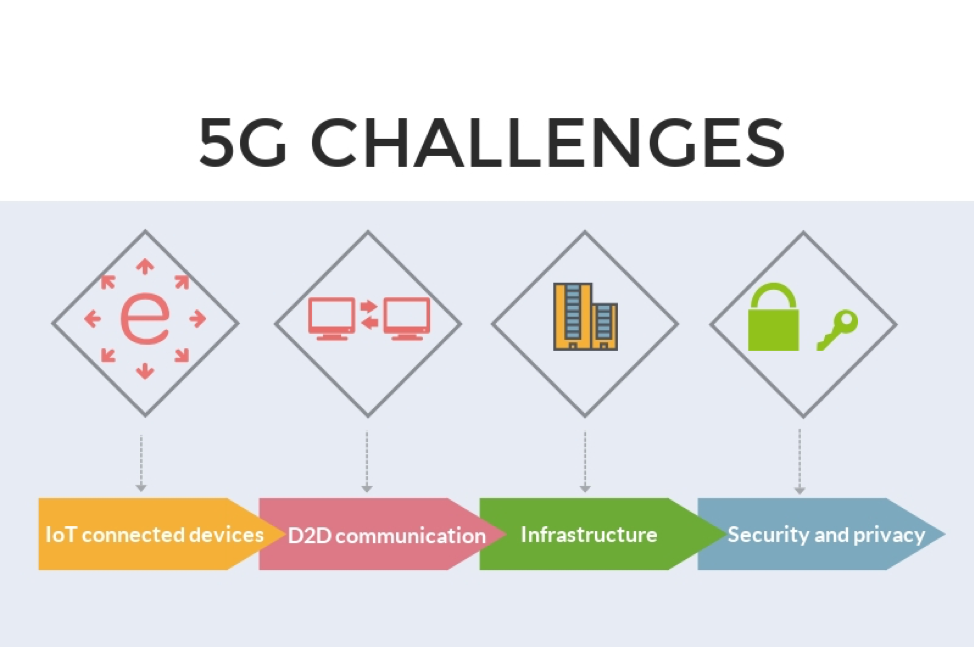
1. IoT devices
It is expected to see a huge hike in the number of IoT connected devices in the coming years. 70%, that is, 1.5 billion IoT-connected devices will use the wireless cellular technology by 2022. As these devices will have massive data sets to be sent and received in real-time, there will arise new demands and requirements for cellular networks, of course. So, the cellular network has to be robust enough to manage all the data transfer seamlessly. Keeping this requirement in mind, investigators should build the infrastructure accordingly.
2. D2D communication
Device-to-device communication is direct communication between two mobile systems that are situated nearby to each other. The concept is not new, however. The devices are not required to wait for the data to travel from the base station, otherwise. Instead, the devices create a direct link with each other, to send and receive data. Here’s where 5G technology is expected to show its potential. But, the challenge here is to have a robust, reliable, and effective deployment of the cellular network. The network meant for a direct device-to-device communication should be such that it manages all the interaction with an adequate coverage area, low latency, and high bandwidth.
3. Data volumes
With every passing day, minute, and second, there generates new data in the digital space. A lot of the data is shared with others too. And this trend is expected to continue and grow. The number of users using the mobile cellular network to send and receive messages has skyrocketed since the debut of 3G. Transmitting data in the form of videos, images, and audios has also increased immensely. All of this data transfer requires a good network speed and zero congestion from the sender’s as well as the receiver’s end. But, more the data, more the bottlenecks in the network system. While building the 5G infrastructure, professionals should most importantly consider the real-time growing data transfer too.
4. Infrastructure requirements
The promise of 5G as a technology is boundless. 3G and 4G provided decent speed, but failed to withstand the expectations of the speed-hungry people. The poorly deployed base stations for 3G and 4G cellular network provided network with glitches, which is why the mobile operators had to find a new way to solve the congestion and speed issues. To meet the bandwidth demands of people, engineers could only set up more base stations, which is a again not that easy. Hence, in the coming era of 5G, operators will tap into the potential of small cells. But, how many small cells will be sufficient for a particular city, such that it can deliver 1Gbps of data capacity, is again a question.
To roll out better than their competitors, cellular network companies should understand the right number of small cells required for making their network the best. Once you have your full-proof plan ready, the required money should be collected for the investments. Taking everything into consideration, the cellular network companies should build an infrastructure that is reliable, robust, and most importantly, allows rapid content distribution.
5. Security and privacy
5G promises to offer lightning-fast Internet speed, but this has led scholars and researchers fear a cyber war. High volumes of data transfer imply intensified malicious attacks. The network will introduce:
- increased speed rates,
- intensified bandwidth,
- hike in the number of use cases in different sectors,
thereby bringing a new set of security issues. Also, the growth in the number of IoT devices will pose security risks and challenges. Risks of hackers is not a new concept, honestly. But, before we enter the world of 5G, researchers should ensure that they create security borders to puzzle hackers.
The world is preparing itself for 5G to arrive. The towering benefits, ranging from ripping fast Internet to lowest latency to swift data deliveries, have made the wait even more exciting for everyone. However, challenges come inevitably; we should be prepared for the worst. Similarly, for our new wait, the mobile operators should take into account the thorny challenges mentioned above, try to analyze them, find appropriate key to suppress the challenges and offer the best services to their customers. Since the technology is still under research, the infrastructure, security policies, and network configurations are yet to be defined. Before the final setup is done, it is better to take all the points mentioned above into consideration. 5G is coming, with a bag full of opportunities and challenges. But, are you as ready and excited as us?