A disturbance can occur anywhere in any form across an oil and gas pipeline. It runs through ocean beds and many remote areas. Delayed repair functions cost a lot for the environment as well as the industry. Making use of connected systems to monitor the pipelines would help in predicting a disturbance in the pipeline and provide the industry a chance to avert major disasters.
Global energy consumption has increased by an average of 2% per year in the past 10 years, according to a statistical review by BP. According to IEA, the global energy consumption for 2013 was 9301 Mtoe (Million tons of oil equivalent).
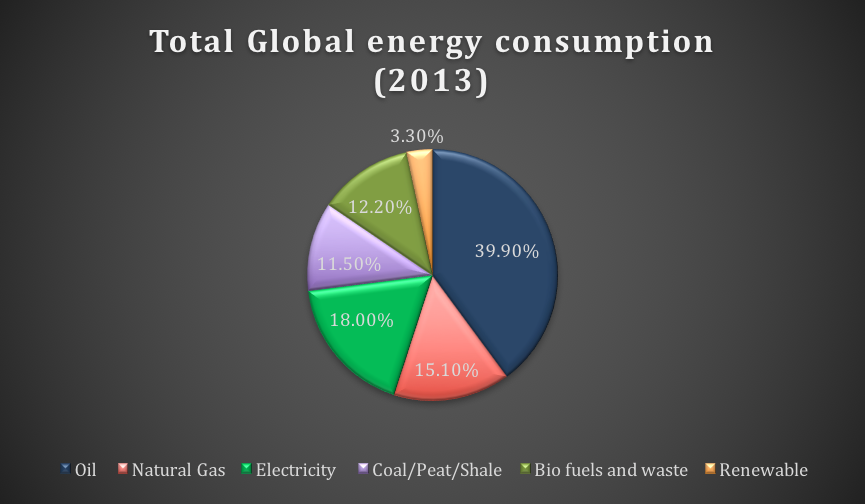
As we can observe from the above pie chart, oil is still the most widely used energy source in the world. Other sources of energy still have a lot of ground to cover in order to replace oil.
The old technology is outdated
The worldwide demand for energy is expected to increase 41% by 2035 according to 2014 BP Energy Outlook, out of which 95% will almost entirely come from emerging countries. Oil companies transport oil from these countries using either oil tankers on ships or oil pipelines. The oil pipelines may pass through various remote regions before reaching their destination. Oil is lost through these pipelines due to various reasons from theft to leaks. Concerned officials come to know about such losses quite late, and by then the damage is already done. Moreover, with new technologies such as hydraulic fracturing, new areas where drilling previously was not cost-effective are being drilled. These areas are often in dangerous and remote locations or in areas near residential communities.
Currently deployed oil and gas pipeline technologies include sporadic telephone lines, and microwave or satellite links. They either prove inadequate or over-expensive. They cannot provide online and real-time pipeline condition data, deliver simultaneous feeds of sensitive areas, or provide frequent measuring points for a more precise flow management.
Connected technology
Connected technology helps in identifying disturbances in oil pipelines before it becomes a major problem. It involves constant surveillance around the pipeline to detect any unauthorized intrusion and leak detection. Voice over IP (VoIP), video and wireless support can be also provided for bring-your-own-device (BYOD) applications up and down the pipeline. Optical fibers can be used to transmit real-time signals about intrusion or leaks to the headquarters. This method can alert the responsible personnel hours, days or months before a small problem becomes huge. The leak detection system could also be programmed to detect temperature changes in the soil around the pipeline, which might be an invaluable source of early leak detection. With an intrusion detection system, a tremor or a drilling operation oblivious to the pipeline can be detected before they damage the pipeline.
 Benefits of connected technology
Cisco and Schneider electric have joined hands to build a connected pipeline management system. Our society depends on natural gas and oil heavily for its energy requirements. But to transport them over continents and oceans can possess a threat to the environment in many ways. To ensure the safety of our environment and creatures living in it, it becomes necessary for the oil and gas industry to secure the pipelines using the latest in technology.