
Despite all the talk about technological advancement and how far humanity has progressed through the centuries, I can’t help but notice the unchanging underlying structures that have persisted through the ages. And this is especially true of the way wealth has been created and distributed across civilizations, which, barring a few welcomed changes, still follows a pattern and structure quite similar to that of the medieval times. Therefore, following and briefly understanding the history of economic systems will lead to a better understanding of why blockchain and Marxism might be the way forward for humanity.
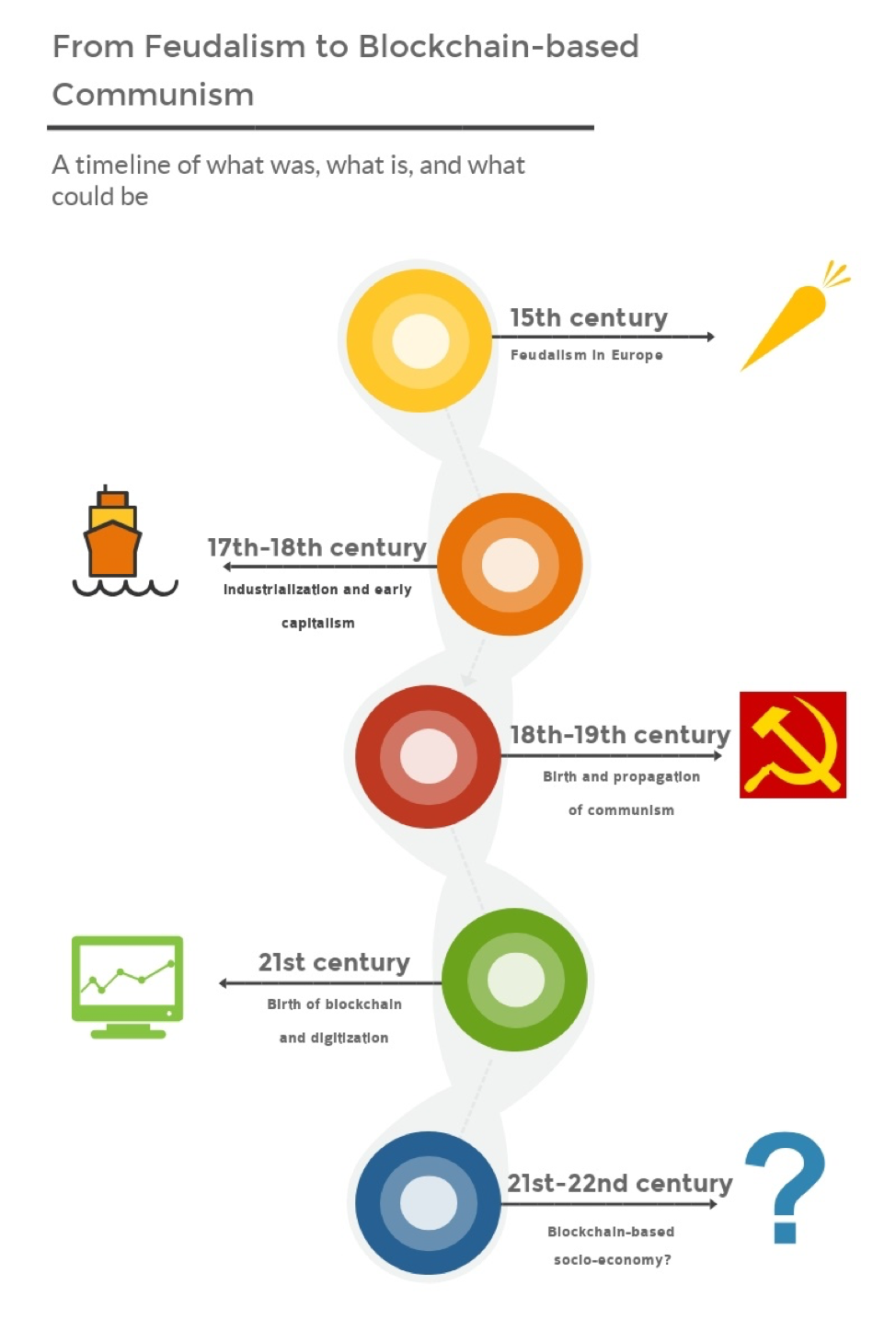 Before the current economic systems of capitalism and communism, there was feudalism. In medieval Europe, landlords lent their lands to peasants and other workers to toil on the fields and produce crops, of which the lords took a major share. Landlords earned profitable incomes by sheer virtue of their ownership of land, while peasants labored on the fields in exchange for remuneration.
Innovation and scientific progress in the 17th century eventually led to the industrial age. Farms were rapidly replaced by mechanized factories and workshops that produced goods. However, the fact remained that a few people owned the means of production, which required the labor of millions of working-class people to operate.
Today in the 21st century, the age of information, the nature of work and the working conditions have drastically changed (for the better). However, the reality is still the same – the means of wealth generation – capital and equipment – are concentrated in the hands of a select few, while a majority of the population is dependent on these powerful hands for their livelihood.
Regardless of the progress we have achieved technologically, the structure of societies and economies hasn’t changed much. The world is still divided between those having an overabundance and those struggling to make both ends meet.
The need for change
The present era can be defined by three worldwide phenomena:
- the rapid evolution and adoption of (mainly digital) technology,
- unrestricted economic, cultural, and political globalization, and
- the constant widening of the gap between the wealthy and the poor to abysmal proportions.
It is no secret that a minuscule section of the world’s population owns a staggeringly high portion of the overall wealth. While the top 8% of the wealthiest people on earth own over 85% of the total wealth, the bottom 70% own less than 3%.
Describing this gross disparity as unfair would be an understatement. In my opinion, it is nothing short of an atrocity. This atrociously disproportionate distribution of wealth can be attributed to multiple factors, most of them stemming from the concentration of the means of production in the hands of a select few, which is allowed by the capitalistic economic policies of regulators. Although it can be argued that capitalism breeds competition, which catalyzes growth and progress, but the benefits of the progress are not experienced equally by everyone. While surplus production and wastage of food run rampant in the developed countries, people in underdeveloped regions face starvation.
Communism as a possible answer to inequity
In the mid-1800s, Karl Marx, a German philosopher pointed out the flaws in the then existing capitalist system and projected a dire future if the system persisted. He was against the idea of the disproportionate concentration of wealth in the hands of a small part of the population, which he felt could potentially lead to the exploitation of the working class. Marx’s philosophy, later known as Marxism, led to the economic ideology that is today known as communism. Communism advocates the distribution of power and the means of wealth generation among all people, based on effort and need. Thus, communism aims to eliminate the need for concentration of power in the hands of a singular party that can potentially exercise tyranny over the populace.
A communist society can ensure the eradication of poverty by making sure that those having nothing are supported by those have more than enough. Sound like the perfect solution, isn’t it? However, the practicality of communism, for fair reasons, has often come under question. The issue that hinders the communist philosophy is the notion that, to exercise equity in distributing resources and control, there needs to be a trustworthy intermediate agency, mostly the government. However, as history has shown us, any kind of power leads to corruption (and even tyranny), which means even communist societies can suffer from corruption. But this problem can be solved by blockchain technology, which embodies the foundational tenets of Marxist communism.
Ideological parallels between blockchain and Marxism
Blockchain and Marxism both idolize the decentralization and distribution of control as a means to achieve fairness. Blockchain is a technology initially purported to underpin the cryptocurrency Bitcoin, which was touted for its decentralized and trustless nature. To be clear, trustless does not mean a lack of trust, but the assumption of trust as an intrinsic element of the system.
Blockchain is a shared ledger system that uses a method of consensus among participating nodes to verify transactions, and stores these records on an immutable block of data. This means there is no need for an intermediate governing agency to ensure fairness in the distribution of control. Similarly, Marxist’s communism proposes a stateless system of wealth distribution that functions on the basis of mutual trust among the participating stakeholders and implies the non-requirement of a governing body.
In addition to the shared advocacy for self-regulated, almost anarchist system of distributed control by both blockchain and Marxism, the two also advocate the pooling in of the efforts of all stakeholders. Blockchain functions by using the hardware resources of all participating computers and then rewards the participants in cryptocurrency, just like Marx supported the remuneration of individuals based on contribution.
A global blockchain-run economy
A blockchain-enabled economy can ensure the even distribution of resources across geographies. It can lead to the standardization of the prices of commodities across economies and enable a transparent and responsive supply chain. Taking this a step further, the use of other technologies like IoT and big data, along with blockhain, can enable governments and global welfare organizations such as the UN to proactively identify the areas where the production of a commodity is deficient and the areas where the production is surplus, and take measures to ideally satisfy the needs of people in underprivileged third-world countries without taking much away from anyone. This, in turn, will solve the problems of food wastage – which amounts to 1.3 billion tonnes annually – and food shortage in the developed and underdeveloped regions of the world, respectively.
In addition to regulating the distribution of resources, the use of blockchain can limit the accumulation of wealth and ensure the distribution of wealth to the working class based on their contribution to their employers. If every unit of a product manufactured and sold is recorded on a transparent blockchain, employees can be remunerated by proportionately sharing the profit earned, possibly using blockchain-enabled smart contracts. Smart contracts can solve the issue of worker motivation, often experienced with socialism and communism. In fact, workers will be highly motivated to contribute to their organization in the expectation of better rewards.
Although blockchain and Marxism do have shared principles, it doesn’t mean the technology should be discounted on account of ideological disagreements. Instead, it should be viewed as an opportunity to solve a long-standing problem that has plagued humanity for centuries, a problem that needs to be addressed before we pat ourselves on our back for our technological progress and accomplishments.