

An enterprise sourcing strategy may include outsourcing, in-house teams or using shared services to accomplish objectives. A structured approach to evaluate and select suitable locations is also critical for success. Every location has different demand drivers and risk potential, as well as other factors that can impact offshore / nearshore operations. Good understanding of these factors will enable sourcing executives to take informed decisions and calculated risks.
Services to be sourced
The services can be spread into four categories depending on their specificity and their strategic importance. Strategic importance refers to the contribution of the goods or services sourced to the competitive advantage of the company on its sales markets. Specificity refers to the degree of individuality of the object – highly specific goods are produced for one customer only. There is, hence, a range of goods from uncritical products with low specificity and low strategic importance to customer-tailored focus products with both high importance and specificity. In between, there are strategic and individual products.
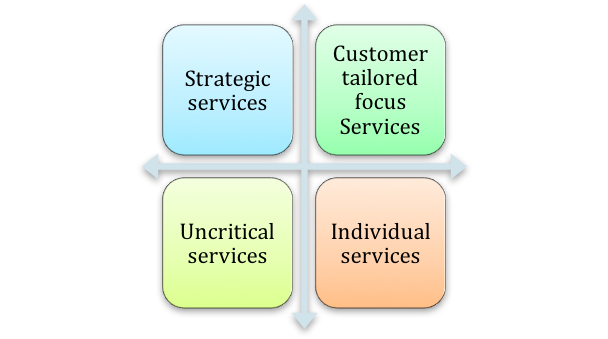
Sourcing strategy patterns
Technology oriented sourcing
This strategy is closely connected with high-tech sourcing outside domestic markets. Sometimes, companies are forced to buy from abroad as there is not much domestic alternative.
Cost oriented global sourcing
It is the strategy pattern that helps to increase competition. The major goal is not to get ahead in technology but to save cost. It can prove to be useful for standardized products where suppliers are easily available in domestic and international markets.
Competition oriented global sourcing
Although the goal of competition oriented global sourcing is also to reinforce competition. But unlike cost oriented sourcing, it does not have a single cost reduction focus. It tries to gain new product ideas and developments in uncritical market situations by addressing foreign suppliers or it looks for wider range of supply markets and suppliers for less critical products.
The above mentioned strategy patterns for global sourcing make the direction for global sourcing clearer. Supply management has to observe the dimensions of the pre-portfolio mentioned above carefully before they can formulate an adequate global sourcing strategy, and especially in case of bimodal companies.