
Many government departments are moving to the cloud, and that is a good thing. But the assumption that migration equals modernization is where things go sideways, especially with AI. What agencies actually need is an AI-ready cloud architecture, and that is a different design problem from moving servers into someone else’s data center.
AI workloads need more than a change of scenery. They need infrastructure that is fast, flexible, and built for computation-heavy, real-time analysis. That is not something “lift and shift” can deliver.
Why “Lift and Shift” Isn’t Enough for AI Workloads
“Lift and shift” means moving applications and systems from on-premise infrastructure to the cloud without changing how they are built. It is popular because it is fast and helps departments hit cloud-migration goals without disrupting operations. It enables relocation, but it doesn’t solve the performance problem.
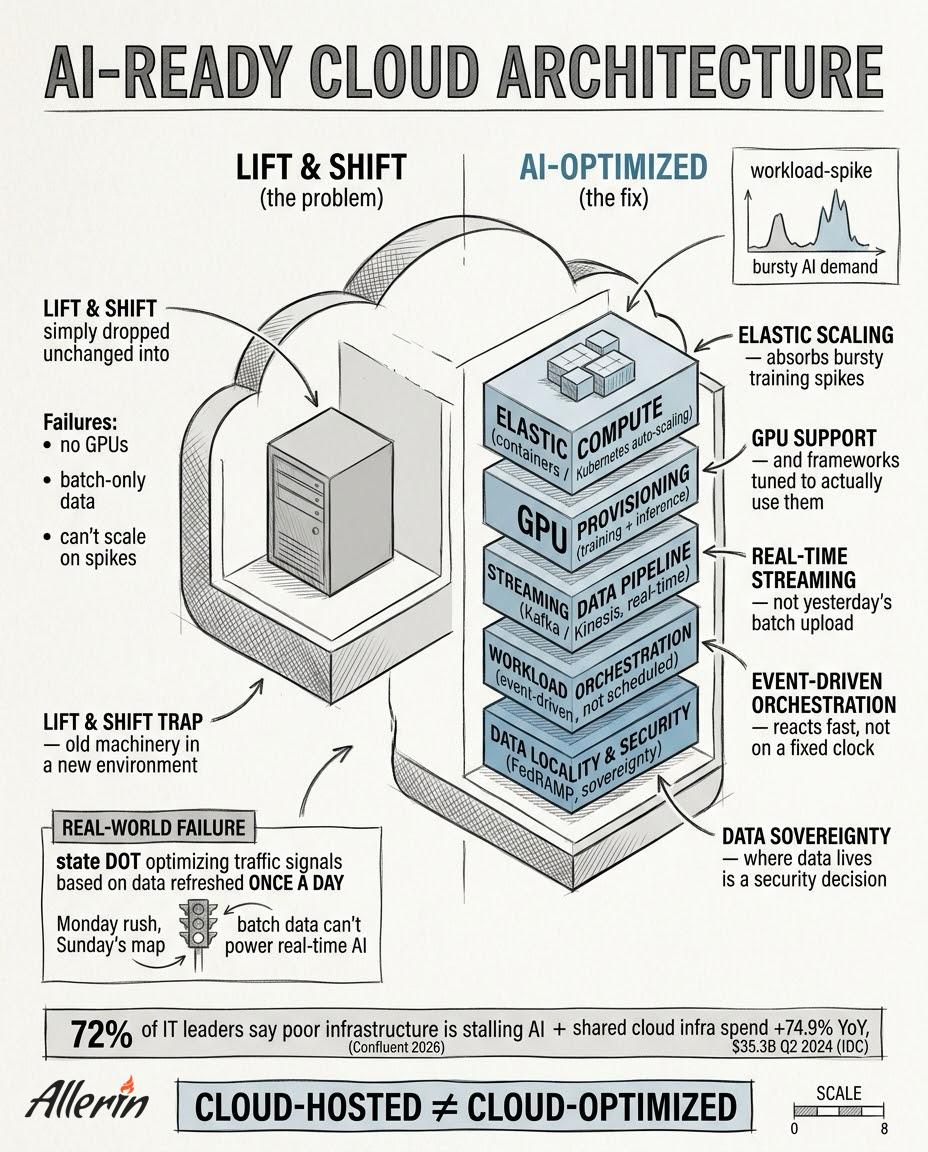
Moving legacy systems to the cloud is a step forward. But most of them still aren’t built to handle what AI needs, like flexible compute, GPUs, or live data streaming. Under the hood, it is still old machinery dressed up in a new environment.
It is like moving into a compact city apartment but trying to recreate the layout of your countryside farmhouse. Technically you have relocated. Practically, nothing fits. And that is where things break, especially when you look at what modern AI workloads demand.
1. AI workloads demand elastic, scalable infrastructure
Unlike traditional workloads, AI compute needs can spike suddenly, especially during model training, which is far more compute-intensive than serving a single prediction. The size of that spike varies widely by model and task, but the pattern is consistent: demand is bursty, and government cloud setups need to keep up. A licensing office running AI document verification on licenses and permits sees the same shape on the inference side, with load tracking the filing calendar rather than a flat daily average.
The infrastructure gap is real and widely reported. In Confluent’s 2026 Data Streaming Report, 72% of IT leaders said poor or insufficient data infrastructure is stalling their ability to scale AI. That figure is cross-industry, but it lands especially hard in the public sector, where legacy systems are the norm. Meanwhile demand keeps climbing: IDC found that spending on shared cloud infrastructure rose 74.9% year-over-year in the second quarter of 2024, to $35.3 billion, driven largely by AI. Yet most organizations remain in the early stages of IDC’s AI maturity model, the “Ad Hoc” and “Opportunistic” levels, experimenting without the infrastructure to scale.
2. Most lift-and-shift setups lack GPU support
Most advanced AI models rely on GPUs for training and inference. But environments built via lift and shift often lack GPU allocation or use generic instances that throttle performance. And even when agencies do provision GPUs, many don’t optimize their code or frameworks (like TensorFlow or PyTorch) to use them well. The result is high costs, slow throughput, and stalled projects.
3. Data movement isn’t built for real-time AI
AI thrives on live inputs and continuous feedback. But most government systems were built for batch uploads and static reporting, not the streaming pipelines AI needs to work in real time. Even after migration, legacy architectures struggle to preprocess data on the fly, maintain a consistent schema, and feed models in real time. The problem usually starts upstream, where records sit in departmental systems that were never designed to talk to each other, so breaking down those government data silos tends to be the precondition for any real-time pipeline.
That creates real risk in time-sensitive sectors like transportation or emergency response, where AI-driven decisions can’t afford a 24-hour data delay. Consider a state Department of Transportation that relies on sensor data updated once a day rather than in real time, which makes it impossible for predictive models to reroute traffic dynamically.
A Real-World Case: Why Yesterday’s Data Can’t Power Today’s Decisions
Imagine a state Department of Transportation trying to use AI to optimize traffic signals across a busy metro. The model is well-trained, but the system updates traffic-sensor data only once per day. So when congestion spikes Monday morning, the model is still working off Sunday’s patterns, like rerouting traffic with a day-old map.
Why? Because the data pipelines were built for batch uploads, not streaming; the APIs delivered static, delayed insights; and the cloud environment lacked the GPU power to process large datasets in real time. The agency had migrated to the cloud, but the architecture still behaved like an on-premise system. AI doesn’t just need access to data. It needs access to data that moves as fast as the world it is trying to understand.
What an AI-Ready Cloud Architecture Actually Looks Like
Moving beyond lift and shift doesn’t mean starting from scratch. It means designing with AI in mind, not just storage and uptime.
Elastic infrastructure
Use containers and microservices so workloads scale dynamically. Technologies like Kubernetes can auto-allocate resources based on real-time demand.
GPU integration
Choose cloud platforms with current-generation GPU provisioning, for example AWS EC2 P6 (NVIDIA Blackwell) or G6 for inference, Azure ND H200 v5, or Google Cloud A4, and configure your frameworks to actually use them.
Smart data pipelines
Automate data ingestion and preprocessing. Use stream-processing tools like Apache Kafka or AWS Kinesis to keep data flowing to your models without delay.
Workload orchestration
Tools like Apache Airflow or cloud-native serverless triggers run AI workflows based on events, not rigid schedules, which is vital for systems that need to react fast.
Data locality and security
An AI-ready cloud architecture isn’t just about performance. It is about control. For public agencies, knowing where data resides is critical for sovereignty, for compliance with standards like FedRAMP, and for protecting against foreign-access risk. Data-center location isn’t just a technical detail. It is a security decision.
Government-Specific Considerations
Public agencies can’t just throw money at the problem. Budgets are limited, regulations are tight, and security is non-negotiable. CISA’s Cloud Security Technical Reference Architecture (TRA), developed with the U.S. Digital Service and FedRAMP under Executive Order 14028, lays out recommended approaches to secure cloud migration and data protection, organized around shared cloud services, secure migration, and cloud security posture management.
Architecture questions also come second. Before an agency designs anything, running a set of data health checks on the records the models will consume shows whether the pipeline is worth building yet, because an AI-ready cloud architecture built on top of incomplete or inconsistent data just delivers bad answers faster.
When starting an AI initiative, agencies should ask:
- Are our current cloud systems GPU-capable?
- Can they handle burstable workloads?
- Are data refresh rates and schema designed for model ingestion?
- Is orchestration automated or manual?
Skip these questions and you get one thing: pilot projects that stall at scale.
The Path Forward: Build for AI, Not Just the Cloud
Cloud migration is essential, but it is not the end goal. To make AI work in the field, agencies have to go beyond being cloud-hosted to being cloud-optimized. That means no more copy-pasting legacy systems into modern infrastructure, no more assuming uptime equals intelligence, and no more building systems that stall when workloads spike. It means designing platforms where AI workloads are not just supported, but accelerated.
Whether you are rethinking compute, data flow, or deployment workflows, the architecture decisions you make now determine whether AI scales or stalls. Helping public agencies design that AI-ready cloud architecture, and the governance to run it responsibly, is exactly the work we do at Allerin.
Sources: IDC: shared cloud infrastructure spending, Q2 2024 (+74.9% YoY) · Confluent 2026 Data Streaming Report (72% say infrastructure is stalling AI) · CISA Cloud Security Technical Reference Architecture · IDC on AI maturity stages