The future of public service won’t be built on algorithms alone. It will be built on the integrity of the data those algorithms depend on. That makes government AI data readiness the most strategic step an agency can take, well before a single model reaches production.
AI Can’t Fix Broken Data. That’s Your Job.
AI is fast becoming a cornerstone of digital modernization in government. From traffic systems to public-service eligibility checks, agencies are under pressure to modernize. But AI isn’t magic. It is math powered by data, and if that data is messy, inconsistent, or incomplete, no model will deliver reliable results.
Most government data systems weren’t built for AI. They were built for specific missions, often in silos, without shared standards. That isn’t a flaw, it is a starting point. Agencies that have already worked through what it takes to break down government data silos tend to reach the AI stage with far fewer surprises. If your agency is serious about government AI data readiness, don’t begin with tools or procurement. Begin with a data-quality intervention.
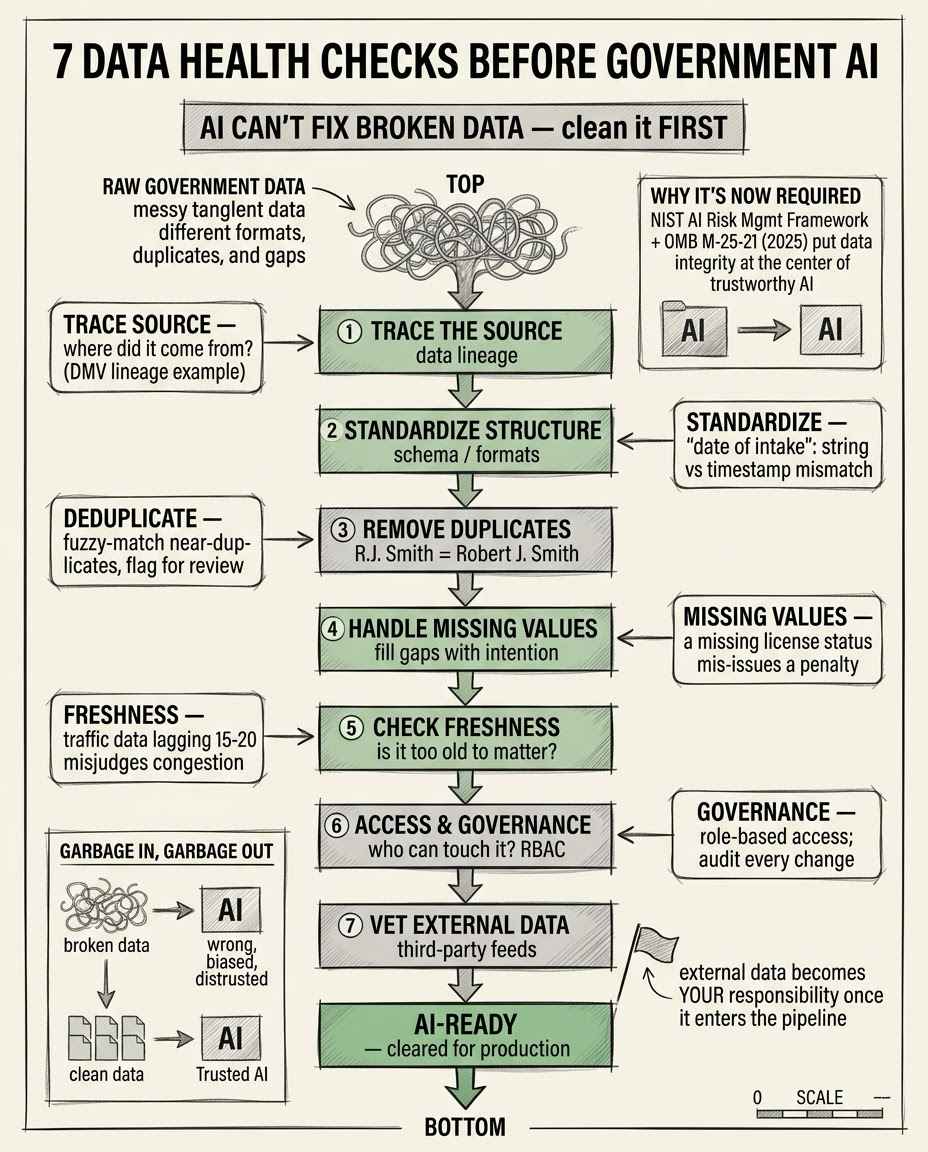
This is increasingly an expectation, not just good hygiene. The NIST AI Risk Management Framework puts data integrity at the center of trustworthy AI, and OMB’s 2025 guidance on federal AI use (M-25-21) requires agencies to identify and manage “high-impact” AI systems, the kind whose outputs drive consequential decisions. In both, reliable data is the precondition. Here are seven practical data health checks to run before putting AI into production.
Seven Practical Checks for Government AI Data Readiness
- Trace the source
- Standardize the structure
- Spot and remove duplicates
- Handle missing values
- Check the freshness of your data
- Review access and governance
- Vet external data before you integrate it
1. Trace the source: where did this data come from?
Every dataset has a story, and without it you can’t trust the outcome. Before data informs any model, your agency should be able to trace its origin, how it was collected, and who has handled it.
This matters most for agencies working with decades-old legacy systems or third-party vendors. A lack of traceability opens the door to incorrect assumptions and undermines public trust.
For example, data lineage in a DMV system might include field-office inputs, central database updates, and integrations with external verification services. Without tracking each touchpoint, errors slip in early and go unnoticed, then compound over time.
Checklist:
- Is the source system clearly documented?
- Are data collection methods standardized?
- Are changes and access logs maintained?
Traceability builds confidence, not just in the data, but in every decision that depends on it.
2. Standardize the structure: is everyone speaking the same language?
One of the most common issues in public-sector data is schema inconsistency. Different systems, or even different teams, may use varying labels, formats, or units for the same field.
A public-health database might log “date of intake” as a string while another logs it as a timestamp. Multiply that across thousands of records and an AI model trained on the data won’t know which version is accurate.
Local police departments often log incident data in different formats or field names. When those records merge into a centralized state or federal system, the inconsistencies cause missing fields, duplicate entries, and reporting errors.
Fix it by:
- Creating cross-agency data dictionaries
- Standardizing formats, field names, and data types
- Mapping and converting legacy schema to match modern systems
Without structure, data becomes harder to interpret, integrate, and trust at scale.
3. Spot and remove duplicates
Duplicate records distort reality. A single citizen appearing multiple times in a public-assistance database, or a permit logged twice under slightly different names, can throw off forecasting, eligibility decisions, and fraud detection.
“Robert J. Smith” and “R.J. Smith” might be the same person in a social-program database. Counted separately, the system risks duplication and misreporting. The stakes here are concrete: our breakdown of how machine learning catches unemployment fraud shows how quickly duplicate and near-duplicate identity records turn a detection model into a source of false accusations.
Best practices:
- Run deduplication checks across citizen, vehicle, or permit records
- Use fuzzy matching to catch near-duplicates and spelling variations
- Establish merge rules to consolidate confidently matched entries
- Flag ambiguous cases for manual review, not automatic deletion
Reliable AI depends on reliable data. Before a model goes live, the underlying records need to reflect the real world, not multiple versions of it.
4. Fill the gaps: handle missing values with intention
Incomplete data is common in government systems, and leaving it unaddressed leads to flawed analysis and poor decisions. Before training any model, agencies need to assess what is missing and how much it matters.
For example, a missing license status in traffic-enforcement data can affect how violations are processed. If a camera captures an infraction but the license record is incomplete, the system may issue penalties incorrectly or skip necessary escalation. Inconsistent handling erodes trust in automated enforcement and creates legal complications.
Steps to take:
- Identify high-impact missing fields by use case
- Set clear remediation logic: default values or a manual-review trigger
- Segment incomplete data from the model-ready set
In domains like public health or criminal justice, even a single missing field can skew AI decisions. Flag these risks early to avoid unintended outcomes.
5. Check for freshness: is your data too old to matter?
Outdated data undermines even the most advanced AI. In public-sector workflows, information more than a few weeks old may no longer reflect real conditions. Fraud detection, demand forecasting, and emergency response all need current, reliable data, which is why government AI data readiness has to be measured on a schedule rather than signed off once.
For example, smart traffic systems that rely on vehicle-sensor data make real-time signal decisions. If that data lags even 15 to 20 minutes, the system can prioritize the wrong intersections or misjudge congestion, leading to longer commutes, inefficient emergency routing, and infrastructure that looks responsive but isn’t.
Audit for:
- Last-updated timestamps across critical datasets
- Required update frequency by program or service type
- Clear indicators for outdated or stale fields
Real-time or regularly refreshed data improves both the speed and accuracy of government decisions.
6. Review access and governance: who touches your data, and should they?
Clean data without proper access controls is still a risk. If sensitive datasets are handled by the wrong people, or changed without oversight, things go wrong. Shared without restrictions, your AI system’s integrity is compromised before it even goes live.
Agencies handle everything from citizen records to public-health information. Without clear governance, internal data becomes a liability.
For example, a state health agency may hold vaccination records with names, birthdates, and medical histories. Without strict role-based access controls, non-medical administrative staff might reach that data, and an undefined permission could let a junior staffer alter records or export sensitive information. That is both a compliance issue and a path to internal misuse or accidental leaks.
Evaluate:
- Who currently has access to each dataset, and who actually needs it?
- Are role-based access controls (RBAC) in place to limit exposure?
- Are there reliable audit trails for every modification or deletion?
- Are sensitive fields masked, encrypted, or anonymized where needed?
Access is not just a technical concern. It is a matter of accountability. Strong governance protects public trust and keeps every AI system operating on secure, verifiable information. For the wider set of practices that hold that trust together once a system is live, see our guide to building public trust in government AI.
7. Vet external data before you integrate it
Government systems increasingly rely on third-party datasets: weather feeds for emergency planning, mapping data for infrastructure, demographic inputs from research vendors. Even when the source is external, the risk is internal. Poor third-party data can compromise model accuracy, introduce bias, or breach compliance.
For example, a municipal planning department might buy third-party demographic data to forecast school-zoning needs. The dataset may look reliable, but on closer review it turns out to be built from outdated census projections and commercial surveys with no local validation. Because it missed recent population growth in some neighborhoods, infrastructure investment was misallocated, leaving some schools overcrowded and others underused. Without checking the dataset’s update cycle, accuracy, and licensing, the agency faced public criticism and budget waste.
What to verify:
- Metadata availability and documentation
- Update frequency and lag times
- Vendor credibility, licensing, and data-sourcing method
Before integration, external data should pass the same quality checks as internal systems. Once it enters your pipeline, it becomes your responsibility.
Clean Data Is the Superpower of Government AI
No government AI initiative succeeds without reliable data underneath it. Advanced models get the headlines, but it is the behind-the-scenes groundwork, lineage tracking, schema alignment, access control, that determines long-term value and trust. Whether you are just beginning or preparing to scale, treating government AI data readiness as the first milestone rather than a cleanup task makes sure your systems deliver real, trusted outcomes. Smart tools only work on smart foundations, and that starts with clean data. Helping public agencies get that foundation right, and then build production AI on top of it, is exactly the work we do at Allerin.
Sources: NIST: AI Risk Management Framework · OMB Memorandum M-25-21, Accelerating Federal Use of AI through Innovation, Governance, and Public Trust (April 2025)