 When everyone talks about the future of public transit, they always end up talking about Electric Vehicles (EVs). And while there’s good reason for EVs getting a lot of hype, the bigger game changer in public transit systems is AI.
EVs Solve One Problem. AI Solves Many.
EVs = Cleaner Vehicles. They cut emissions and lower operating costs (less fuel, fewer parts to maintain). But EVs don’t fundamentally change how transit systems operate. They’re just cleaner buses and trains. AI, on the other hand, can revolutionize how the entire system functions—from scheduling to predictive maintenance to passenger experiences.
EV = Hardware upgrade
AI = Systemwide brain upgrade
AI in Public Transit: An Optimization at Every Level
Public Transportation Optimization
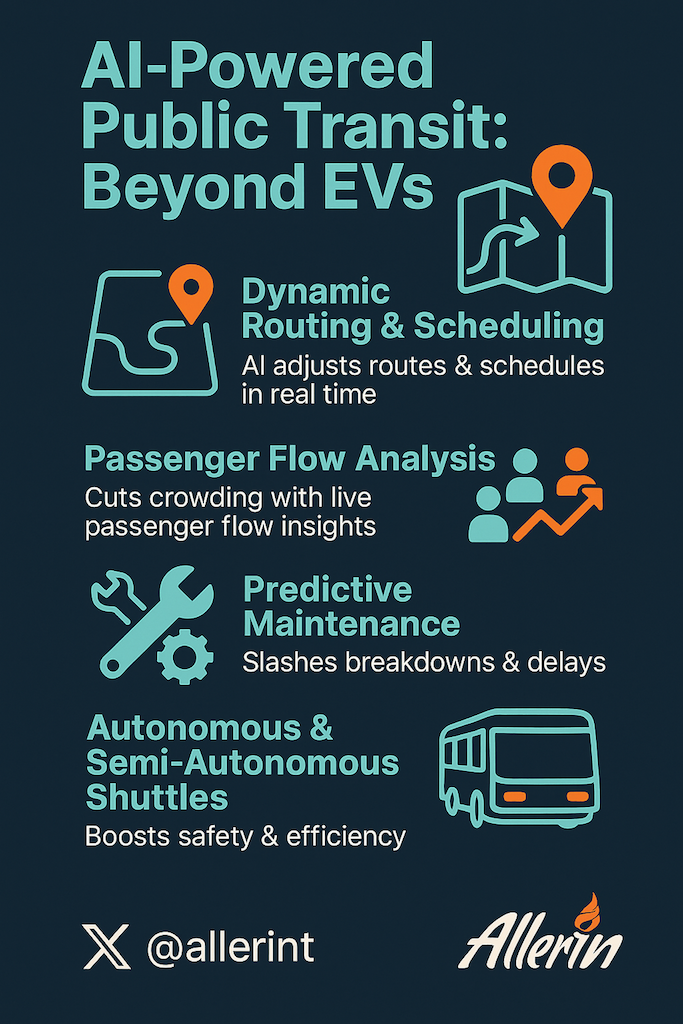
AI can dynamically adjust routes, schedules, and service frequencies in real time based on a range of variables—including traffic congestion, weather conditions, and real-time passenger demand. By continuously analyzing data from GPS, ticketing systems, traffic feeds, and even social events calendars, AI can predict ridership patterns and recommend service adjustments before passengers experience delays. For instance, if a concert lets out early, AI can trigger additional buses to nearby stops. AI can also optimize vehicle spacing to avoid bus bunching and overcrowding, ensuring smoother, more reliable service. This level of flexibility and foresight is impossible with static schedules alone.
Passenger Flow Analysis
AI-powered sensors, cameras, and ticketing systems work together to provide continuous, real-time analysis of passenger flows across public transit networks. By monitoring station crowding, vehicle occupancy, and platform usage, AI helps agencies spot bottlenecks and reroute or reschedule vehicles to ease congestion. Historical data combined with machine learning enables AI to forecast passenger surges—for example, after a sporting event or during morning rush hours—so transit operators can pre-position vehicles. AI can also trigger alerts for crowd control staff or dynamic signage to guide passengers to less crowded platforms, improving overall passenger comfort and safety.
Predictive Maintenance
AI dramatically improves the reliability of transit systems through predictive maintenance capabilities. Onboard sensors continuously monitor the health of key vehicle components—brakes, engines, doors, and HVAC systems—while AI analyzes performance data to predict when parts are likely to fail. This allows agencies to schedule repairs well in advance of breakdowns, avoiding disruptive mid-route failures. AI can also assess infrastructure conditions, such as tracks and overhead power lines, detecting signs of wear or stress before they escalate into safety hazards. This predictive approach minimizes downtime, extends equipment lifespan, reduces maintenance costs, and enhances passenger safety.
Autonomous Vehicles (AVs)
AI powers both fully autonomous and semi-autonomous transit vehicles, from driverless shuttles operating in defined loops to advanced safety and efficiency systems in conventional buses and trains. In semi-autonomous systems, AI assists with adaptive cruise control, automated lane-keeping, and precise docking at bus stops. AI algorithms can detect pedestrians, cyclists, and vehicles in real-time, enabling safer navigation through busy urban environments. Fully autonomous pilot programs, often in partnership with tech companies, are demonstrating how AI can manage vehicle operations, monitor passenger behavior, and even handle fare collection. As these technologies evolve, AI will make transit safer, smarter, and more efficient.
Railway & Runway Inspection
AI enhances infrastructure safety and maintenance by enabling continuous, automated inspection of railway tracks, runways, and tunnels. Drones equipped with high-resolution cameras and sensors fly along tracks, capturing images and environmental data. AI algorithms analyze these images for signs of stress, cracks, or misalignments in rails and concrete, flagging areas that need immediate attention. This proactive approach allows for timely repairs, reducing the risk of accidents caused by infrastructure failures. Combined with data from onboard sensors on trains, AI can monitor track conditions in real time, adjusting speeds or rerouting trains when necessary, enhancing both safety and operational efficiency.
Personalized Passenger Experience
AI can elevate the passenger experience by delivering highly personalized and context-aware travel recommendations. AI-powered transit apps can analyze a passenger’s trip history, preferred modes of transportation, and even real-time weather or traffic disruptions to suggest the best route options. These suggestions can dynamically update during the trip if conditions change, helping passengers avoid delays and crowded vehicles. AI can also integrate with multimodal platforms, incorporating bikeshare, rideshare, or walking routes into trip plans. Personalized notifications—such as service alerts tailored to a passenger’s regular commute—further enhance convenience, making public transit feel seamless and user-centric.
AI Scales Across All Modes—Not Just Buses
EVs mostly apply to buses, maybe trains. AI applies to buses, trains, ferries, bike-sharing, ride-sharing, even sidewalks and intersections. AI can integrate these modes into seamless “mobility as a service” platforms that suggest the best multi-modal routes for each trip.
AI Delivers Cost Savings and Service Improvements Simultaneously
EVs save on fuel and maintenance, but they don’t improve operational efficiency. AI helps agencies do more with less—fewer empty buses, smarter staffing, fewer breakdowns, and better passenger experiences. That’s a direct economic and service impact—which is what agencies, politicians, and the public care about.
AI Future-Proofs Transit for the Smart City Era
Cities are evolving into smart ecosystems—traffic lights, bike lanes, parking, rideshares, and public transit all need to talk to each other. AI is the only technology capable of stitching together all these data points into a cohesive, adaptive system.
AI Enables Proactive, Not Reactive Management
Today’s transit systems are largely reactive—they respond to problems after they happen. With AI, agencies can predict and prevent disruptions, optimize routes before demand shifts, and balance vehicle loads before overcrowding happens.
AI Can Win Against Public Transit’s Biggest Competitor Today: Flexibility & Convenience
Personal cars and rideshares (Uber, Lyft) offer on-demand, door-to-door convenience. Public transit can’t compete on flexibility using traditional fixed routes and schedules. People often choose personal cars or rideshares not because they love driving, but because they know exactly when they’ll leave, exactly when they’ll arrive, and they don’t have to worry about delays, detours, or missed connections. AI changes the game by making public transit far more responsive and personalized, bringing it closer to the convenience of personal cars and rideshares. AI can potentially dynamically adjust bus or train schedules, routes, and vehicle deployment based on demand, traffic conditions, and even weather. This real-time responsiveness means transit can work more like an on-demand system. Imagine: A bus that changes its route mid-trip to avoid congestion or picks up extra passengers based on real-time data—that’s AI-driven transit.
Passenger Experience is Everything
Cars and rideshares provide predictability and control—passengers know what to expect. Public transit often feels unpredictable: Will my bus be late? Will my train be overcrowded? AI can predict and communicate delays, reroute passengers automatically, and adjust capacity dynamically, making public transit feel as reliable and personalized as a car or rideshare. Uber and Lyft already use AI extensively for demand prediction, dynamic pricing, and optimal routing. If public transit systems don’t adopt similar capabilities, they’ll always feel less responsive and less competitive.
Electrification Alone Won’t Solve Convenience
EVs make transit cleaner, but they don’t make it more reliable, flexible, or passenger-friendly. AI is the only technology capable of turning transit into a truly competitive alternative to private vehicles and on-demand rideshares.
Bottom Line
EVs = Important step toward sustainability.
AI = The true transformation that turns public transit into a dynamic, responsive, passenger-centric, cost-efficient system.
If we want public transit to compete with personal cars and rideshares, AI is the only way to get there.
Looking for specific AI solutions for city public transit systems? At Allerin, we work closely with several governments to build AI solutions that can make life better for the people they serve. Contact us or visit our website to learn more.