
 The real estate industry has always been slow in embracing technology. But that’s a thing of the past. There’s more customer data available to businesses now than ever before, thanks to technologies like IoT and big data analytics. And this data is helping real estate businesses to implement AI systems. The use of AI in real estate can help in determining property value, enabling seamless customer management, providing tailored recommendations, and assisting sales agents in decision making.
How AI in real estate is transforming the industry
The capability of AI systems to gather, process, and learn from a large inflow of data has paved the way for its several applications across the real estate industry.
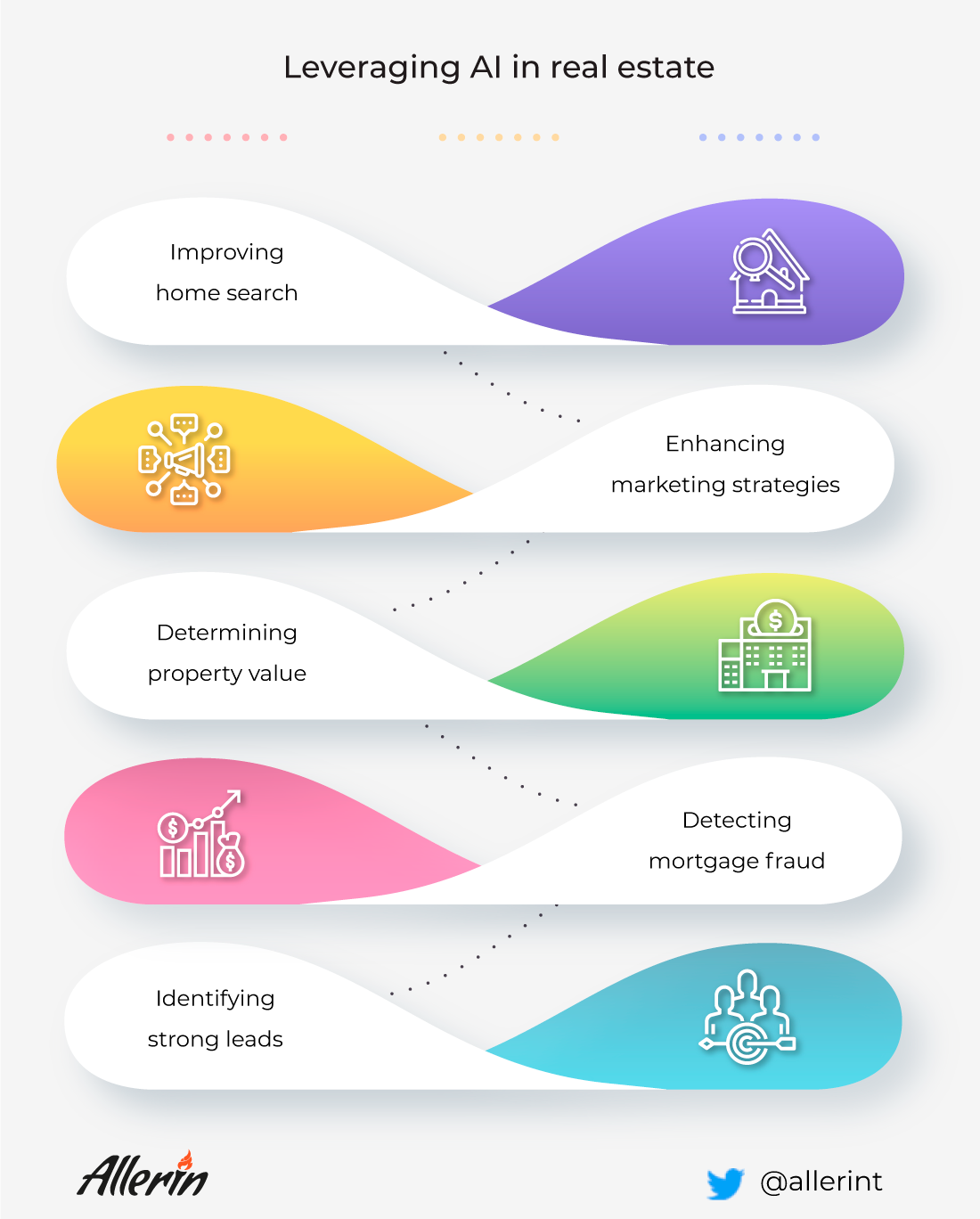
By improving home search
Every real estate customer wants to find the ideal home. Ever since home listings have become available online, it has become easy for customers to narrow down their search. But, narrowing the home search based on attributes like location, price, area, and the number of bedrooms still leaves customers with hundreds of options to consider. The customers then have to narrow down the filters even further to find the best options among them.
AI can also do the same by tagging and categorizing homes into different groups based on various features like the ones mentioned earlier. You would think that makes AI and other home listing software similar. But that’s not the case. What makes AI systems differ from other home listing software is that it can analyze search patterns of a customer to accurately predict what customers want and display the closest options. For instance, a leading real estate marketplace uses AI to improve home buying experience by matching buyers’ patterns with previous similar buyers to provide accurate recommendations and save search time.
Sales agents might not be able to remember all the available properties, and this can result in the customer losing a great home that would have been most suitable for him or her. AI-chatbots created with the help of Natural Language Processing (NLP) can understand customers’ queries and also remember all the available properties with minute details. Chatbots can thus act as sales agents to assist customers in evaluating all the options to find the best one for them.
By determining the property value
Many people see real estate as an investment opportunity. Property valuation plays a vital role in real estate investment. For instance, property value determines the rent, sale price, tax, and insurance amount of a property. Hence determining accurate property value becomes important for sales agents, insurers, and property owners themselves.
With the help of computer vision and AI, real estate agencies can determine property value. With each property image lies a wealth of information, and computer vision can scan such images to extract critical information. For instance, it can scan an image and tag it with all real-estate specific features like floor types, interior design, exterior design, lawns, and pools. It can also take into consideration the condition of rooms and added equipment like TV and refrigerators to determine the best value. The predictive capability of AI also helps to understand how the value of a property will fluctuate in the future based on current property trends. When trained from historical property value data, AI systems can consider factors like currency inflation and home features to estimate the property value after a certain number of years. For instance, HouseCanary is a real estate data and analytics platform that uses AI to forecast how property value will fluctuate in the next three years.
Determining current and future property values also helps investors to invest in the most profitable properties and the best time to sell them to generate a huge amount of profit.
By identifying strong leads
Converting leads into sales is always challenging across all the industries. But when it comes to real estate, the investment amount increases, and simultaneously the challenges and difficulties in converting them into sales also increase. For instance, it becomes difficult for sales agents to know whether the customer is capable of buying the property that he is dreaming about. Sales agents can leverage AI to distinguish serious buyers and sellers from those who are daydreaming. AI can identify hundreds of data points like income, lifestyle, and past purchases to distinguish buyers and identify strong leads.
AI-based chatbots can also enable constant communication with leads to convert them into customers. For instance, they can understand queries and send responses automatically. They can also provide fine-tuned and tailored responses to the leads.
By enhancing marketing strategies
In addition to converting strong leads into sales, AI also helps to generate the leads in the first place. Generating new leads and attracting new clients is all a part of marketing, and AI can assist real estate businesses to create accurate marketing as per the customers’ needs. AI has the power to segment customers based on their preferences, location, demographics, lifestyle, and investment capability. They can also monitor customers’ digital footprints on the internet and social media. With the help of such segmentation, AI can assist real estate businesses to create marketing strategies for each category. For instance, AI can create different marketing strategies for people with high and low investment capabilities.
By detecting mortgage fraud
With the help of deep learning and computer vision, real estate businesses can scan property documents to detect and prevent mortgage fraud. When trained with historical mortgage fraud data, AI can detect current fraud attempts by matching patterns of changes in the documents. For instance, income fraud is a type of mortgage fraud where borrowers overstate their income to qualify for a higher loan. AI can compare income details with bank statements of the borrower. And then match the patterns with previous data to detect frauds. AI can then alert higher authorities and bank administrators who can validate the borrower application before processing loans. Thus, AI can help the real estate industry to detect and prevent mortgage fraud.
While the use of AI in real estate can bring all the aforementioned benefits, combining it with other technologies like blockchain can provide further benefits like smart contracts and reduced land fraud. Blockchain can prevent land fraud by allowing anyone with decentralized ID on the blockchain network to sell their property without the need for middlemen, and reduce land fraud instances. The collaboration of blockchain and AI in the real estate can thus provide seamless and secure selling and buying of properties.
