 The education sector as an industry has long been stable without much innovation. However, in recent years, technology has slowly started penetrating the sector. Technologies such as holographic AR, VR, AI, and IoT have disrupted the industry in recent years. These technologies have primarily focused on transforming the experience inside the classroom. Another technology that is making the rounds in the education sector is blockchain. Blockchain technology will not have an impact on the education methods inside the classroom but will help in bringing transparency in the processes outside the classroom. Blockchain brings transparency, and this will be significantly helpful for students as well as educational institutes to reduce instances of fraud and help in better management of records of students and the institutes.
Use cases of blockchain in education
Reducing instances of frauds
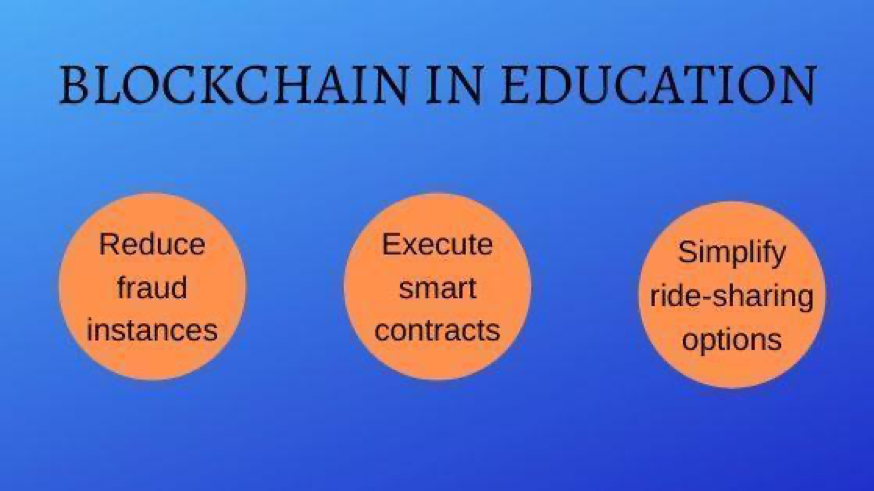
The main benefit of using blockchain in any industry is bringing in transparency. Blockchain allows for the recording of data on a decentralized public chain where the data can be viewed by everyone but can be modified by only authorized persons. The blockchain contains historical data of every event and thus increases data transparency. Universities can create records of students on the blockchain that can help other universities verify the authenticity of education records submitted by students applying for further studies. The process of student verification is streamlined efficiently and helps save time and human resources currently spent in the student verification process.
Enabling smart contracts
Blockchain smart contracts feature can be leveraged to significantly reduce the paperwork involved in the education sector. Applications of smart contracts in education include the admission procedure. The entire admission procedure can be carried out by enabling smart contracts. The smart contracts can be executed once ‘certain conditions’ for the same are met. For example, once the student’s details and identity are verified on the blockchain, a smart contract can be executed, confirming the admission for the particular student. The process is swift and automated on the blockchain and completely eliminates physical paperwork.
Ridesharing
Blockchain can be leveraged in ride-sharing in general and this will prove highly beneficial for students. Most students commute to their school or college and need to search for new commuting options daily. With blockchain, students can match with ridesharing drivers so that they can commute easily to university and back. They can create a smart contract on a weekly, monthly, or yearly basis, depending on their needs. Schools or universities, too, can leverage ridesharing and connect with a group of drivers for pupil transportation, especially for kids with special needs. Thus, the daily to and fro commute of students will be significantly simplified and might improve their productivity in class.
Although blockchain may not prove useful in providing a better education model, it can surely impact the sector in other significant ways. Educational institutes need to give blockchain the same importance as other technologies for their overall development. The adoption of blockchain in education will rise only if the institutes get a proper understanding of how blockchain will impact their working and for that awareness needs to be raised by businesses involved with the blockchain technology.