

“The $14-plus billion marketplace for HR software and platforms is reinventing itself.” That’s what Josh Bersin, the Founder and Principal at Bersin by Deloitte, writes on his blog page in Forbes.com This number is likely to increase to almost $20 billion by 2021, according to RnR Market Research. Slowly, but surely, HR is moving out of its shell and losing its shyness towards modern technologies. And for good reason, too. Like in every other function, technology harnesses the power to move HR from a simple cost-center to a business-enabler.
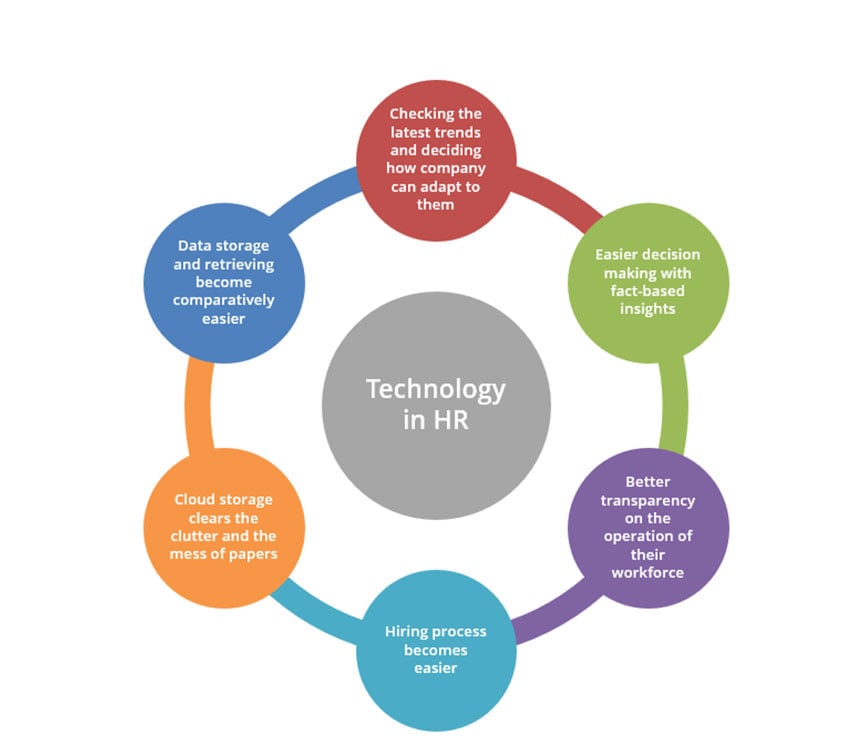
Technology in HR brings data-driven insights
Data is the driving force behind every successful organization today. Companies use data to gain customer insights, develop better products and make processes faster. How, then, can the unbelievable value of data mining be kept away from the HR function?
Using big data technology in HR can provide the ability to determine the latest trends in the market that competitors are using and how your organization can benefit by adopting similar trends. These trends include pay package, terms and skills that are popular in job descriptions, job cycles, location density, talent density, etc.
Thus, the hiring process becomes more efficient as HR does not need to hire an employee based on intuition but on insights based on data analytics. This empowers the HR to hire employees that can truly make a mark in the organization.
Risk management also becomes comparatively easier for HR with big data. HR can focus on teams that have been lagging and identify employees who can improve with the help of extra training.
As mentioned in one of our previous blogs, too, data-driven analytics based on wearable devices that use the Internet of Things (IoT) also promises to increase employee engagement and productivity.
Cloud storage reduces costs
Earlier, HR teams had store all the data in paper format. Eventually, the storage became digital. But with the amount of documents involved, organizations still need to invest in infrastructure needed to save, access, delete and manage rights and compliances around this data.
HR teams can switch the storage patterns with cloud storage. Storing the data on cloud systems not only allow organizations to have lower capex costs but, with the right vendors, can also ensure that the information being stored at an optimum level of security.
This is only the beginning. An SHRM/Globoforce Employee Recognition report developed in 2015 identifies turnover, employee engagement, recruitment, performance management, employee satisfaction and productivity as major HR challenges, among others. It is here that we will see technology filling up most of the gaps. We’re going to see a lot more technology around IoT, artificial intelligence, machine learning, virtual reality and augmented reality in the future HR space.