

Customer retention is crucial to any organization, and the airline industry is no different. The airline industry faces robust competition, and the business has steadily increased after the COVID-19 pandemic. Today, customers are looking for the best features and services. Since there are a plethora of choices available, customers can easily switch to another airline if they’re dissatisfied with the services. In such cases, it becomes crucial to identify such customers and try to retain them.
Customer churn is a concept used by many organizations to identify customers who’re bound to discontinue using their services. Acquiring new customers requires tumultuous marketing efforts, which makes it very expensive. Retaining customers and building a loyal customer base is far more efficient.
According to research, increasing customer retention by 5% can increase profits by more than 25%. And so, implementing the concept of churn prediction and prevention in the airline industry is crucial.
What is Churn Prediction and Prevention in the Airline Industry?
Churn prediction, also known as customer attrition, is the rate at which a company loses customers over a specific period. Several factors come into play when a customer decides to discontinue service. It can be due to high prices, poor customer service, competitive offerings, etc. There are several ways to calculate the churn rate. One of the easiest methods to calculate the churn rate is to divide the number of customers lost during a specified period by the total number of customers the airline had at the start of this period.
For instance, let’s say the airline had 100 customers at the start of the month. Then, by the end of the month, it had 90. Meaning the airline lost ten customers over the period of a month. To calculate the churn rate for that month, simply divide the number of customers lost (i.e., 10) by the number of customers the airline had at the start of the month (i.e., 100). In this case, the airline experienced a churn rate of 10% for that particular month.
If a company’s churn rate is high, it will face issues like reduced revenue. Airline industries depend on ticket sales to earn a major part of their revenue. An increased churn rate increases costs to acquire new customers to replace the ones who left. This can lead to companies spending less on customer services. If other customers are dissatisfied, it will further increase the churn rate.
Factors to Build Machine Learning-Based Churn Prediction Model
It is important to build an accurate prediction model and deploy prevention techniques to prevent churn rates in the airline industry. Here are some factors you need to build an effective churn prediction model.
1. Data Gathering
Collecting an enormous amount of data is necessary to understand why customers discontinue services. Information like reservation history, flight preferences, website activity, and more can be used to understand customer behavior. Then, it can be used to build an effective churn prediction model. This data can be analyzed to predict the timing of customer attrition. Companies can also collect competitor data to understand customer behavior further.
2. Data Filtering
Apart from collecting data, it’s essential to filter the collected data. Airline industries generate massive amounts of data, including user information, flight patterns, etc. It’s bound to include noise, which is unnecessary data like duplications and errors. By filtering this data, it becomes easier to identify customers at a higher risk of churn. It can also be used to create microsegments to understand which phase is more likely to cause customer attrition. Effective data filtering can help airlines identify important customers loyal to the airline and those who use premium services. Once identified, airlines can take the necessary steps to retain them.
3. Machine Learning-Based Predictive Modeling
Manually gathering, filtering, and analyzing massive amounts of data to predict churn is time-consuming and requires a massive workforce. However, airlines can use the latest artificial intelligence (AI) applications, like machine learning (ML), to build accurate predictive models. ML-based predictive models can go through massive amounts of data and analyze complex customer patterns. It can track the patterns in real time and allow organizations to take necessary actions immediately. Since ML-based models are self-learning, their accuracy increases over time.
The faster you predict customer churn, the better you can prevent it. So here are some of the techniques you can use to decrease the churn rate.
Churn Prevention Techniques to Boost Customer Retention in Airline Industry
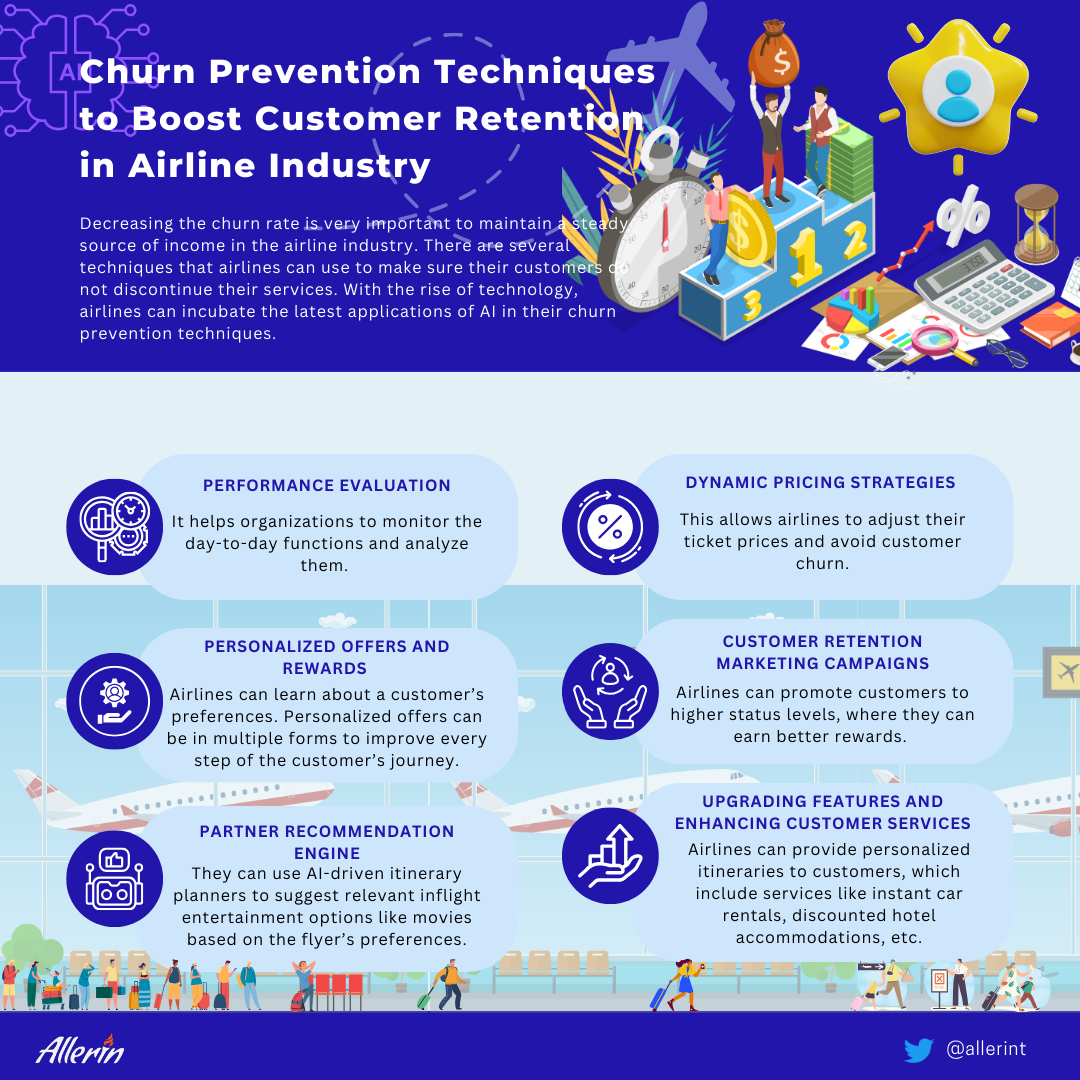
Decreasing the churn rate is very important to maintain a steady source of income in the airline industry. There are several techniques that airlines can use to make sure their customers do not discontinue their services. With the rise of technology, airlines can incubate the latest applications of AI in their churn prevention techniques.
1. Performance Evaluation
Performance evaluation is an integral part of preventing customer churn. It helps organizations to monitor the day-to-day functions and analyze them. To avoid losing loyal customers, it is important to ensure that there are no hindrances in their experience. These hindrances include flight delays, luggage misplacement, subpar inflight amenities, and more. If customers are dissatisfied with the services, they are bound to choose an alternative service.
An organization can learn about customer preferences through feedback forms, purchasing history, and more to avoid that. Then, use the gathered information to identify and work on the areas of improvement. For instance, airlines can analyze a plane’s data to determine when it may need maintenance. This can prevent maintenance delays and save the customer’s time.
2. Personalized Offers and Rewards
Another technique to reduce the churn rate in the airline industry is to provide personalized offers and rewards to customers at risk of leaving. Since airline is a service-based industry, a great customer experience is a must. According to a study by McKinsey, successful experience-led growth strategies can increase customer satisfaction by at least 20%. By analyzing data, airlines can learn about a customer’s preferences. Using this information to craft custom-tailored offers for the customer makes them feel special. It shows that the organization cares about the customer and promotes loyalty.
Personalized offers can be in multiple forms to improve every step of the customer’s journey. This will not only help companies to retain customers but also boost brand reputation through word-of-mouth marketing.
3. Partner Recommendation Engine
Partner recommendation engines learn customers’ buying patterns and suggest relevant services. This helps the customer to streamline their purchasing journey and save time. Recommenders can be used at every stage of the journey. Based on purchasing history, it can recommend personalized travel offers to the flyers. Then, they can use AI-driven itinerary planners to suggest relevant inflight entertainment options like movies based on the flyer’s preferences. At the journey’s end, they can suggest relevant hotel accommodations to flyers. Recommendation engines can also be used to build chatbots. These can help flyers to resolve any doubts regarding their journey.
4. Dynamic Pricing Strategies
Ticket price is an important factor that affects a customer’s purchase decision. There is a high chance of travelers switching airlines if they find better services at the same price. So it’s important to monitor the ticket prices of your competitors. Fortunately, airlines can use AI-based dynamic pricing strategies. These use complex algorithms to keep an eye on real-time market conditions. This allows airlines to adjust their ticket prices and avoid customer churn.
5. Customer Retention Marketing Campaigns
Loyalty programs are one of the most effective ways to retain customers. In these programs, airlines provide points (like travel miles) to customers who regularly use their services. Customers can pool these points and redeem them to get discounts and other offers like access to exclusive lounges, cabin upgrades, and more. Airlines can promote customers to higher status levels, where they can earn better rewards. This is helpful for both the company and the customers. Customers get more value for their money, and companies get repeat business.
6. Upgrading Features and Enhancing Customer Services
Apart from using multiple techniques, the airline industry can always improve its services to ensure its customers remain loyal. Adding new features and services can help airlines to stand out from their competitors. They can use technological advancements to introduce features like the gamification of airports, which can help customers make the most out of their time there. Airlines can further automate customer journeys by integrating with partner services. For instance, airlines can provide personalized itineraries to customers, which include services like instant car rentals, discounted hotel accommodations, etc.
Conclusion
Churn prediction and prevention in the airline industry are crucial metrics for maintaining stable revenue. Calculating churn can help companies to predict fluctuations in business. However, by leveraging applications of artificial intelligence like machine learning, companies can zero in on the factors that lead to customer attrition. Once the factors are identified, companies can adapt accordingly and use effective techniques to prevent churn and increase brand loyalty. This will help airlines to build better and long-lasting relationships with their customers.