
Facial recognition technology (FRT) has moved quickly from laboratory experiments to frontline use in areas such as secure facility access, immigration processing, and public safety. As agencies adopt FRT to speed identity checks, strengthen security, and deliver services more efficiently, they also have to navigate hard questions about how, and under what authority, this powerful tool is deployed.
Embedding FRT into government workflows takes more than buying the latest software. It demands a clear policy framework that defines acceptable use cases, mandates upfront impact assessments, ensures explainability and auditability, and gives the public meaningful avenues for oversight and redress. In the sections that follow, we outline a set of practical principles, from transparency and consent to accountability and data retention, that help decision-makers deploy facial recognition responsibly while preserving citizen trust.
The Tech That Watches All, but Who’s Watching It?
Despite widespread adoption, and the possibility that physical IDs may one day become obsolete, FRT often operates in a regulatory gray zone. In the United States, no federal law explicitly governs its use by government agencies, which leaves room for abuse and civil-liberty violations.
FRT’s advance has outpaced existing statutes, eroding public trust amid fears of unchecked surveillance. When images collected for one purpose are repurposed, often without consent, citizens worry their movements and identities could be tracked in ways they never authorized. Governments worldwide deploy FRT to reduce crime and speed up immigration, but without clear legal guardrails, the risk of misuse grows.
Private-sector use adds another layer. Retailers mine biometric data to personalize marketing, and social media platforms automate photo-tagging to boost engagement. Precisely because the technology is so powerful, its oversight cannot be an afterthought.
Principles for Responsible Use: Building Trust Through Ethics
For governments and organizations trying to use FRT responsibly, a strong ethical foundation comes first. Start with four cornerstone principles until firmer laws are in place: transparency, consent, accountability, and non-discrimination. These are not abstract values; they are actionable pillars that can guide real policy. Groups like the Center for Strategic and International Studies (CSIS) and the Security Industry Association (SIA) advocate for principled frameworks along these lines.
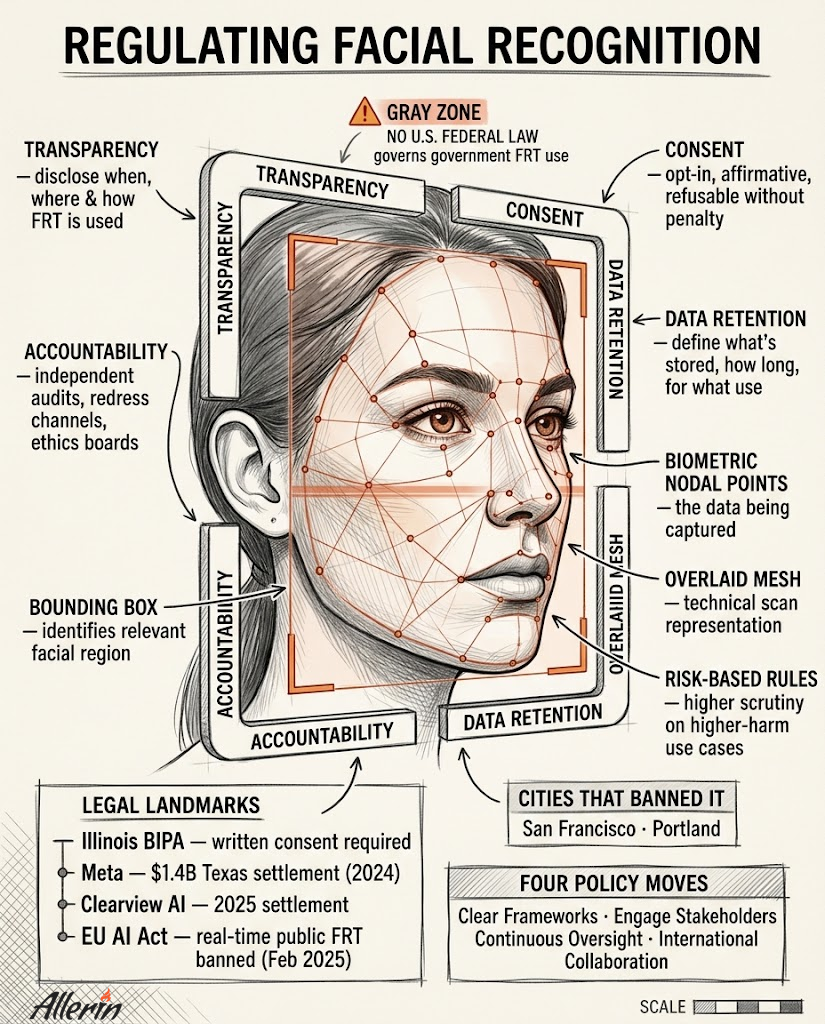
So what do these pillars stand for?
Transparency
Secrecy around FRT deployment is one of the biggest problems. These systems are often rolled out in public spaces without the public’s knowledge, which leaves citizens feeling vulnerable, unaware that they are being scanned. Ethical transparency means disclosing when, where, and how FRT is used, clarifying who is responsible for its operation and oversight, and making policies publicly accessible and easy to understand.
San Francisco, for example, banned government use of FRT after officials saw a lack of transparency and public awareness. Trust erodes without transparency; with it, citizens can be part of the conversation.
Consent
Biometric data is some of the most personal data a person has, and FRT captures it. Without explicit consent, collecting and analyzing it goes beyond intrusion; it can be unconstitutional. Meaningful consent means informing people of their rights and how their data will be used. It must be opt-in and affirmative, not buried in terms and conditions, and people must be able to refuse FRT without penalty.
The Illinois Biometric Information Privacy Act (BIPA) is a prime example of consent-based regulation, requiring written consent before a company collects or shares biometric data. Courts have taken it seriously, and the landmark cases show why. Meta settled biometric claims for $650 million in Illinois and a record $1.4 billion with Texas in 2024, and Clearview AI reached a 2025 settlement that gave affected users an equity stake in the company. Illinois also amended BIPA in 2024 to limit damages to one claim per person, a sign the law is still evolving.
Accountability
Being technically sound is not enough; FRT programs must be accountable. That means structures to monitor use, correct abuses, and ensure fairness over time: independent audits and impact assessments, clear grievance and redress channels for anyone whose rights are violated, and ethics boards that review FRT applications regularly. Portland’s facial recognition ordinance, one of the strongest in the country, bans both government and private use.
Data Retention
A core concern is that images collected for one purpose end up used for another without consent. Rules must be explicit: define when images can be stored, for how long, and under what circumstances stored images can be used.
International Regulatory Approaches: A Global Glimpse
Countries have taken varied approaches. The EU’s Artificial Intelligence Act puts strict obligations on high-risk AI systems, and its first prohibitions took effect in February 2025. Real-time remote biometric identification in public spaces by law enforcement is now banned, with narrow exceptions such as preventing a terrorist attack or locating a missing person, and untargeted scraping of the internet or CCTV to build facial recognition databases is prohibited outright. Penalties reach up to 35 million euros or 7% of global turnover.
In the UK, former Prime Minister Tony Blair has advocated for integrating digital identities and live facial recognition into the criminal justice system, part of a broader, and contested, push toward national digital ID.
Balancing Innovation with Privacy: Progress Without Compromise
Whether the goal is stronger security or a better user experience, FRT offers real benefits. The task is to balance innovation against unintended consequences like mass surveillance or discrimination. Risk-based rules tied to specific use cases put higher scrutiny on the applications most likely to cause harm. At the same time, engaging communities to understand concerns, and disclosing both system capabilities and vulnerabilities, supports better decisions and builds trust. With these strategies, governments can make the most of FRT while upholding individual rights.
Policy in Practice: Recommendations for Policymakers
Policymakers are playing catch-up in a field shaping the future today, one that affects both public safety and personal privacy. To build a future where innovation and civil liberties coexist, governments need a proactive, thorough, and collaborative approach. Four moves matter most:
- Develop clear frameworks
- Engage all stakeholders
- Ensure continuous oversight
- Foster international collaboration
Develop clear frameworks
Clear laws governing FRT, built on transparency, consent, and accountability, are the starting point. They should define acceptable use cases and distinguish high-risk from low-risk scenarios. Set clear standards for consent, transparency, and data protection, making it illegal to use data without notifying people or securing permission. Less is more with data: collect only what a given scenario truly needs. And require impact assessments and audits before any FRT rolls out in public or government systems.
Engage all stakeholders
Facial recognition regulation should not be the exclusive domain of technocrats or legislators. Policies that affect millions need a diverse range of voices:
- Civil liberties advocates (e.g., ACLU, EFF) to protect individual rights
- Tech developers to explain technical limits and possibilities
- Law enforcement agencies to weigh security needs
- Communities that are often disproportionately affected by surveillance
Ensure continuous oversight
Oversight has to be dynamic. Mandate periodic audits for accuracy, bias, and privacy compliance, and require real-time incident reporting to track misuse or failures.
Foster international collaboration
Aligning with global partners to standardize and share best practices matters, even if it comes at a later stage. One promising step is the Council of Europe’s Convention 108+, which sets international legal standards for data protection and includes provisions on biometric and facial recognition technologies.
The Path Forward
The rise of facial recognition isn’t a problem to solve; it is a reality to govern. The real question is how. By building clear frameworks, listening to diverse voices, staying vigilant through oversight, and collaborating globally, governments can move from reactive measures to proactive stewardship. The goal is to use these technologies in ways that strengthen society without undermining what makes it worth protecting: privacy, freedom, and trust.
As FRT spreads across more sectors, the job is to set rules that safeguard individual rights without stifling innovation. By holding to transparency, consent, and accountability, governments can capture the benefits of FRT while protecting privacy. The path forward takes collaboration, foresight, and a steady commitment to ethical governance, and it is the kind of work we help public agencies get right.
Sources: Texas AG: $1.4B Meta facial recognition settlement (2024) · Clearview AI BIPA settlement · Illinois BIPA 2024 reform · EU AI Act regulatory framework