
Technology service providers with DevOps capabilities understand that the value in a software delivery life cycle is created mainly at two places – when the software is created and when feedback is received from the customer after the software has been delivered. We take an extra effort to ensure a great experience. Read on to know more about the benefits of DevOps and how it provides a great customer experience.
DevOps is focused on processes that add value, organizing themselves around value developing actions and trying to minimize the risks. Although traditional IT understands these concepts, it either treats all stages of software delivery life cycle with equal importance, or emphasizes on the wrong stages.
Small Batch Sizes
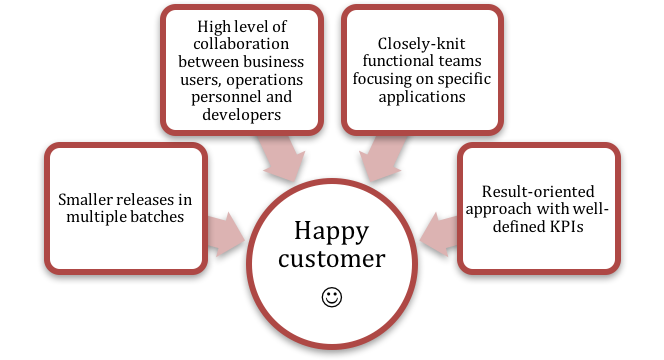
Traditionally, IT has oriented towards using the waterfall model, which takes a lot of time and involves large sized batches. Also, the updates are expensive and disruptive. Operations allows developers only a limited window in a year to release software. DevOps on the other hand has a different point of view. It understands that large batch sizes can be complex, risky and hard to coordinate. Small batches are comparatively simpler and easy to understand and test rigorously. The impact is minimal when something goes wrong and can be easily fixed. The organizations are able to come up with new releases frequently and become more responsive to the customer.
Dedicated cells
As we know, there are skill centric silos in traditional IT methodologies. A new feature has to go through at least 3 to 4 silos before a customer receives it. The feature has to spend 80% of the time waiting and shuttling between silos. DevOps teams, on the other hand, are arranged in cells that contain dedicated functional teams, and focus on one application. These cells are self-sufficient as they contain developers, testers, business analysts and operators. The work can be moved from one stage to another without any hand-offs, promoting cross-training and focusing the team on the end goal rather than their individual work. The reduction in cycle time that is achieved by this method improves productivity and lowers the operating costs for the customers.
Better visibility
In traditional IT, developers handle the coding and then hand it over to operations department for implementation. DevOps has broken down these barriers to promote more effective collaboration across IT teams. This type of workflow helps in keeping projects moving and maintaining optimal performance goals. Everyone in the cell knows what others are doing and also why they are doing it. This would provide the teams with much needed visibility and help consistent delivery. This methodology also provides the ability to perform any last minute changes quickly and boost the overall quality and customer experience.
Use of metrics
Information rules within any team and better visibility across projects helps to monitor and track performance. Measurement of the performance of an application has been overlooked in the past sometimes, but DevOps aims to continue support throughout the program’s lifecycle. Teams can track KPIs such as number of visits per user per week, time spent, user growth rate, etc. The data from these attributes allow teams to make necessary changes to fully meet the client’s requirements, improving the overall experience.
DevOps is now pushing enterprises to rethink their development strategies and forcing them to build a more customer friendly environment. The mentioned benefits of DevOps allow teams to make critical decisions and send out deliverables faster than ever. DevOps is quickly making a name for itself in improving application development and boosting overall customer satisfaction.