
When customer service first came into existence, all major companies hired a room full of people whose only job was to answer calls and provide solutions to problems faced by customers while using a product or service. While customer service is still carried out via call centers, the process has improved drastically since the evolution of chatbots.
Chatbots have reduced the need for human intervention. Artificial intelligence and machine learning have accelerated the evolution of chatbots to blur the line between human and bot style of interaction. Chatbots are getting even better with emotional intelligence that helps personal assistants to have conversations that appeal to human emotions. With continuous development in technology, the evolution of chatbots is only making the chatbots more user-friendly and business-ready.
History of Chatbots
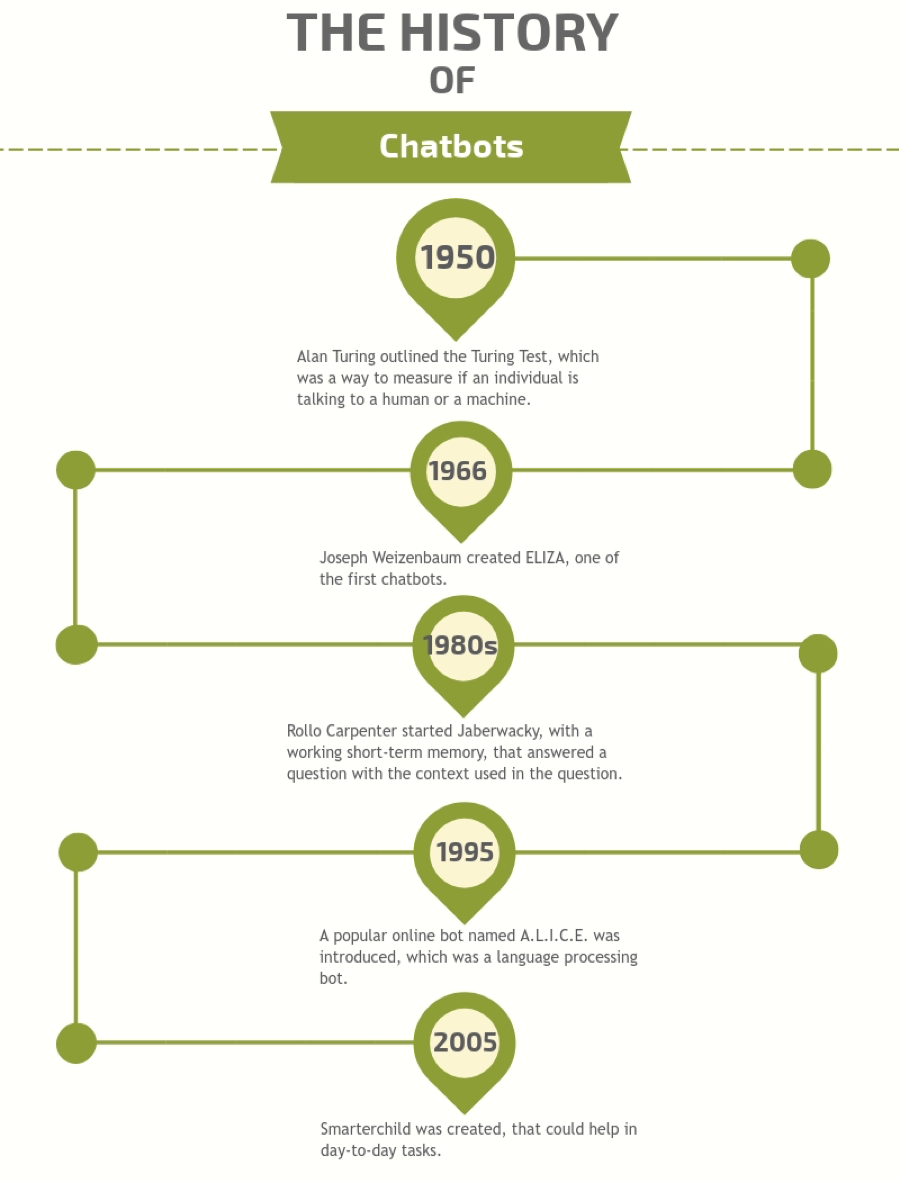
- In 1950, Alan Turing, a renowned English scientist, published an article, “Computer Machines and Intelligence.” In the article, Turing asked a vital question that laid the foundation for developments in the field of artificial intelligence -“Can machines think?” He outlined the Turing test that gauged if an individual in conversation with a machine could find out that they’re talking to a machine or another human. The Turing test was the first step in the development of artificial intelligence and the evolution of chatbots.
- In 1966, Joseph Weizenbaum created ELIZA, one of the first chatbots. Despite failing the Turing test, ELIZA did help in creating the schema of chatbots that worked around keywords, specific phrases, and pre-programmed responses.
- Around the 1980s, a British programmer, Rollo Carpenter, started developing Jabberwacky with the sole purpose of passing the Turing test. He used the concept of a short-term working memory that answered a user’s query, strictly keeping in mind the context provided in the question. For example, if a user said, “I love my country,” then Jabberwacky would reply with, “I love my country too. Tell me more about this!” Jabberwacky was more efficient in imitating human interaction compared to its predecessors.
- A popular online bot named A.L.I.C.E. was introduced in 1995. A.L.I.C.E was a language processing bot. Even though A.L.I.C.E. was unable to pass the Turing test, it was considered the most advanced bot at the time.
- Smarterchild was released on AOL Instant Messenger and MSN Messenger in 2001. The developers of Smarterchild created a chatbot that could help with the day-to-day tasks. The developers fed Smarterchild with information like movie times, sports scores, stock prices, news, and weather. Smarterchild was capable of displaying weather information, movie timings, and much more. In many ways, Smarterchild was a precursor to Siri and S Voice and served as a milestone in the evolution of chatbots.
Chatbots in the present day
Today chatbots like Google Assistant, Siri, and Cortana are programmed to help us get directions while driving, book movie tickets, book a cab, reserve a table at our favorite restaurant and do just so much more for us, in our day-to-day life. Today’s advanced chatbots can imitate human conversations, crack jokes, and sing songs for us. Alexa and Google Home are IoT applications of chatbots that combine with hardware like Bluetooth speakers and the Internet to go an extra mile to add convenience and comfort to our lives.
Chatbots are used for conversational commerce on social media marketplaces like Facebook, Amazon, and WeChat to provide 24×7 customer support, guide customers on products and services for sale, and increase the traffic on the page. It is the evolution of chatbots that has made social media experience so personalized for every user.
One of the most common applications of chatbots is to provide customer support. Chatbots can help customers have their queries answered in real-time while saving only the more complex queries for customer service representatives to answer. Chatbots have, therefore, significantly brought down the expenditure on maintaining a large base of customer services representatives and has also improved the workforce efficiency by sharing the workload to service customers.
Then there are chatbots like Hipmunk, Mezi, Snaptravel, HelloGbyte, and Pana help users plan their trips, book hotels, and build personalized itineraries. There are various novelty chatbots too. Nadia is a chatbot that provides disabled people with access to the National Disability Insurance Schemes, and Lara is a virtual dating coach chatbot.
Problems with present-day chatbots
Chatbots are used extensively to provide a better user experience and reduce human intervention. But, every chatbot faces multiple issues at present. Some of the commonly faced issues with chatbots are:
Lack of emotional intelligence
The number of chatbots that are used on commercial and social platforms is huge. According to VentureBeat, Facebook alone has over 100,000 chatbots on their platform, which means that the criteria for the quality of new chatbots is pretty low. Ever since Facebook announced that their messenger platform is allowing chatbots, developers rushed to create a large number of chatbots in a short amount of time. Hence, some of the chatbots on Facebook messenger are relatively new and not developed enough to function efficiently. The natural language processing technology used with the new chatbots do not possess the emotional intelligence to hold a conversationco or respond in accordance with the context of the conversation.
No monetization model
At present, a business model for paying the developers of the chatbots, on popular platforms such as Facebook Messenger, does not exist. Multiple brands use chatbots that require an immense amount of time and effort, without figuring out a standard model for paying their developers. Currently, the developers can get paid only if they develop chatbots for third parties.
Cross-platform integration
The reason for the existence of thousands of different chatbots is that chatbots are not platform independent. A chatbot created for one platform cannot be used on another platform. For example, a chatbot created for Facebook cannot be used on WeChat, Amazon, or any other platform.
Fixing all these problems should be one of the major concerns in the evolution of chatbots. In the future, we might have more advanced natural language processing technology, with better cross-platform integration, and a business model that can help in paying the developers appropriately.
Future of chatbots
With new developments in technology, machine learning and artificial intelligence can be used efficiently to become an industry leader. Emotional intelligence helps imitate human conversations and is one of the major concepts involved in the future evolution of chatbots.
AI and chatbots
Google developed an AI called AlphaGo Zero that defeated a world champion of the ancient Chinese game, Go. Moreover, the paper published by Google DeepMind regarding AlphaGo Zero shows that the AI system was created without using any data from the human games, and still, it was stronger than any of the previous versions. The example of AlphaGo Zero shows that the requirement of data would be less critical, and finding use cases where the AI system would improve itself would be more significant. According to Finance Digest, AI will handle 95% of the customer interactions by 2025, which will free up the need for human interaction. Such advanced AI technology would create a self-learning system for chatbots, where chatbots can learn to respond without any scripts for every instance of a conversation.
Voice recognition and chatbots
Big players such as Amazon and Google have started pushing out smart speakers that have the ability to recognize speech and respond effectively. Such a trend will carry on in the future, where typing to chatbots would be obsolete, and chatbots can hold conversations in the form of audio. Hence, the newer generation of chatbots would be so advanced, that they could recognize math queries like, “Ten multiplied by fifteen, plus twenty-five” in speech, and answer correctly.
Blockchain and chatbots
Since 2017, cryptocurrencies like Bitcoin and Etherium, are creating headlines in every major news portal. Multiple organizations and governments are already experimenting with the blockchain technology by building their own crypto-tokens. And, many companies have the intentions to integrate their crypto-tokens into the chatbots, to create their own virtual economy. The rapid growth of blockchain technology will revolutionize the landscape of chatbots, and chatbot developers would use cryptocurrencies to strengthen their value proposition.
From a thought experiment to booking our movie tickets and cabs, the evolution of chatbots has come a long way. But, there are multiple possibilities waiting to be unlocked still! With other advanced technologies such as artificial intelligence, machine learning, blockchain and many more, the development of chatbots has skyrocketed. Chatbots are getting more sophisticated and functional with time. Hence, no organization in any sector should dismiss chatbots as a passing trend; they must think of ways to leverage it instead.