

Organizations are increasingly utilizing the power of AI with the aim to automate their business processes, enhance organizational productivity, and stay relevant in a competitive landscape. The growing popularity and benefits of AI adoption have been shaking the new-age CIOs, making their job more demanding than ever before. Deciding to implement AI is easy, but successfully deploying AI isn’t. Therefore, to initiate a successful journey with AI and to reap its benefits fully, CIOs should consider the following factors before investing in AI:
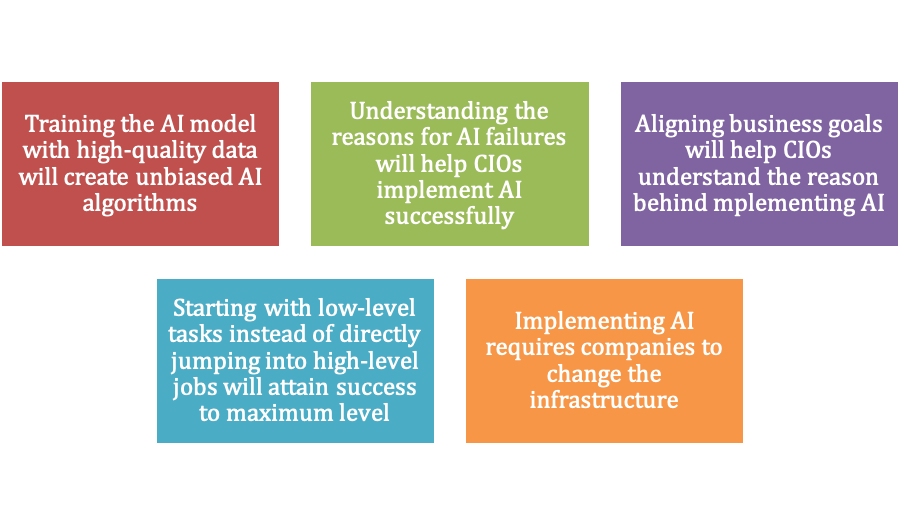
1. Training the AI model
One of the biggest myths about AI is that the technology almost always provides the correct output. The reality, however, is that the effectiveness of AI applications depends on the data used for training. Higher the quality of the training data, better the performance of AI, and vice-versa. Hence, it is necessary that CIOs collect high-quality and unbiased data to train AI in their organization.
2. Understanding the reasons for AI failure
For the technology to give productive outcomes, CIOs should carefully analyze the reasons for AI failure. There may be several possible reasons, including the inadequacy of high-quality training data, lack of expertise, and the inability to meet business goals. CIOs should interpret the reasons well and work jointly with other industry peers to find appropriate solutions to these problems.
3. Aligning business goals
The next important factor that CIOs should pay heed to, before adopting AI, is defining aligning their organizational goals with the objectives for implementing AI. CIOs should work in collaboration with other departmental and organizational heads to:
- examine tasks that need optimization,
- gauge current financial resources, and
- analyze market trends.
4. Starting with low-level tasks
CIOs should understand that ‘starting slow’ is the key for successful implementation of AI. CIOs should first replace all the tedious, mundane, and repetitive manual tasks with AI. For example, using robotic process automation will help companies automate their one of the most time-consuming tasks such as data entry. Immediately adopting AI for making critical decisions is not a good option. Instead, CIOs should experiment with various relevant business use cases and learn slowly before making AI their top-most priority.
5. Changing the infrastructure
CIOs should understand that adopting AI needs a different infrastructure altogether. The ever-growing volume of data and its storage, the use of sophisticated analytical tools, and the need for networking demand a different type of infrastructural for AI at work. AI-defined infrastructure will:
- incorporate resources that are necessary for AI adoption,
- support the ever-increasing data, and
- adjust itself to the self-learning environment
CIOs should understand that AI cannot address all the existing problems that their business faces. The success of the technology depends on how the organization prepares, scales, and applies it. For becoming a winner in the ‘technological space,’ CIOs should have in-depth knowledge of the technology and should learn ‘how’ to fill in the missing gaps.