
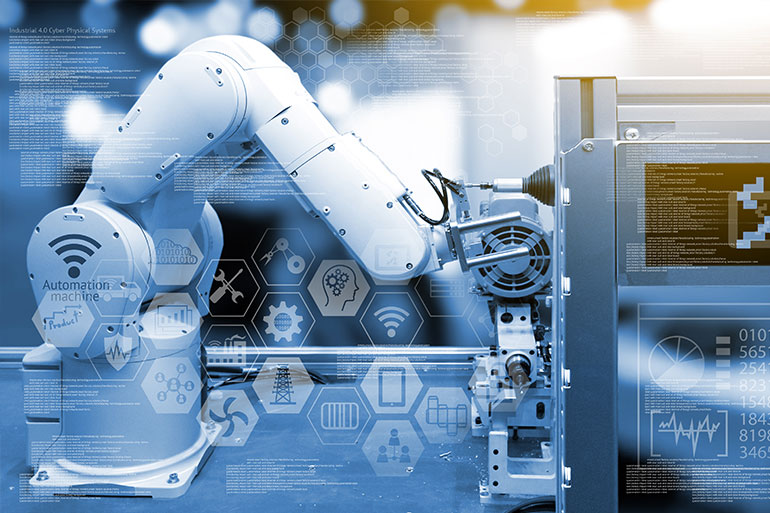
Robotic Process Automation (RPA) is the application of technology that facilitates employees in an organization to configure computer software or a “robot” for capturing and interpreting existing applications for processing a transaction, triggering responses, manipulating data, and communicating with other digital systems.
For any company that uses labor on a large scale for data processing work, where people are performing high-volume, highly transactional process functions, Robotic Process Automation can boost capabilities, save money, and time. RPA “robots” are revolutionizing the way companies think about and administer business processes, workflow processes, IT support processes, remote infrastructure, and back-office work. RPA facilitates dramatic improvements in accuracy and cycle time and thereby, helps in increasing productivity in transaction processing.
Applications of RPA technology
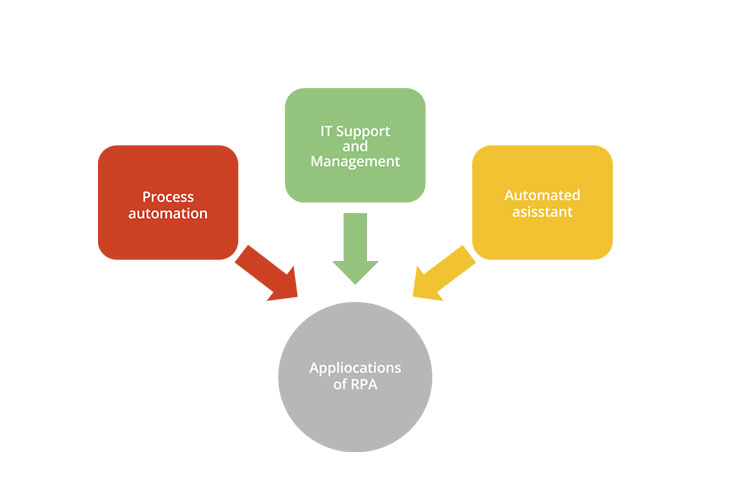
Process Automation
Technologies like presentation-layer automation software mimic the steps of a rules-based, non-subjective process without having to compromise on the existing IT architecture. These technologies are able to consistently carry out prescribed functions and easily scale up or down to meet changing demands. Thus, with RPA, process automation can expedite back-office tasks in finance, supply chain management, procurement, accounting, customer service, and human resources.
IT Support and Management
Use of RPA in in the remote management of IT infrastructures can consistently investigate and solve problems for faster process throughput. RPA can also help in improving service desk operations and the monitoring of network devices. Moreover, it helps in separating scalability from human resources thereby, allowing a company to handle short-term demand without extra recruiting or training.
Automated Assistant
By implementing machine learning, voice recognition software or automated online assistants, RPA can provide answers to employees or customers in natural language instead of providing a software code. This technology can help in conserving resources for large call centers and for customer interaction centers.
Benefits of Robotic Process Automation
Accuracy and Quality
Robotic Process Automation is highly suitable for processes with greater human error rate. It helps in avoiding re-work. As robots will follow the rules, they would produce 100% accuracy, and thus, your process output quality would improve drastically.
Cycle Time and Cash Flow
Depending on technology and the underlying IT environment, RPA can help in performing work significantly faster than humans. Reduction in your processing can reach up to 90%. But, this factor depends a lot on the latency of your underlying applications.
Better Customer Experience and Increased Revenue
As RPA facilitates shorter cycle times and increased quality lead, this leads to improved customer experience. Thus, RPA helps in generating more sales from existing satisfied customers.
RPA is an emerging technology that adds impetus to business innovation and profitability. It enables organizations to deploy software robots that can easily automate manual and repetitive tasks at a fraction of the cost of their human equivalent. Early adopters of RPA technology can experience transformative efficiency gains, deliver superior customer service, and develop more intelligence around their process.