
 There is enough evidence pointing towards a future run on IoT. Implemented the right way, the potential benefits from enterprise IoT are numerous. These could further be amplified with timely execution. As the IoT movement is gaining pace, the onus is on technology leaders and CIOs to steer their organizations towards an IoT era. This requires CIOs to adapt to the trend and enable their organizations to do the same. Although adopting IoT involves inputs from the entire management team, the CIO has a significant and influential role to play here.
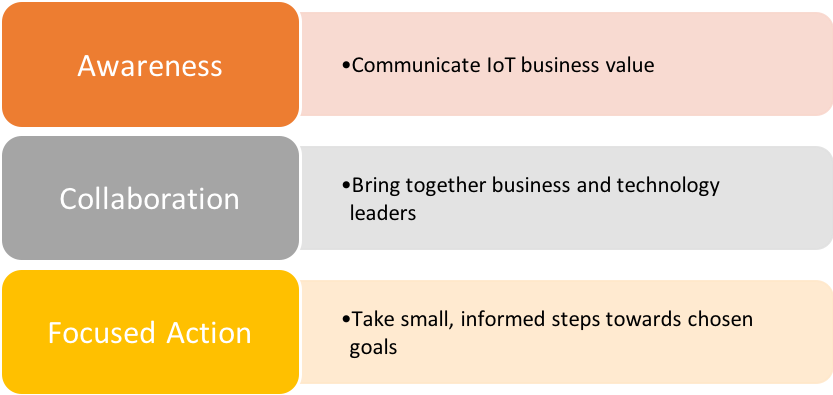
Communicating the business value of IoT
The primary role of a CIO is to learn, understand, and communicate the business value of implementing enterprise IoT. Besides, it’s helpful to research and cite the impact of IoT on organizations across different industries, and making sure that everyone in the organization understands and buys into the IoT movement.
The disruptive nature of IoT entails a high degree of change at all levels of the organization. It is, therefore, quite natural to face resistance to change within different departments of the organization. Therefore, it is incumbent on the CIO to create a clear IoT vision and a plan to achieve it. The CIO’s vision will go a long way in boosting the confidence of the rest of the organization.
Collaborating to create use cases
IoT integration should not be seen merely as an IT endeavor, but as a comprehensive redesign of the entire business process. This requires participation of members serving different functions in the organization, be it business or technological, or any other. The CIO should ensure that all members of the organization view IoT as a collective venture. Each member can then contribute her expertise to expedite the incorporation of enterprise IoT. The CIO should oversee the collaborative problem-solving meetings, involving leaders and experts to formulate different use cases. A use case will define the interaction between the users and the IoT systems. The most relevant use cases can then be further discussed, and the development of capabilities corresponding to those can be prioritized.
Focusing on relevant IoT elements
A complete overhaul of the entire business model, though possible, is not always feasible and will be accompanied by heavy opportunity costs. Total absorption of IoT into the business will entail dealing with a multitude of intricacies. This requires an extensive and ever-evolving knowledge base on relevant IoT subjects. To avoid being overwhelmed by the complexity of IoT, the initial focus should be on the capabilities and benefits of IoT that congruously align with the strategic goals of the organization. Thus, it is important for CIOs to ensure that the scope for initial stages of implementation is manageable, small, and relevant to the target KPIs. Planning and executing pilot projects that minimize risk and ensure a smooth transition can help achieve this.
Keeping up with the global trend of IoT incorporation, while simultaneously maintaining critical business operations, can be very challenging. In the absence of circumspect action, failure of IoT implementation is possible. The focus should be on steady progress instead of instantaneous disruption. Hence, CIOs should focus on implementing change in small cycles of analysis, planning, execution, and review to progressively bring the business on to the IoT platform. It is highly advisable during this period to employ experts, with knowledge and experience in the field of IoT, to ensure a seamless and successful IoT implementation at the enterprise level.