

Big data and its analysis have laid down an array of benefits for different types of organizations. However, the complexity involved in big data, especially w.r.t. volume and veracity, only keeps on increasing. Therefore, in order to extract maximum value from big data at timely intervals, companies must have a solid strategy, which among other critical factors encompasses data biases as well.
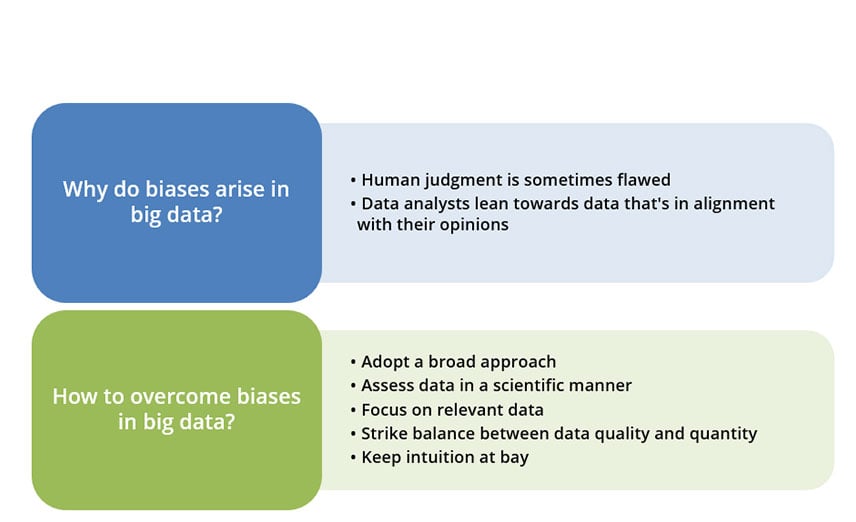
Why do biases arise in big data?
Organizations have a lot to gain from big data, provided they know how to extract valuable insights and drive decisions from them. Very often, enterprises seem to forget that humans, in this case, data analysts and data scientists, are responsible for the collection, organization, and analysis of data. While data sets and tools may be precise in their findings, data scientists and analysts may be not. Human minds are impressionable and their perceptions and beliefs are different. Therefore, organizations need to be open to the fact that the data presented to them by their data team can be biased. These biases arise when data analysts rely on past experiences or give importance to data that is in alignment with their thoughts and opinions. A few common and hidden biases like confirmation bias, availability bias, selection bias, and Simpson’s paradox are most likely to have an unintentional influence on data mining. This, in turn, leads to the development of inaccurate judgments that affect business outcomes and hinder organizational growth.
How to overcome biases in big data?
Data bias harms an organization’s outcome, especially in terms of revenue, and leads to unprecedented challenges. Data analysts and scientists must first keep their assumptions at bay and then carry out the task ahead of them.
Adopt a broad approach
To overcome biases in big data, data analysts must consciously strive to be impartial. In this context, the word impartial emphasizes on adopting a broad approach. Analysts must keep aside their personal and emotional views at bay and look at the data in a scientific and objective manner. If they set to explore and analyze data, while they already have an established conclusion in mind, they will not be able to extract valuable insight from it.
Focus on relevant data
While it is important to assess a lot of data sources, it is equally important to focus on data that is relevant to your goals and problems. Getting distracted by irrelevant data will just add to the confusion and magnitude of the process.
Concentrate on quality
One of the 3 V’s of big data is volume; therefore, it is very easy to drown in the mounds of information available. However, it is important to not get swayed by numbers and strike the perfect balance between the various facets of quantity and quality of the data available. Instead of focusing on overall data trends, big data analysts must try and make sense of the factors that have the potential to affect data.
Organizations must remember that data is as valuable as the people who are deployed to assess it. That is why importance must be given to professionals who are equipped with the right kind of talent and skills – those who do not make assumptions based on their personal beliefs and intuition, but trust the data to steer them to make the right decisions.

