


Whether you’re a traveler discovering new places, a foodie in search of new restaurants, or a newbie in town who’s navigating her way to office, digital maps are tailored in a way to meet the modern day requirements that go way beyond plotting distances: as the process of technological development is continuous, digital maps can do more than routing today. From weather predictions to traffic conditions, digital map technologies have a lot of other data and assistance to offer!
What are digital maps?
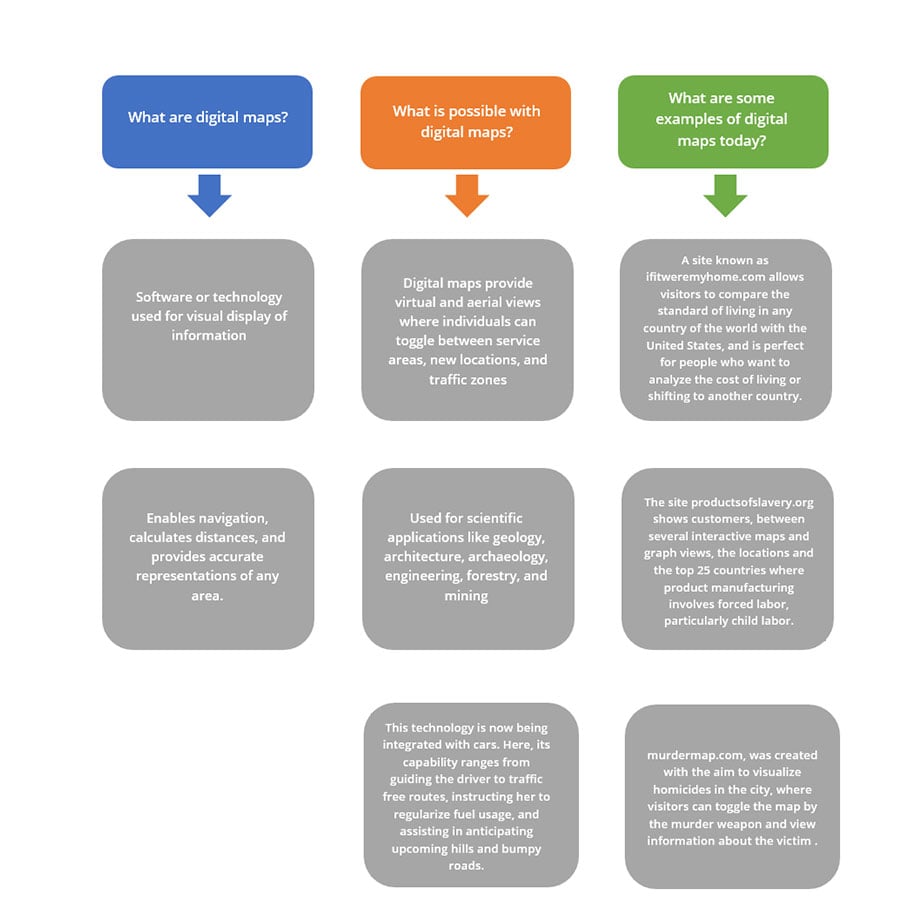
A digital map is software or technology used for visual display of information, and can be accessed from a cell phone, tablet, or a GPS system. The primary function of digital maps is to enable navigation, calculate distances, and provide accurate representations of any area. It is an effective tool, which is easily customizable and can be accessed by almost anyone.
What is possible with digital maps?
Earlier, digital maps had the same functionality as paper maps, providing only a virtual view of roads and places. However, in the past decade, the usability of digital maps has grown. Maps today facilitate a hybrid combination of virtual views and aerial views where individuals can toggle between service areas, new locations, and traffic zones.
Apart from navigation, digital maps are now used for scientific applications like geology, architecture, archaeology, engineering, forestry, and mining as well. Furthermore, this technology is now being integrated with cars. Here, its capability ranges from guiding the driver to traffic free routes, instructing her to regularize fuel usage, and assisting in anticipating upcoming hills and bumpy roads. Future possibilities include the use of digital maps for addressing infrastructure issues, to the installation of the technology in self-automated cars like BMW and Audi for access to high level and fast-paced information. A billion-dollar industry, digital maps today, benefits individuals, businesses, and governments tremendously.
What are some examples of digital maps today?
We live in a world that is constantly going online. Customers want to be updated regularly with new and upcoming technologies in all spheres. In the 21st century, the functionality of digital maps has become even more diverse. Around the world, a few innovative online maps have become popular with the people for the unique services they have got to offer. Shared below is a brief description of some such popular and unique digital maps.
- A site known as ifitweremyhome.com allows visitors to compare the standard of living in any country of the world with the United States, and is perfect for people who want to analyze the cost of living or shifting to another country. Along with showing a scale image of each country, it provides several statistics like staple diets, family patters, and usual jobs.
- There was a time when people were unaware of where their branded products came from. Today, customers can’t be satisfied with quality products alone. They believe in making choices that are not just economically but also ethically right. Socially and environmentally aware and sensitive customers, today, are against child labor, deforestation, and simply anything that involves destroying innocent lives for material purposes. The site productsofslavery.org shows customers, between several interactive maps and graph views, the locations and the top 25 countries where product manufacturing involves forced labor, particularly child labor.
- A London-based comprehensive dataset on homicides in London, murdermap.com, was created with the aim to visualize homicides in the city, where visitors can toggle the map by the murder weapon and view information about the victim.
The future of digital maps seems even more exciting. Applications will explore possibilities ahead of what’s already been achieved. They will continue to get more accurate and comprehensive. The way we navigate and interact with the world is about to change.