
Due to their integrity, blockchain is being used in highly complex applications for the purpose of information governance. They not only secure the involved data, but are also self-validating. This has cemented their proliferation across various industries. However, data scientists need to adopt different governance styles, and ways to enforce them, in different ecosystems.
Information governance styles with blockchain
- Permissionless blockchain governance style
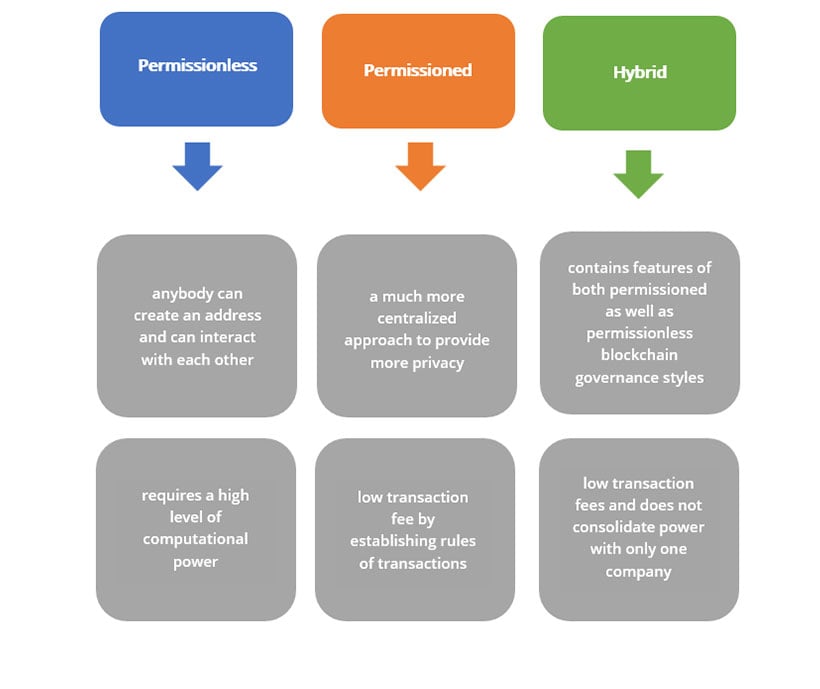
In the permissionless blockchain governance style, anybody can create an address and can interact with each other. It is decentralized and can be accessed by anyone over the Internet. An example of permissionless blockchain is the Bitcoin that created trust in the otherwise risky online financial transaction space. It assured privacy by collecting the cryptographic proof in exchange for a small transaction fee that helped build trust amongst its users.
The challenge with this form of governance is that creating a high level of trust also requires a high level of computational power. For individual transaction and verification purposes, the energy spent is less and can be adjusted with a small transaction fee that an individual pays. But if an agglomeration of organizations from one country wants to use blockchain for verification of an organization situated in some other country, then the transaction fee sums up to millions. Thus permissionless blockchain governance style needs to be improved when handling big transactions.
- Permissioned blockchain governance style
Permissioned blockchain governance style, on the other hand, adopts a much more centralized approach when compared with its permissionless counterpart. It provides more privacy, as every participant’s role and access are uniquely identified. Permissioned blockchains also reduce the transaction fee cost by establishing rules of transactions between different organizations. Companies like Ripple offer real-time payment options, which have drastically reduced transaction fees, thereby encouraging companies to adopt its services.
- Hybrid blockchain governance style
A hybrid blockchain governance style contains features of both permissioned as well as permissionless blockchain governance styles. It offers low transaction fees and does not consolidate power with only one company like in the case of permissioned blockchain governance style. Unlike the permissionless governance style, it does not allow every person on the web to participate in the transaction process. Companies like IBM and Multichain have adopted this style, which allows them to serve a wider base by allowing and restricting participants as per their needs.
As all the three governance styles mentioned above have unique characteristics, and offer exclusive solutions under distinct circumstances, every business has the option to go for a governance style that suits them best.