


Thus, many organizations are resorting to application consolidation. In our previous blog, we spoke about different ways to consolidate your applications. Out of those steps, application rationalizations provide huge scope for transformation. Applications rationalization helps enterprises fully understand their applications portfolio and help in creating an appropriate consolidation strategy.
Following are the 5 steps for a successful rationalization initiative:
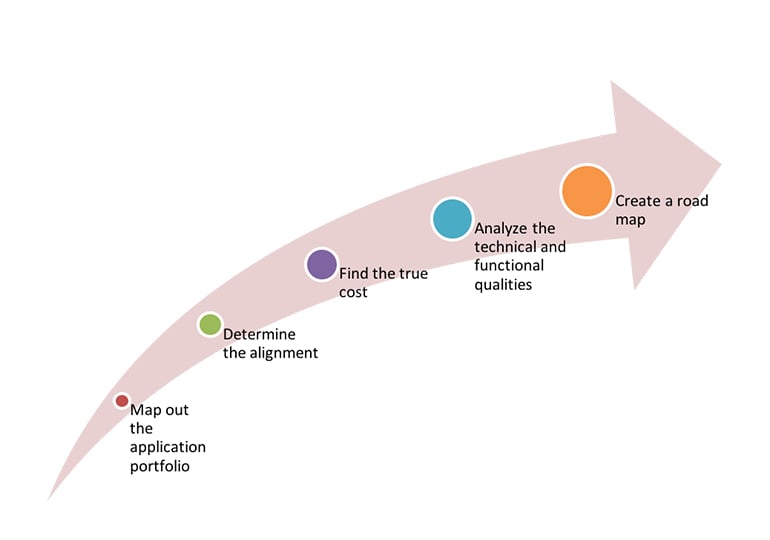
1. Map out the applications portfolio
In this step, you have to gather data from all the departments in your organization. Using this data you must build a complete, accurate, and well- defined inventory of applications. This inventory must include IT owners for each application.
2. Determine the alignment
In this step, you must map each application in your organization’s portfolio to business processes and to locations of its use. This kind of mapping will help you in exposing redundancies and show the potential opportunities for consolidation.
3. Find the true cost
In this step, you must determine what the cost of each application in the portfolio is. While finding the true cost you must cover all the aspects like infrastructure and operation cost, licensing cost, licensed software support, direct application support, applications break/fix support and other enhancements that are required. After this, you must break down the application costs by the business functions they support. This will help you to understand how much of the overall applications budget is supporting HR, manufacturing, etc.
4. Analyze the technical and functional qualities
In this step, you must determine the business value of your application rationalization initiative by combining the functional and technical quality of each application. Firstly, you must survey the functional quality of each application; how efficiently is each of the application fulfilling the business requirements, criticality of the application to business processes and its integration with other application platforms. Secondly, you must survey the technical support staff to determine how well the application meets the required technical standards. This will help you in discovering the scope for change.
5. Create a road map
This is the last step, in which you must chalk out a final plan to consolidate and simplify your application portfolio. This plan must focus on reducing redundancies, improving effectiveness, and saving on support costs. Also, you must pay attention to improving the functional and technical qualities of an application and filling the gaps. This map must be a road map that will lead you towards the desired state of consolidation. By following this road map, your organizations should be able to reduce its number of applications as well as the total inventory of infrastructure and management resources.
Application rationalization is defined as the radical reshuffling of an application portfolio to minimize application bloating and achieve a business outcome. If it is done in a correct way, your application rationalization initiative can be successful bring powerful business benefits and increased agility to your business.