For the modern government procurement professional, the RFP queue looks very different now. Tucked between solicitations for IT hardware and consulting services are proposals shimmering with the language of science fiction: large language models, neural networks, transformer architecture, generative pre-training. Vendors promise to transform everything from constituent services to policy analysis with generative AI, and evaluating AI vendors has quietly become one of the hardest jobs in the contracting office.
That influx is a real challenge. As a procurement officer, you are the steward of public funds and a guardian of public trust. Your expertise is in navigating regulations, assessing risk, and ensuring value for the taxpayer. Yet you are now asked to procure a technology that is famously opaque, a “black box” that learns, evolves, and can be confidently wrong. How do you write a statement of work for a system whose outputs are probabilistic, not deterministic? How do you ensure fairness when the training data is a closely guarded secret?
The feeling can be professional vertigo. The fear isn’t just a failed IT project, but deploying a system that erodes trust, introduces bias, or compromises sensitive citizen data. That fear is well founded, which is why building public trust in government AI has to be treated as a procurement requirement rather than a communications exercise after launch.
The answer isn’t for every procurement officer to earn a Ph.D. in machine learning. It is to equip them with a new toolkit, an AI procurement compass built on practical evaluation frameworks, targeted non-technical questions, and shared knowledge across agencies. The ground has also shifted in buyers’ favor: OMB’s M-25-22 now governs federal AI acquisition and puts interoperability and anti-lock-in at the center of the rules, while the NIST AI Risk Management Framework gives buyers a common vocabulary for the risks below.
Why Evaluating AI Vendors Is Unlike Any Other IT Acquisition
Before building the compass, understand the terrain. Adapting old software-acquisition models to AI is like using a road map to navigate the open ocean. Here is why AI is different.
- Probabilistic, not deterministic. Traditional software is predictable: input “A,” always get “B.” A generative AI system is probabilistic. Ask it to summarize a document and you may get a slightly different, still valid, summary each time. That makes performance requirements and acceptance testing far more complex. You can’t just check a box; you evaluate quality and reliability within a range of acceptable outcomes.
- Data is the engine. A generative model isn’t just code; it is code plus the vast datasets it was trained on. That raises questions standard software never did:
- Provenance. Where did the training data come from? Does it include copyrighted material or reflect societal bias?
- Privacy. How will your agency’s data be used? Will it be absorbed into the vendor’s core model to serve other clients? That is a serious data-sovereignty and security risk.
- The hallucination risk. Generative models are built to produce plausible text, not to be factually accurate. They can invent sources, fabricate statistics, and state falsehoods with total confidence. For a government agency, a source of truth for the public, deploying a hallucination-prone system without safeguards is a catastrophic liability.
- The constantly evolving product. The model you test in June may be updated in August, changing its behavior, performance, and risk profile. Contracts must account for that, ensuring updates don’t degrade performance or introduce new vulnerabilities.
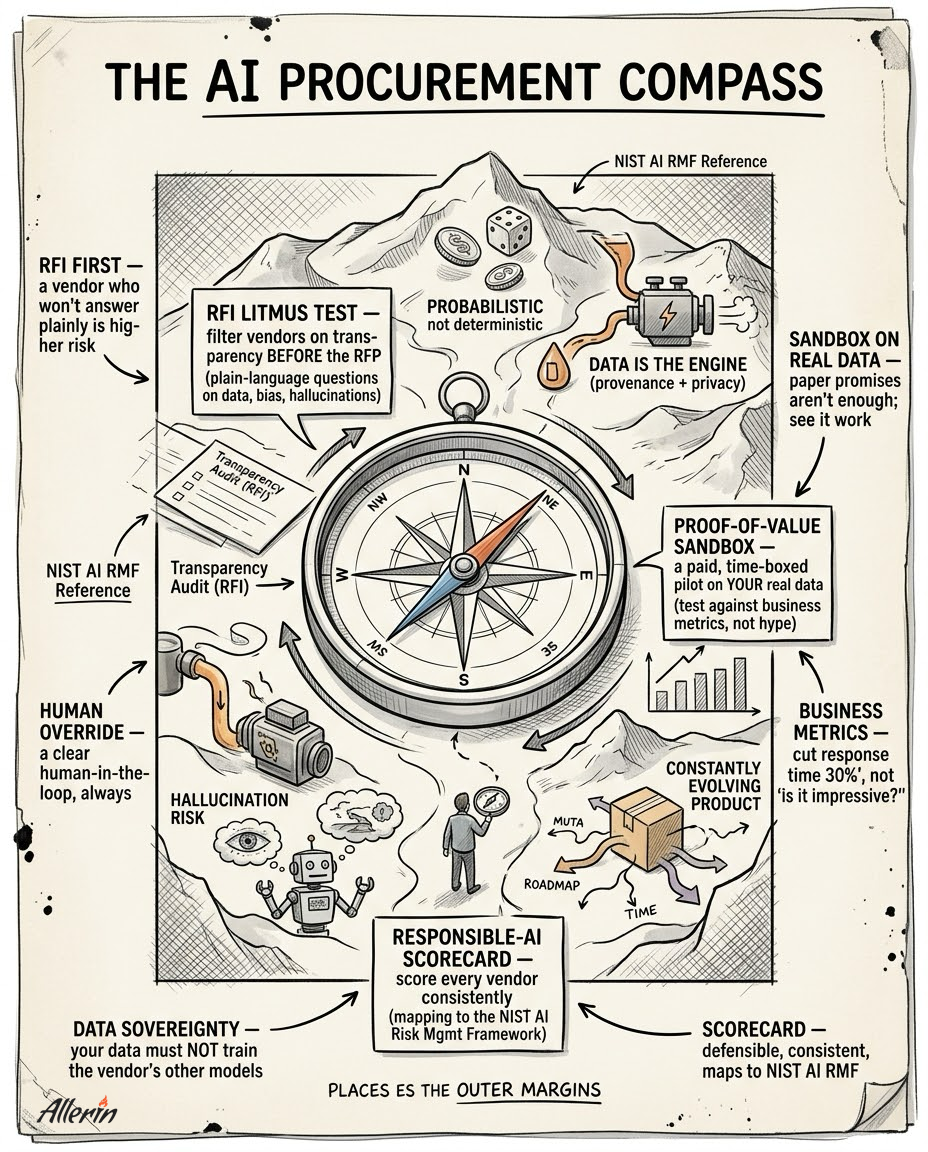
The AI Procurement Compass: A Three-Part Evaluation Framework
Procurement professionals need a structured framework for evaluating AI vendors, one that translates complex technical traits into the familiar domains of risk, performance, and compliance. The compass has three parts.
Part 1: The “Request for Information” litmus test
Before a formal RFP, use a targeted RFI to filter for vendor maturity and transparency. These questions should be answerable in plain language, testing a vendor’s commitment to responsible AI, not just technical prowess.
- Data governance. Describe, in non-technical terms, your data-handling policies. How will our data be segregated? Will it train or fine-tune models for other customers? Provide your data-privacy policy.
- Bias mitigation. What specific steps do you take to identify and mitigate algorithmic bias (racial, gender, geographic)? Share your methodology and any third-party audits. The regulatory fight over government facial recognition shows what happens to a deployment when that testing is skipped and the bias only surfaces in public.
- Transparency and explainability. When your AI gives a recommendation or summary, what tools let a human understand the sources and logic behind it?
- Handling inaccuracy. How do you measure and minimize hallucinations or factual errors? How can users flag errors, and what is the correction process?
A vendor who can’t or won’t answer these clearly is revealing a lack of maturity, and should be treated as higher risk.
Part 2: The proof-of-value sandbox
Paper promises aren’t enough. The best way to evaluate an AI solution is to see it work on your data and use cases. The RFP should require a paid, time-boxed pilot, a “sandbox,” as a prerequisite for a full contract. Federal buyers have a head start here: GSA’s USAi platform, launched in 2025, is a shared environment for safely evaluating generative-AI tools.
Define business-centric metrics. The question isn’t “Is the AI impressive?” but “Does it solve our problem?” Tie success to clear outcomes, for example:
- Reduce average public-inquiry response time by 30% while holding a 95% citizen-satisfaction score.
- Correctly route 98% of incoming digital correspondence to the right department.
- Generate draft summaries of regulatory documents that need 50% less editing time from human analysts.
Test with real scenarios. Give the vendor a representative, anonymized dataset and real tasks. This lets you evaluate performance, spot bias, and assess the user experience before a full deployment. The sample you hand over has to be sound first, so run the seven data health checks for government teams before the pilot starts, or you will end up grading the vendor on problems your own records created.
Part 3: The responsible-AI scorecard
Use a standardized scorecard so that evaluating AI vendors stays consistent across the RFI, sandbox, and RFP stages. It creates a defensible, transparent decision, and the domains below map cleanly to the NIST AI Risk Management Framework.
| Evaluation domain | Key questions for a vendor |
|---|---|
| Transparency and explainability | Can they trace outputs back to source data? Is the decision process auditable? |
| Data privacy and security | Is our data encrypted at rest and in transit? Does the solution have FedRAMP or equivalent authorization? |
| Fairness and bias | Do they run regular bias testing? Are there mechanisms to address issues found? |
| Performance and reliability | What are the contractual guarantees for accuracy and uptime? How are factual errors measured and minimized? |
| Governance and human oversight | Is there a clear human-in-the-loop workflow? Can a human easily override the AI? |
Forging the Shield: Community Knowledge and Contractual Safeguards
No agency should navigate this frontier alone, and increasingly they don’t have to. Much of the shared infrastructure already exists.
Plug into the resources that already exist. The General Services Administration runs an AI Community of Practice, a cross-agency forum for procurement and IT professionals, and has published a Generative AI Acquisition Resource Guide with the questions contracting officers should ask. GSA has also launched USAi for shared AI evaluation and partnered with NIST to strengthen AI evaluation science in federal procurement. Rather than reinventing the wheel, buyers should:
- Exchange experiences with specific vendors and solutions through the AI Community of Practice.
- Use and contribute to shared libraries of pre-vetted RFP language, scorecard templates, and contract clauses.
- Learn from anonymized case studies of both successful and failed implementations.
State and local buyers can mirror the same model regionally, pooling knowledge instead of each agency starting from scratch.
Engineer smarter, AI-ready contracts. Codify your scorecard and sandbox findings into the contract. Work with legal counsel on clauses specific to AI risk:
- A non-negotiable clause that all agency-provided data, and all data generated from its use, remains the agency’s sole property and won’t be used to train any general model accessible to other customers.
- The right to audit the AI’s performance logs and decision trails, especially after an adverse outcome or public complaint.
- Defined metrics (accuracy on a set test, a maximum allowable hallucination rate) the system must meet, with financial penalties for failure.
- At least 90 days’ notice and re-validation results before a significant update to the core model is pushed to production, so the agency can test and approve the change. This aligns directly with M-25-22’s emphasis on tracking performance and avoiding lock-in.
From Gatekeeper to Strategic Enabler
The procurement office is the strategic center for managing risk and ensuring value in government, and in the age of AI that role matters more than ever. It is evolving from a compliance-focused gatekeeper into a strategic enabler of responsible innovation.
Confidence in evaluating AI vendors doesn’t come from understanding the internals of a neural network. It comes from a strong framework for asking the right questions, a practical method to test the answers, and a community to share the vigilance. With that compass, and the federal guidance and shared tooling now backing it, procurement professionals can confidently lead their agencies into the future, putting AI to work to build a more efficient, effective, and trustworthy government. Helping agencies build exactly that evaluation and governance capability is part of what we do at Allerin.
Sources: GSA: AI Community of Practice · GSA: Generative AI Acquisition Resource Guide (2024) · Akin Gump: OMB M-25-22 on driving efficient acquisition of AI in government · NIST: AI Risk Management Framework
Once a vendor is chosen, the controls around it still have to be yours. The AI Infrastructure & Governance Planning engagement sets them out in two to three weeks: control owners, one gateway with hard per-team budgets, guardrails, and per-action audit records.