Modern AI runs on integrated, high-quality data. Whether the goal is forecasting public health trends, optimizing transportation networks, or improving emergency response, the work depends on data that is clean, connected, and accessible. When that data is scattered, incompatible, or buried in legacy infrastructure, even the most promising AI initiative struggles to get off the ground.
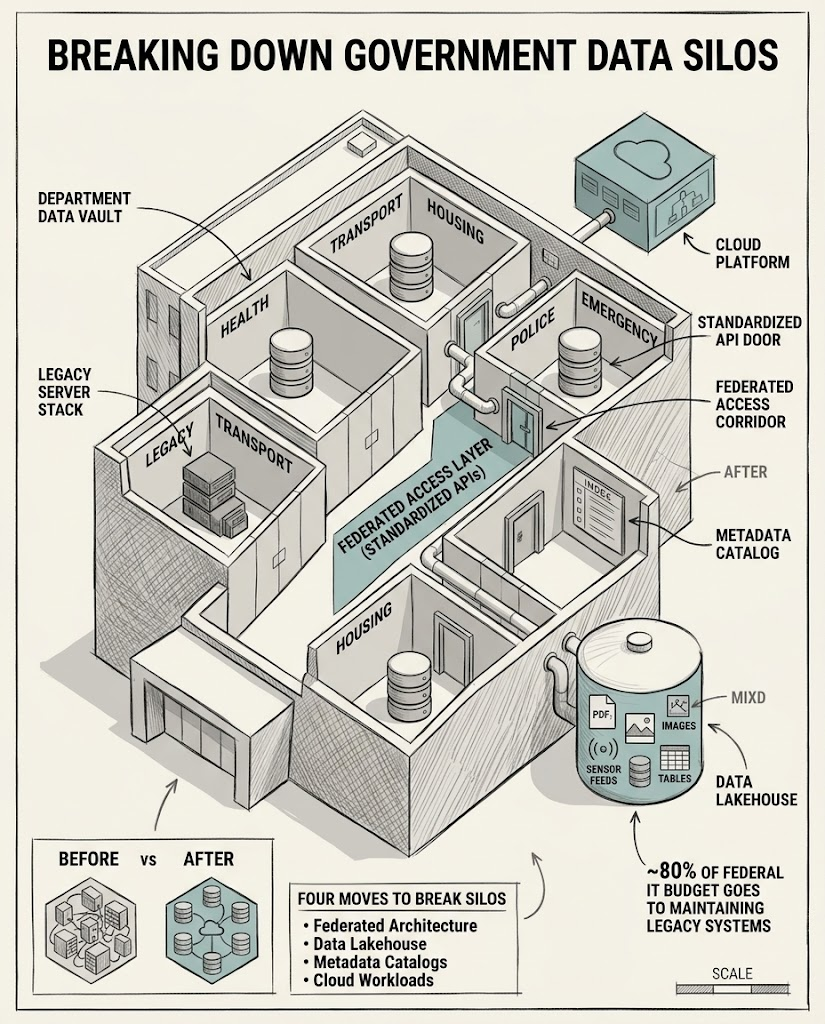
Federal agencies still spend close to 80% of their IT budget just operating and maintaining existing systems, much of it decades-old legacy infrastructure, according to the GAO. Those architectures dominate many federal and state environments, and they were built when the volume and velocity of data were far lower than what today’s applications demand.
The public sector is now expected to move faster, personalize services, and make smarter, more equitable choices, all while staying accountable and transparent. That is close to impossible when data stays locked in departmental silos inside legacy systems.
What Are Data Silos, and How Do They Affect Decision-Making?
Silos are isolated pools of data. They form when departments or agencies collect, store, and manage data independently, with little communication or integration across the rest of government. Whether the cause is a legacy IT system, departmental turf, or a plain lack of interoperability, these silos are a major obstacle to progress.
When data can’t flow between departments, no one sees the full picture. During Hurricane Ida, local government in Louisiana struggled to quickly identify which neighborhoods housed vulnerable populations. The federal FEMA housing program required extensive paperwork before a survivor could benefit, which delayed targeted outreach and led to inefficient resource deployment for the people who needed help most. That kind of bureaucracy gets worse when data is trapped in disconnected systems spread across departments and jurisdictions.
Integrated data creates a more responsive governance environment, and citizens experience the government as one system rather than many. At the simplest level, that means fewer forms to fill. With AI, you can go further and improve both the speed and the reach of services. AI can build a heatmap showing clusters of medically vulnerable individuals so agencies can coordinate ambulances, buses, or mobile clinics. It can re-route emergency supplies in real time as roads become impassable, cutting delivery delays and wasted effort.
AI can make responses smarter and faster, but only when systems can actually talk to each other. So how do you get there?
Three Main Barriers to Data Integration in Government
Legacy infrastructure. Outdated systems built for lower data volumes consume most of the budget and can’t meet the speed or scale that modern AI demands.
Lack of interoperability. Incompatible systems that don’t communicate keep data from flowing across agencies.
Independent data management. Without shared standards and access protocols, collaboration stalls and critical decisions get delayed.
Practical Strategies to Break Down Silos
Breaking down silos doesn’t mean starting from scratch or centralizing everything overnight. For most public agencies, the smarter path is to modernize step by step, making existing systems more discoverable, interoperable, and scalable. Here are practical, architecture-aligned moves agencies can make now to set up useful AI later.
1. Prioritize federated data architecture over full integration.
Connecting every system across every agency is a logistical and political nightmare. A more workable option is federated architecture, where each agency keeps control of its data but makes it accessible through standardized APIs and governance protocols. Think of it as giving each agency a key to its own data vault while building standard doors so other authorized departments can knock when they need to. It avoids the bottlenecks of centralization and still lets AI query or pull relevant data in real time, for example during an emergency response.
AI models don’t need to ingest all the data. They need the right data at the right time. This approach respects data ownership, reduces duplication, and lets agencies scale integration gradually while gaining the benefits of cross-agency collaboration.
2. Adopt a data lakehouse model to handle diverse data.
Many government datasets don’t fit neatly into rows and columns: unstructured case notes, sensor feeds, satellite images, PDFs. A data lakehouse combines the flexibility of a data lake (raw data stored in its native format) with the structure and reliability of a warehouse, which makes it easier to store and analyze varied data types in one place. It suits agencies running a mix of new and old systems, where clean data is rare but volume is high. It also lets them ingest large volumes of varied data without full harmonization upfront.
3. Use metadata catalogs for data visibility and discovery.
Before using data, you need to know what exists, where it lives, and who owns it. A metadata catalog works like an internal search engine. It tags datasets, describes formats, tracks update frequency, and flags sensitivity levels. For AI teams, that saves enormous time otherwise spent chasing files or duplicating work. For compliance teams, it helps enforce data-handling policies. For leadership, it supports smarter decisions about which data assets to prioritize or open up. Catalogs don’t require moving data; they document and index it, which makes them a low-friction first step toward breaking down silos.
4. Move select workloads to cloud-based data platforms.
Shifting select workloads to cloud-based data platforms gives agencies infrastructure flexibility without overhauling every legacy system. These platforms offer secure, compliant, scalable environments for storing and analyzing large volumes of data, with built-in tools for data governance, encryption, and role-based access control that the public sector depends on. Cloud adoption doesn’t have to be all or nothing. Agencies can start by moving specific functions, such as dashboards, batch analytics, or model experimentation, into the cloud while keeping core systems intact. It is a cost-effective way to modernize without disruption.
Build a Culture of Collaboration
Technology alone won’t solve data silos. Coordination and collaboration will. That makes culture and change management just as important as architecture. Start by bringing together data stewards from different departments who can surface overlapping efforts and spot quick wins. Data silos are not only technology problems; they are system problems, and once you treat them that way, the payoff reaches well beyond IT.
Sources: GAO-25-107795: Agencies Need to Plan for Modernizing Critical Decades-Old Legacy Systems (2025) · GAO-23-106821: Agencies Need to Continue Addressing Critical Legacy Systems