Drones have moved from novelty to necessity in the public sector. They add visibility, automate hazardous inspections, and improve response times. Compliance is where the conversation gets harder. As drones move into infrastructure monitoring and public safety, agencies face a real challenge: how to deploy them within legal and ethical boundaries that satisfy both federal and local rules while keeping community trust.
Understanding the Regulatory Landscape
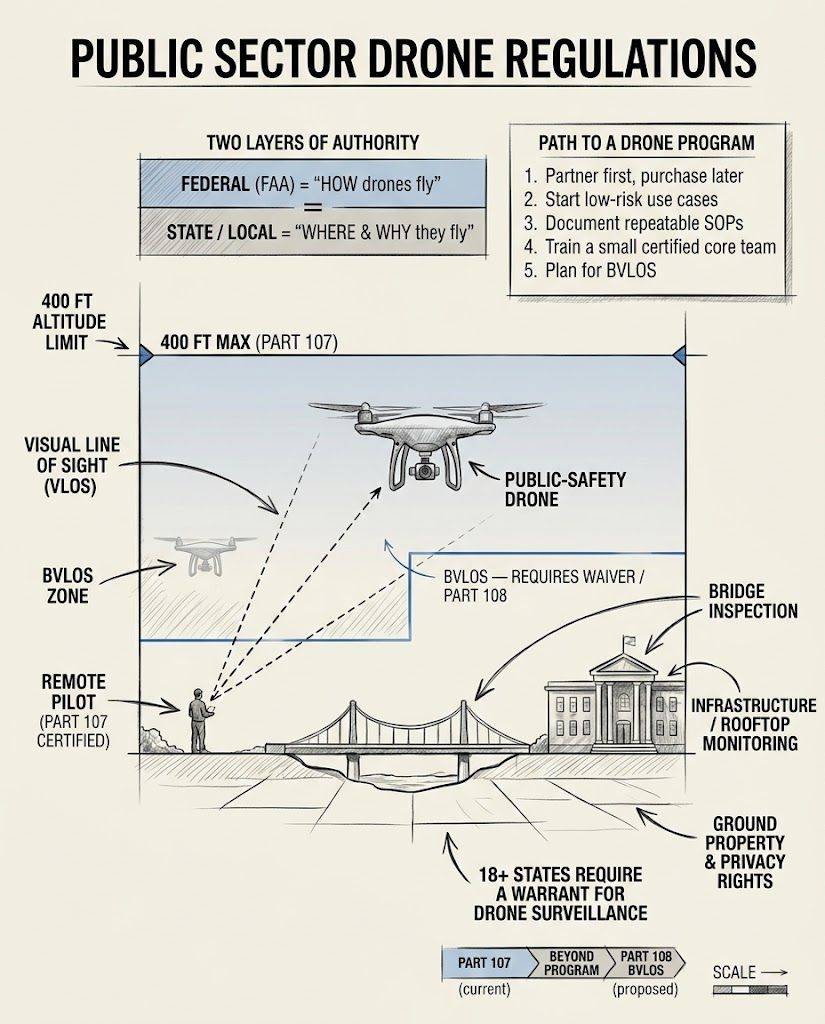
In the U.S., drone operations are governed primarily by the Federal Aviation Administration (FAA), which holds exclusive authority over the national airspace. The FAA’s Part 107 rules set the foundation for most commercial and government drone use. They cover pilot certification and flight limits, including keeping the aircraft within visual line of sight, not flying over people without a waiver, and altitude restrictions. For public agencies, especially law enforcement and infrastructure teams, more complex missions often require special waivers or Certificates of Authorization (COAs).
That is just the federal layer.
At the state and local level, governments keep authority over areas tied to traditional police powers, such as privacy, trespassing, land use, and law enforcement procedure. Many of these laws shape how drones can be used on the ground.
At least 18 states, including Alaska, Florida, and Texas, require warrants for drone surveillance to protect Fourth Amendment rights, with exceptions for exigent circumstances where immediate action is needed.
In short, the FAA governs how drones fly, while state and local rules decide where and why they fly, especially for public safety and property rights. Agencies have to navigate that interplay carefully.
Paving the Way for Public Sector Drone Programs
Agencies know better than anyone that operating a drone is not “buy and fly.” Regulations are tight for good reason, but the direction of travel favors adoption at the state, local, and tribal level, and the federal government is actively encouraging it.
The signals are concrete. The FAA’s BEYOND program lets selected public agencies run advanced operations and feed safety data back into rulemaking. The proposed Part 108 rule, published for public comment in August 2025, would replace the slow case-by-case waiver process with a standardized framework for Beyond Visual Line of Sight (BVLOS) flight. And in Congress, the Drone Infrastructure Inspection Grant Act has been introduced across several sessions, with the House passing an earlier version in 2022, to fund agency drone programs for infrastructure inspection. It has not yet become law, but it signals sustained legislative interest.
Here is how agencies can move forward safely.
Partner first, purchase later.
You don’t need to solve everything yourself or buy top-tier hardware on day one. Partnering with a university, startup, or local utility gives you access to proven systems, experienced pilots, and working data models. It is a low-risk way to test workflows and learn the regulatory limits. Where national security matters, favor domestically manufactured drones, which is also the direction federal grant proposals like the DIIG Act would reward.
Start with controlled, low-risk use cases.
Drone programs often stall because early missions are too ambitious. Begin with low-risk, repeatable flights such as inspecting storm drains, monitoring road conditions, or assessing the rooftops of public buildings. These usually happen in controlled environments under standard Part 107 rules. Once the workflows are validated and documented, expand to harder cases like emergency response support or traffic-pattern analysis.
Develop and document repeatable procedures.
Build your own standard operating procedures from day one. Even for basic missions, SOPs give you a structure to scale legally and safely. Define flight procedures, pre- and post-flight checklists, incident response protocols, and data-management workflows. They also prepare your agency for FAA audits and public records requests.
Train a small, skilled core team, then grow.
You don’t need to certify the whole department at once. Start with a cross-functional team of two or three people with technical aptitude and an interest in geospatial tools, inspection, or emergency response. Each must hold a Part 107 Remote Pilot Certificate and follow the FAA’s operational limits. Invest in training beyond the Part 107 basics, including airspace management, emergency landing protocols, and public safety coordination for events or disaster zones. Federal grant proposals like the DIIG Act would set aside dedicated funding for this kind of training, a recognition that effective drone programs depend on trained, certified people.
Work within current FAA rules and plan for BVLOS.
Stay current on FAA rules, especially around BVLOS. The FAA has traditionally required drones to stay within the pilot’s line of sight, and today it approves BVLOS through waivers and the BEYOND program. The proposed Part 108 rule would change that by creating a standard path for routine BVLOS, but as of mid-2026 it is still working through rulemaking and is not final. Build your program so it runs cleanly under today’s waiver process and is ready to adopt the new framework when it arrives.
The North Carolina Department of Transportation shows what this looks like in practice. Working with the FAA’s BEYOND program, NCDOT runs BVLOS missions for bridge inspections, and by documenting its safety processes it has cut manual inspections significantly.
An Indispensable Tool for Public Safety and Infrastructure
Highway patrol, fire marshals, and emergency management teams increasingly rely on drones. Because drones are faster, cheaper, and safer to operate, they have proven valuable for SWAT support and search-and-rescue missions across the country.
With a cautious but forward-looking approach grounded in compliance and collaboration, public agencies can fold drones into their operations successfully. The regulatory landscape is becoming more favorable, and public sector use cases are leading the way.
We help public agencies stand up drone programs that are effective and fully compliant, from selecting the right technology to building SOPs and supporting FAA waivers. If that is on your roadmap, there has rarely been a better time to start.
Sources: DroneXL: FAA Part 108 delay (Jun 2026) · Pilot Institute: Part 108 Explained · Congress.gov: H.R.3593 Drone Infrastructure Inspection Grant Act · J. Rupprecht: State Drone Laws