The impact of AI on government work is hard to avoid, given how versatile the technology is. One high-impact use is government hiring, an area long plagued by bureaucratic delays, slow processes, and subjective bias. But as governments lean into AI to speed up recruitment, a new challenge comes with it: how do we make sure these systems are fair, accountable, and transparent?
In AI-driven hiring, algorithmic transparency isn’t just a technical requirement. It is a cornerstone of public trust and democratic legitimacy. Hiring responsibly with AI has to be done with fairness and accountability built in.
The Rise of AI in Government Hiring
With many public servants nearing retirement and newer generations expecting modern, digital services, agencies are under pressure to modernize recruitment. AI adoption in government hiring has surged as a result. These tools can scan thousands of resumes quickly, rank candidates against pre-determined criteria, and even predict performance from historical data.
Like any powerful tool, automation brings risks: opaque decision-making, embedded bias, and no explanation or recourse for rejected applicants. Those risks are exactly why fairness, accountability, and transparency matter so much in AI-driven hiring.
Why Transparency Matters in AI Hiring
Transparency is about more than opening the hood of the algorithm. In hiring, it means making sure:
- Candidates understand how decisions are made
- Governments can audit and explain outcomes
- Public trust in the fairness of public-service recruitment holds
When hiring algorithms are opaque, they can hide discriminatory decisions that disproportionately harm marginalized communities, leaving those applicants with no insight into, or way to appeal, a biased outcome.
Best Practices for Algorithmic Transparency in Public Hiring
Here are practices governments can follow so AI in hiring lives up to democratic ideals.
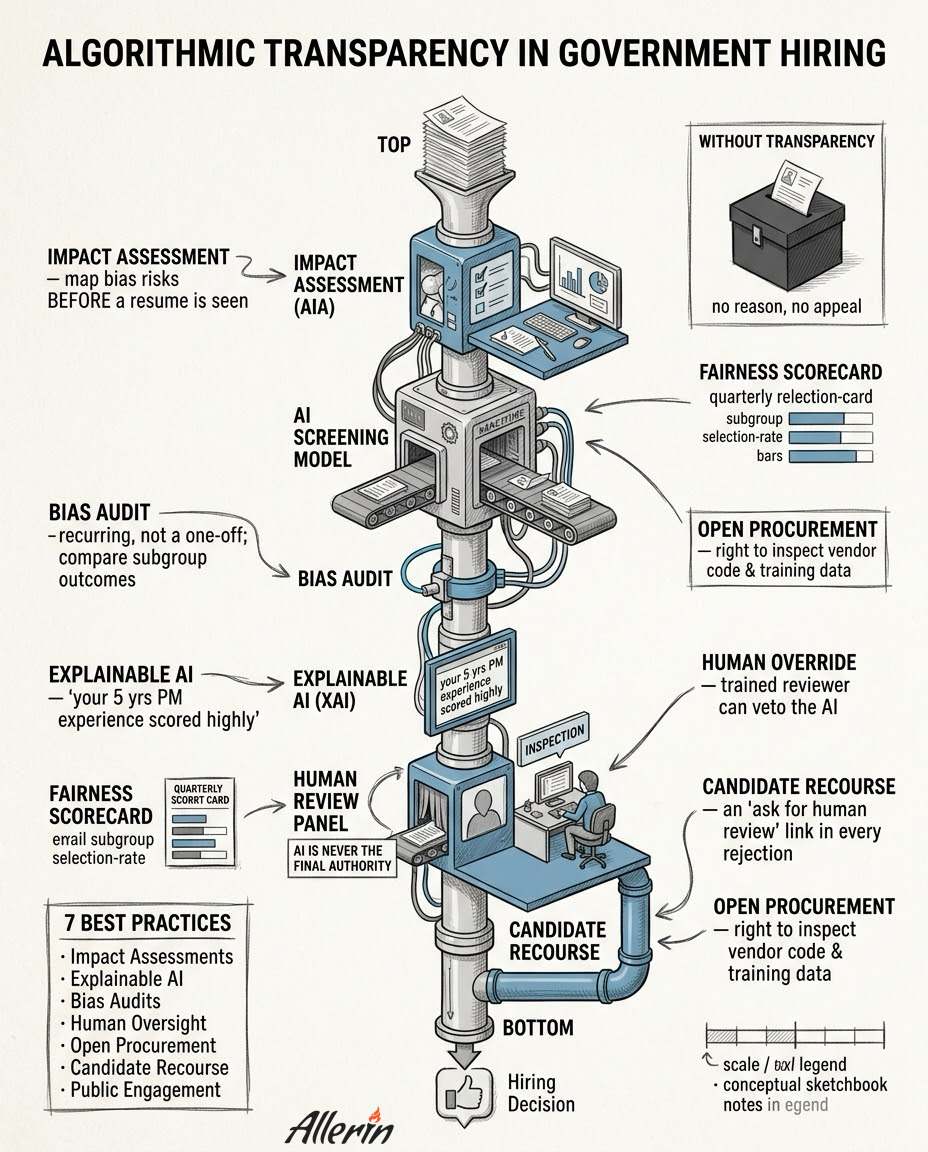
Algorithmic Impact Assessments (AIAs)
Before an AI hiring tool sees a single resume, agencies should run a clear, public-facing risk assessment that details data sources, decision logic, and potential harms. Treat it like an environmental review: outline where bias might arise, how errors could affect candidates, and what human controls will be in place. Revisit the assessment whenever the model is retrained or new features are added, and consider classifying tools by risk level so high-stakes roles trigger deeper scrutiny. To keep it grounded, bring in independent reviewers, such as ethicists or community representatives, to vet the findings, and publish a one-page summary so non-technical audiences can follow along and respond.
Explainable AI (XAI)
Candidates deserve an understandable answer when they ask, “Why wasn’t I chosen?” Whether you use inherently transparent models or layer plain-language explanations over more complex ones, every decision should trace back to tangible factors. Pilot your explanation format with real applicants or HR staff to make sure it is clear and useful, then put the key drivers, like “Your five years of project-management experience scored highly,” directly into notification messages. Behind the scenes, keep secure, timestamped logs of every explanation so you can audit both the decision and the rationale later. And if performance needs force a black-box model, wrap it with a simpler surrogate that approximates its behavior and can explain itself in everyday terms.
Bias Auditing and Fairness Testing
No matter how well you train a model, historical data can carry unfair patterns that AI will replicate or amplify. Make bias audits a recurring event, not a one-off checkbox. Embed automated fairness tests in your development pipeline so each change triggers a report comparing selection rates, false-negative frequencies, and outcomes for intersecting subgroups (for example, by gender and region). Set clear thresholds for acceptable variance, and add alerts that flag any drift beyond them. Publishing a quarterly fairness scorecard shows your commitment to equity and surfaces emerging issues early, before they affect real candidates.
Human Oversight and Review Panels
AI should never be the final authority on someone’s career. Build human review into the workflow with explicit override protocols that spell out when and how a trained reviewer can veto or adjust an AI recommendation. Rotate panel membership to keep it fresh and unbiased, and give reviewers structured checklists that prompt them to weigh both the algorithm’s output and the context a machine might miss. Every time someone overrides a recommendation, log the reason and feed it back into model retraining, so the system gradually learns from human expertise and repeats fewer errors.
Open Procurement and Source Disclosure
When you buy AI from private vendors, insist on full transparency around algorithm design, training datasets, and performance metrics. Add contractual clauses that give you the right to inspect code, audit outputs, and hold source-escrow arrangements in case the vendor changes ownership. Before committing, require vendors to demonstrate their tools on sanitized, representative datasets so you can verify their accuracy and fairness claims. Consider piloting open-source alternatives where feasible, and periodically run adversarial red-team exercises, where experts try to game or break the system, to find vulnerabilities before they reach applicants.
Candidate Notification and Recourse
Honesty up front builds trust. Tell every applicant clearly that AI will be part of their evaluation, then give them a simple way to respond, such as an “Ask for human review” link in rejection emails, to appeal or request more detail. Track those appeals closely: who appeals, why, and how often a human reviewer overturns the original decision. Those patterns can reveal systematic issues and guide model improvements. At the same time, protect candidate privacy so any logs or explanations you share don’t expose sensitive personal data.
Public Education and Stakeholder Engagement
Real transparency goes beyond policies and reports; it depends on dialogue. Offer short explainer videos and plain-language guides for job seekers, deeper white papers for advocacy groups, and live Q&A webinars for HR teams. Host quarterly forums, inviting unions, community advocates, and technologists, to surface concerns before they become crises, and keep an open suggestion portal where anyone can propose improvements. Maintain a living FAQ on your recruitment site that grows with each new question, which shows your AI practices adapt to real-world feedback rather than sitting frozen in place.
Transparency Is a Trust Multiplier
This may look like a lot of work, but transparency isn’t a compliance burden. It is a trust multiplier. Public trust is fragile, especially in something as personal as access to a job. When people understand and believe in the fairness of a system, they are more likely to accept its outcomes, even when those outcomes don’t go their way.
By adopting these practices, governments can lead by example and show how AI can be used not just efficiently but ethically.
AI in public hiring is here to stay. The question isn’t whether we use it, but how. With deliberate, transparent practices, governments can uphold their duty to fairness and accountability, and build not just better systems but better societies. That is the kind of AI program we help public agencies design.