 Regulatory compliance is more than a list of checkboxes; it is a frontline defense for public health, environmental protection, and the credibility of governing institutions. Yet, meeting these obligations has grown increasingly complex. Industries are expanding at breakneck speed, and limited budgets often make it challenging for agencies to keep up. Against this backdrop, artificial intelligence can serve as a useful ally, able to handle massive data streams, sift out meaningful patterns, and enable more proactive, real-time oversight.
Recognizing the Need for Next-Generation Compliance
Organizations like the Occupational Safety and Health Administration (OSHA) and the Environmental Protection Agency (EPA) have long been recognized for their diligence. They conduct inspections, enforce standards, and educate stakeholders on regulatory compliance. But with mounting workloads and limited resources, traditional methods can no longer guarantee wide-scale, timely coverage. AI significantly lightens these demands by automating labor-intensive processes—be it routine inspections or complex data analysis—and enabling immediate alerts when issues arise.
Government agencies also face heightened public expectations for transparency and fairness. Paper-based methods, prone to delays and human error, no longer satisfy these demands. Today’s leaders in public governance need solutions that sift through mountains of data quickly, respond intelligently to dynamic situations, and pave the way for a more transparent administrative process. AI excels at precisely this type of heavy lifting, freeing personnel to focus on strategic policy-making instead of logistical firefighting.
Land Use and Environmental Compliance
Land use oversight sits at the intersection of environmental stewardship and economic development. It touches everything from industrial sites to agricultural fields and growing residential areas. Yet investigations by the EPA and other bodies reveal worrying levels of noncompliance, such as municipal wastewater systems that fail to meet minimum safety standards or industrial facilities that stretch their Clean Water Act permits to the breaking point. In fact, over the last eight years, 60 to 75 percent of the nearly 7,000 major facilities with Clean Water Act permits—including the largest and highest impact power plants and wastewater treatment facilities—have reported they are not in compliance with federal law.
AI bolsters these efforts in a remarkable way. Drones equipped with image-recognition technology can spot illicit waste dumps or unpermitted construction faster than a traditional on-the-ground team could cover the same area. Satellite imagery can be processed almost instantly to identify variations in vegetation or water quality that suggest possible violations. By examining these trends early, agencies can direct their limited resources to areas most in need of intervention, staving off environmental damage before it spirals out of control.
Proactive Insights and Transparent Reporting
Machine learning goes a step further by shifting oversight strategies from reactive to proactive. Through the analysis of historical data—spanning environmental incidents, equipment malfunctions, past violations—AI algorithms can predict when and where compliance failures are likely to occur next. Early notifications to site managers and relevant officials encourage preventive measures, thereby reducing both environmental harm and administrative strain.
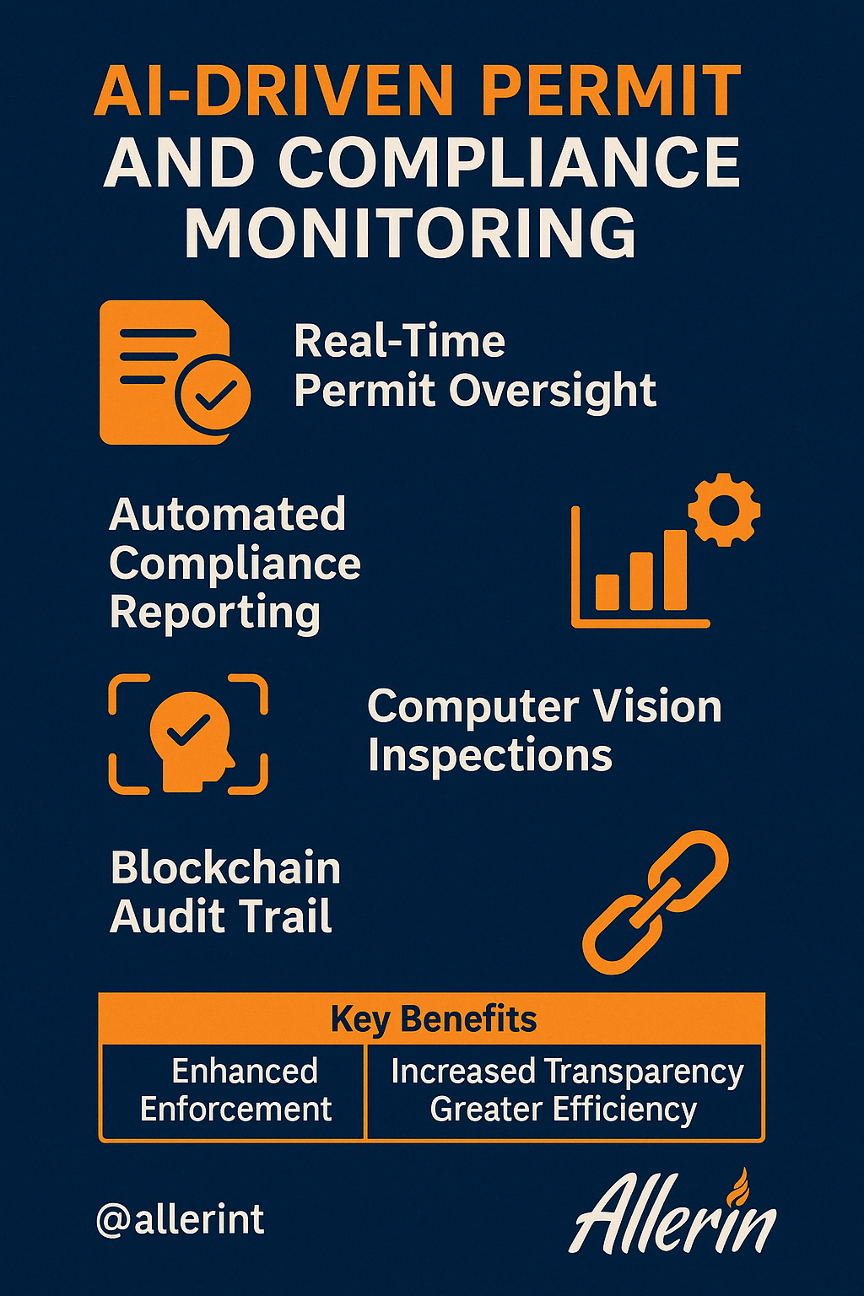
Blockchain technology adds another layer of value. When AI-driven data collection combines with the immutable nature of blockchain, the result is a transparent ledger of inspection results, emissions data, and audits that is accessible to authorized parties. This design not only deters tampering but also allows for near-instant validation of compliance. In other words, regulators, organizations, and community stakeholders can all review the same reliable information, promoting collective trust and accountability.
Transforming Workplace Safety
Within the framework of OSHA and similar bodies, workplace safety is frequently top-of-mind. AI offers novel solutions here as well. Surveillance systems empowered by computer vision can automatically detect employees who forget to wear required protective gear. This helps minimize human oversight while boosting compliance rates. Wearable sensors can also monitor everything from temperature levels to heart rates, alerting supervisors to risky environmental conditions or worker fatigue before an accident takes place.
The technology even enhances safety training. Virtual reality simulations—combined with AI analytics—give employees hands-on practice for emergency scenarios in a controlled environment. Meanwhile, digital assistants or chatbots powered by AI provide instant answers to procedural questions, so staff can double-check safety requirements on the spot without losing valuable time. The outcome is a safer, more informed workforce that significantly reduces incident rates and related financial penalties.
Overcoming Front-Line Hurdles in Permit Enforcement
Many agencies deal with permit and enforcement tasks that, at first glance, seem straightforward—like parking regulations or traffic flow management. However, field officers often wrestle with malfunctioning apps, patchy connectivity, and massive amounts of manual data entry. A single misread license plate can sow confusion, reduce public trust, and spark dispute after dispute.
AI-driven applications address these pain points by accurately scanning license plates, validating permits, and predicting where violations might spike. Instead of sifting through spreadsheets or static databases, officers receive real-time prompts that guide them to potential infractions and chronic offenders. The result? Faster responses, fewer errors, and stronger community confidence in public services—an outcome that helps agencies, officers, and citizens alike.
Building a Future-Ready Compliance Framework
As AI solutions continue to evolve, agencies that embrace these tools will be well-positioned to adapt to emerging challenges. Real-time data processing can help allocate scarce resources more strategically. Patterns of noncompliance become clearer, enabling officials to focus on the most urgent cases first. And since AI systems can scale across entire regions, even smaller agencies gain the capacity to monitor large territories without a proportional increase in staffing or physical inspections.
Equally important is the increased trust factor. When constituents understand that government agencies have transparent, data-driven tools at their disposal, skepticism about enforcement fairness or accuracy diminishes. This clarity positions public bodies as objective stewards of safety, environmental well-being, and the public interest.
Still, it is important to recognize that deploying AI effectively is not a simple matter of plugging in new software. Phased pilot programs, rigorous testing, and staff training ensure a smooth transition. Careful planning of governance frameworks can mitigate the risk of over-reliance on technology or potential ethical pitfalls. With these guardrails in place, agencies can reap the immense benefits of AI without losing sight of core responsibilities to the communities they serve.
Government agencies stand at an important crossroads in the evolution of permit and compliance monitoring. While traditional methods have set the foundation for public safety and environmental stewardship, modern challenges necessitate a more robust approach. AI provides that approach—revealing patterns invisible to manual methods, enabling predictive oversight, and delivering a more transparent, cost-effective, and just regulatory system.
By strategically investing in AI-powered solutions, agencies reinforce their commitment to the public good, better protect the environment, and strengthen societal trust. The benefits extend well beyond organizational efficiency. They also include a heightened sense of accountability, a safer workforce, and more sustainable land use practices. In this era of rapid technological growth and tight resource constraints, AI stands poised to help government bodies meet and exceed the expectations of the communities they serve.