
Colleges and universities are finally ditching legacy database systems and moving on to managing big data and its applications. This only goes to show how big data’s adoption will be insuppressible across various industry sectors
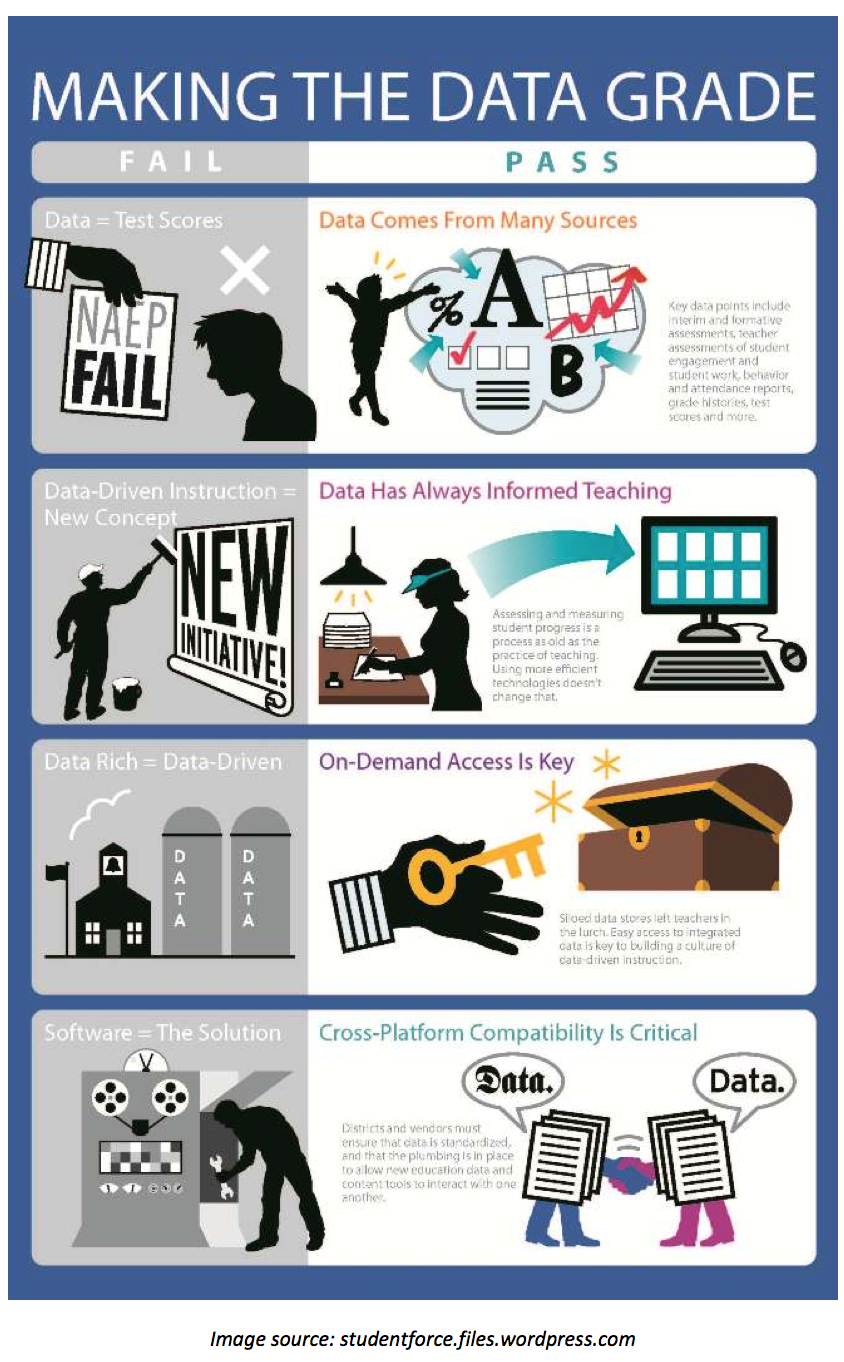
Colleges and universities are not only inundated with data from legacy systems but have also begun to link disparate information from across the campus. The application of data-driven decision making has begun to permeate all aspects of campus life and operations, as enterprising leaders harness predictive analytics to tackle bottleneck courses, power advising initiatives and share best practices with their peers. We look at some features here that big data application might be able to provide in education sector.
Improved Student Results
The overall goal of Big Data within the educational system should be to improve student results. The answers to assignments and exams are the only measurements on the performance of students. During his or her student life, every student generates a unique data trail. This data trail can be analyzed in real-time to deliver an optimal learning environment for the student as well as to gain a better understanding in the individual behavior of the students.
It is possible to monitor every action of the students – how long they take to answer a question, which sources they use, which questions they skipped, how much research was done, what the relation is to other questions answered, which tips work best for which student, etc. Answers to questions can be checked instantly and automatically (except for essays perhaps) to give instant feedback to students.
In addition, Big Data can help to create groups of students that prosper due to the selection of a group. Students often work in groups where they may not be complementary to each other. With algorithms, it would be possible to determine the strengths and weaknesses of each individual student based on the way a student learned online, how and which questions were answered, the social profile etc. This will create stronger groups that will allow students to have a steeper learning curve and deliver better group results.
Create mass customized programs
All the data will help to create a customized program for each individual student. Big Data allows for customization at colleges and universities, even if they have 10,000 students. This can be created with blended learning; a combination of online and offline learning. It will give students the opportunity to develop their own personalized program, following those classes that they are interested in, working at their own pace, while having the possibility for (offline) guidance by professors. Providing mass customization in education is a challenge, but algorithms make it possible to track and assess each individual student.
We already see this happening in the MOOC’s (Massive Open Online Courses) that are being developed around the world. When Andrew Ng taught the Machine Learning class at Stanford University, generally 400 students participated. When it was developed as a MOOC at Coursera in 2011, it attracted 100,000 students. Normally this would take Andrew Ng 250 years to teach the same amount of students. 100,000 students participating in a class generates a lot of data that can deliver tremendous insights. Being able to cater for 100,000 students at once also requires the right tools to be able to process, store, analye and visualize all data involved in the course. At the moment, these MOOC’s are still mass made, but in the future they can be mass customized.
Reduce dropouts, increase results
When students are closely monitored, receive instant feedback and are coached based on their personal needs, it can help reduce dropout rates. Predictive analytics on all the data that is collected can give educational institutes insights in future student outcomes. These predictions can be used to change a program if it predicts bad results on a particular program or even run scenario analysis on a program before it is started. Universities and colleges will become more efficient in developing a program that will increase results, thereby minimizing trial-and-error.
Over the last decade, Georgia State coupled data analytics with college advising to eliminate the gap in graduation rates between low-income and minority students and the rest of its student body, while also raising their overall graduation rate by 22 points.
After graduation, students can still be monitored to see how they are doing in the job market. When the resultant insights are made public, it will help future students in their decision to choose the right university.
While big data is still in a very nascent phase, its advantages in every sector are being realized with every passing day. The Education sector will always continue to be one of the most important areas of development for any country. Incorporating big data methods in education is surely going to help the students and society by placing the right people at the right positions. It’s our future, let’s make it big.