
 Major companies across various domains have adopted augmented reality technologies. Mobile manufacturers are leading the way for making augmented reality a household tech. However, the technology hasn’t caught up in the smart-glasses segment. Augmented smart glasses can become the gateway for mass adoption of augmented reality in our daily lives. Yet, they are a rare sight even after seven years after being announced as a commercially available option to consumers. Let’s understand the reasons why smart glasses should be ’seen’ more often and what challenges they currently face.
How augmented smart glasses can push forward the adoption of augmented reality technology
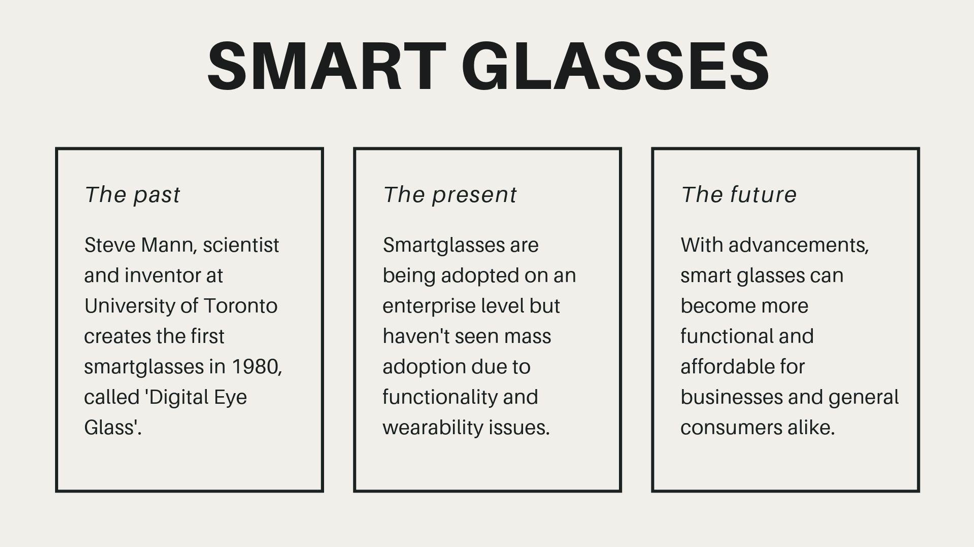 Augmented smart glasses may not be popular on a consumer level, but they are already mass-adopted by large enterprises. Smart glasses are being used in the healthcare, construction, and retail industries. However, their use is restricted only to major firms. The technology has not yet become affordable to a large section of professionals and casual users alike. However, this scenario needs to change as smart glasses can be very beneficial over other augmented reality solutions.
Smart glasses are non-obtrusive as they operate on a hands-free concept. The user doesn’t need to hold a device in their hands for using augmented reality. This is proving beneficial for many professionals, such as surgeons, construction workers, and trainers. They can carry out their tasks easily while simultaneously leveraging augmented reality technology. As the technology becomes more affordable, it can see a widespread application in industries unimagined. And with improved designs, it can become commercially available to a large number of people.
Why augmented smart glasses haven’t caught on
Even though it’s been seven years since a major company like Google announced a smart glasses concept, they haven’t become a common sight. Many other companies have invested in augmented smart glasses, but they haven’t gained mass recognition. One of the major challenges faced by augmented smart glasses is maintaining a balance between functionality and wearability. To add to this, the cost of the smart glasses must be such that it is affordable to a large set of the population. Feature-rich smart glasses tend to be bulky and are costly. The fashionable ones, on the other hand, have to sacrifice performance and features to attain a sleek look. The affordable ones are neither eye-catching nor have any function. Hence, smart glasses are currently restricted to enterprise use where function matters over form.
Even though the widespread use of augmented smart glasses remains on hold, they have found implementation on the enterprise level. As the technology develops and grows, it will not only see a wider application on a professional level but will finally penetrate the general market.