

As unstructured data is getting piled up at increasing pace, different approaches and platforms are emerging in order to help businesses make greater analytical use of data.
Among the latest approaches is an intelligent crowdsourcing platform that leverages experience of domain specialists to perform “custom micro-tasks.”
Once these micro-tasks are filtered for quality, they can be used for applications ranging from training artificial intelligence models and improving searches to augmenting directories. Using crowdsourcing in machine learning helps in combining human insights with machine learning techniques and facilitates better analytical use of unstructured data.
Let’s take a look at three advantages of collaborating crowdsourcing and machine learning.
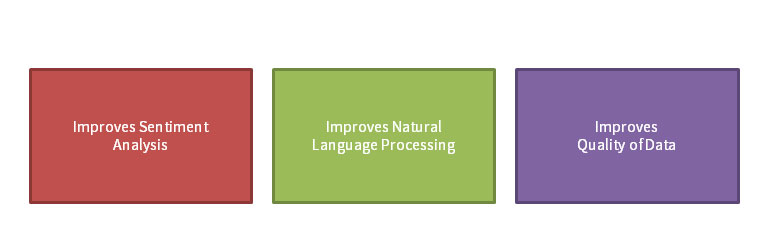
Crowdsourcing in Machine Learning Improves Sentiment Analysis
Many companies have begun to generate revenue streams by analyzing the reputation and background of their clients in online media, such as established news sources, blogs, and micro-blogs. The obstacle occurs in understanding the accurate polarity. The combination of machine learning and crowdsourcing has a number of advantages in terms of sentiment analysis.
By using a classifier, a huge number of unlabeled items can be classified to provide robust statistics about sentiment trends.
Statistics can be generated after the annotation process ends. The extent to which this can be done relies on the amount of concept drift that occurs over a period of time in the specific domain of interest.
The primary objective of using crowdsourcing along with machine learning is to produce unbiased assessments of sentiment in a dynamic collection of news articles, thereby identifying and visualizing trends and differences between varied sources.
Crowdsourcing in Machine Learning Improves Natural Language Processing
Today, customer reviews are important information for understanding market feedback on certain commodities and services. However, to accurately analyze those reviews is a challenging task due to complications arising in natural language processing in reviews. Existing methods in machine learning only focus on studying efficient algorithms, but they cannot guarantee accuracy of review analysis. Crowdsourcing can improve the accuracy of natural language processing techniques. Firstly, multiple machine learning algorithms are collectively used to pre-process review classification. Secondly, reviews are selected on which all machine learning algorithms cannot agree and assign them to humans to process. In the final stage, results from machine learning and crowdsourcing are aggregated to generate the final analysis result. Thus, valuable information for understanding customers’ evaluations can be extracted through data analysis.
Crowdsourcing in Machine Learning Improves Quality of Data
The emergence of crowdsourcing has created a variety of new opportunities for improving traditional methods used for data collection and annotation. This, in turn, has created new opportunities for data-driven machine learning. Convenient access to crowd workers for simple data collection has resulted in leveraging more arbitrary crowd-based human computation for supplementing automated machine learning. Due to crowdsourcing, labelled data is now available in abundance which has proved to be a boon to data-driven machine learning. Crowdsourcing has reduced traditional barriers to data collection which formerly encouraged several researchers to reuse existing data rather than collect and annotate their own. Crowdsourcing is thereby changing the landscape for the quantity, quality, and type of labelled data available for training data-driven machine learning systems.
One of the most obvious benefits of crowdsourcing is that it has the ability to coordinate the distribution and validation of tasks. Data classified through crowdsourcing is being fed into computers to improve machine learning so that computers can learn to recognize images or words almost as well as we do. This has helped in maximizing the efficiency of machine learning to great extent