
 Recently, Commonwealth Shakespeare Company and Google teamed up to create ‘Hamlet 360: Thy Father’s Spirit.’ This iteration of the Shakespeare masterpiece is based on virtual reality technology where the viewers are cast as Hamlet. Just like theater artists, several filmmakers are also creating VR films that are showcased at multiple film festivals. Virtual reality has gained such popularity due to its potential for immersive storytelling. Also, various VR solutions can be adopted for several business applications such as employee training and virtual meetings. Due to such advanced applications, consumers and business owners are adopting VR at an increasing rate. Reportedly, 12.4 million VR units were sold in 2018 and the sales are expected to rise annually at the rate of 52.5%.
Even after the aggressive adoption and increasing popularity, most consumers have little-to-no knowledge about the history of virtual reality. Questions like how VR came into existence and what the vision for VR was in its early stages might be a mystery for many VR users. Similarly, several VR users have to consider what the future of virtual reality would look like. Several tech experts are making bold predictions about the future of virtual reality in discussions comparing real-world VR applications to sci-fi fantasies.
History of virtual reality
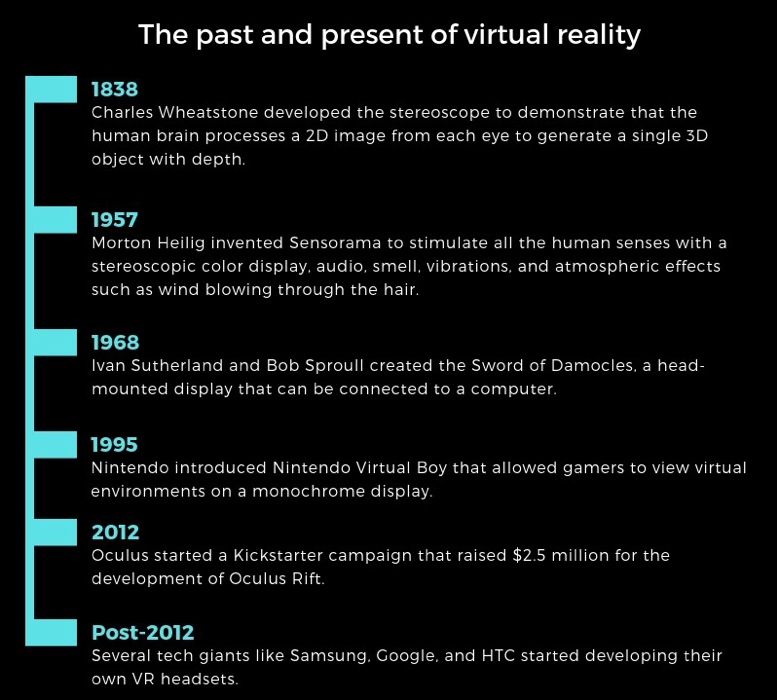
In 1838, Charles Wheatstone developed the stereoscope to demonstrate that the human brain processes a 2D image from each eye to generate a single 3D object with depth. This discovery was the basic idea behind the development of virtual reality. Based on this principle, filmmaker Morton Heilig invented Sensorama, a machine that combined several technologies to create a 3D immersive environment. Sensorama intended to stimulate all the human senses with a stereoscopic color display, audio, smell, vibrations, and atmospheric effects such as wind blowing through the hair. Unfortunately, Sensorama never went beyond the concept stage, but it laid the foundation for the development of virtual reality. In 1968, Ivan Sutherland and Bob Sproull created the Sword of Damocles, a head-mounted display that can be connected to a computer. This headgear allowed users to view grid-like images that are superimposed on a background. However, the device was impractical due to its large size.
Jaron Lanier, an American computer scientist, coined the term, “Virtual Reality” to introduce the technology to the mainstream audience. In 1995, Nintendo played a crucial part in the history of virtual reality by introducing Nintendo Virtual Boy. Gamers could see a virtual environment on a monochrome display with the help of this device. In the history of virtual reality, the research and development took a turn towards the establishment of the modern VR industry with Oculus VR. In 2012, Oculus started a Kickstarter campaign that raised $2.5 million for the development of Oculus Rift. This moment in the history of virtual reality led to the rise of compact VR headsets and helped lay the groundwork for virtual reality revolution.
Present-day virtual reality
Currently, several tech giants such as Google, Samsung, Sony, and HTC have launched their own VR headsets. These VR headsets can track head and eye movement along with physical motion. Due to these features, various industry sectors such as education, healthcare, and construction have adopted virtual reality for numerous applications. For instance, in healthcare, doctors can analyze the human body and perform diagnoses for several disorders using virtual reality. Also, virtual reality can be used in distraction therapy for patients during painful and uncomfortable medical procedures. In the military, virtual reality can be used for battlefield simulation that could help in training soldiers.
Virtual reality has gained immense popularity in mainstream media. Movies like The Matrix and Ready Player One have built virtual reality-based fictional environments to tell compelling stories. Such stories try to predict how the future of virtual reality will be like. Similarly, the gaming industry has been one of the biggest adopters of virtual reality. The global virtual reality gaming market is predicted to be worth $32.8 Billion by 2023. Several game developers are releasing multiple high-end VR games for various platforms such as Oculus Rift, PS VR, and HTC Vive. Also, the music industry has its own virtual reality platform now. These platforms allow fans to virtually experience concerts from multiple angles. Various talented artists have made their virtual concerts available for their fans.
Although virtual reality has exhibited untold potential, there are some major hurdles that hold VR back. One of these hurdles is the fact that VR headsets need to be connected to additional hardware like smartphones, computers or gaming consoles. Hence, several tech giants like Oculus, Google, and HTC are developing standalone VR headsets. These devices will be the first wave of standalone VR headsets. Another issue with present-day VR is the lack of interoperability among different VR platforms. Developers have to separately create content for various types of VR headsets.
Future of virtual reality
One can only imagine the future of virtual reality just years from now where all the sci-fi fantasies become real. For instance, in the popular sci-fi comedy, ‘Rick and Morty,’ Rick designs a virtual world full of bright colors and rainbow-colored rivers for his daughter, Beth. Experts predict that the future of virtual reality will be full of next-gen VR headsets that are standalone wireless devices and offer a 360° field of view. Faster internet speeds and wider network coverage with the help of 5G and further generations of wireless networks will be fruitful for the future of virtual reality. Additionally, tech companies will develop a standard set of protocols and frameworks for all VR devices. With this approach, these companies can ensure better interoperability across various VR headsets. Multiple startups are also developing tactile gloves that would allow users to touch and feel VR objects. Also, developers will allow users to create their virtual avatars to help them communicate and collaborate better. With such immense potential, smartphones and laptops may soon become obsolete.
The future of virtual reality will lead to the development of various business applications. For instance, organizations will create virtual offices to simulate their workplace environment. Such virtual offices can also hold virtual business meetings across the globe. Likewise, multiple applications will be developed for various industry sectors. For example, banks can create virtual branches for their customers to help them carry out their transactions. Such virtual branches will also help banks eliminate their overhead costs associated with maintaining brick-and-mortar branches. The future of virtual reality will also transform the tourism industry. Tourism agencies can offer virtual tours for any destination around the globe. With such tours, tourists can preview all available destinations and select the most suitable one. With location-based VR, businesses can create their own tourist attractions by developing arcades and theme parks.
The future of virtual reality will be even more advanced with the advent of extended reality. Extended reality will leverage virtual reality, augmented reality, and mixed reality together to combine real and virtual environments and human-machine interaction. Extended reality will present better opportunities for the development of immersive technologies and its applications. The estimated market size of extended reality is expected to reach more than $209 billion by 2022 and become mainstream in four to five years.