
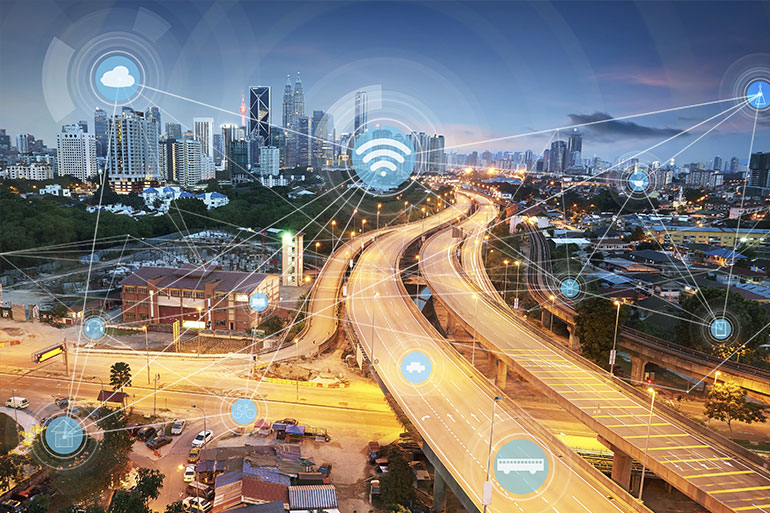
By 2030, about 5 billion people will make a move from rural to urban areas. This will, in all probability, lead to a resource crunch and consequently affect the quality of life. Governments are investing in smart cities to better monitor the day-to-day activities and enhance the quality, performance, and interactivity of urban services.
What is a smart city?
A smart city heavily depends on technology to efficiently and securely manage a city’s assets, such as hospitals, power plants, water dams, universities, schools, and waste management, to name a few. Real-time monitoring systems, using sensors, are used to collect data from citizens, as well as public and private facilities, which give a detailed view of what is happening in the city. This allows city officials to interact with the community directly or indirectly. Use of IoT in these cities helps reduce costs and resource consumption. Besides, it helps governments give a real-time response to citizen concerns.
A smart city analyzes the data collected from various sources for efficient use of civic amenities. This supports healthy economic and social development. It focuses on an e-governance model that encourages people to participate, leading to collective development of the city. Countries like Singapore are already adopting such features and budging towards becoming one of the first smart cities in the world.
Why is everyone investing in smart cities?

● Massive drift of people from rural to urban areas
As per a study by the UN, in 2014, about 54% of the world population drifted from rural to urban settings. This number is expected to reach 66% by 2050. Countries need to invest in smart cities to manage complexities and inhibit expenses. Smart cities are expected to create better livelihood and lifestyles for people.
● Smart management of water
In the cities we live, about 50% of the water is lost due to leakages in the water infrastructure. Smart cities can have smart water meters that lead to an increased efficiency of irrigation systems that alert government officials about shortage of water in times of drought.
● Smart management of energy
Presently, about 14% of the energy supplied to cities suffers transmission losses. Only about 32% of the energy is generated using renewable sources. Smart cities have increased dependence on renewable energy, which will drastically reduce CO2 emissions and have improved energy efficiency by reducing the transmission losses.
● Smart management of waste
As of now, cleaning streets and collecting wastes is an expensive and non-optimized process, in most countries. Smart cities have an improved waste collection system in place. By incorporating real time management of missed garbage collection points, these cities ensure there’s no trace of dirt left anywhere. They reduce dumped waste and optimize collection routes, which helps reduce the associated costs and enables waste recycling.
Governments around the world are investing in smart cities because they can unlock new economic and social boundaries. However, other stakeholders must also participate and invest in these cities to reap maximum and timely benefits. Smart cities are an ideal opportunity for not just domestic PPP but also for foreign investments.