
 Weather forecasting is a complex science. It deals with massive data sets collected from thousands of weather satellites every day. Gathering the data, identifying patterns in the observations made, and then deducing results to get accurate weather predictions can be quite strenuous. Besides, almost all of this needs to be done in real-time. To prevent disasters, it is absolutely important that weather data is collected and analyzed in real-time. Artificial Intelligence (AI) uses computer-generated mathematical programs and computational problem-solving methods on vast data sets to identify patterns and make a relevant hypothesis, generalizing the data. Considering the various intricacies involved in weather prediction, scientists are now using AI for weather forecasting to obtain refined and accurate results, fast!
AI for weather forecasting
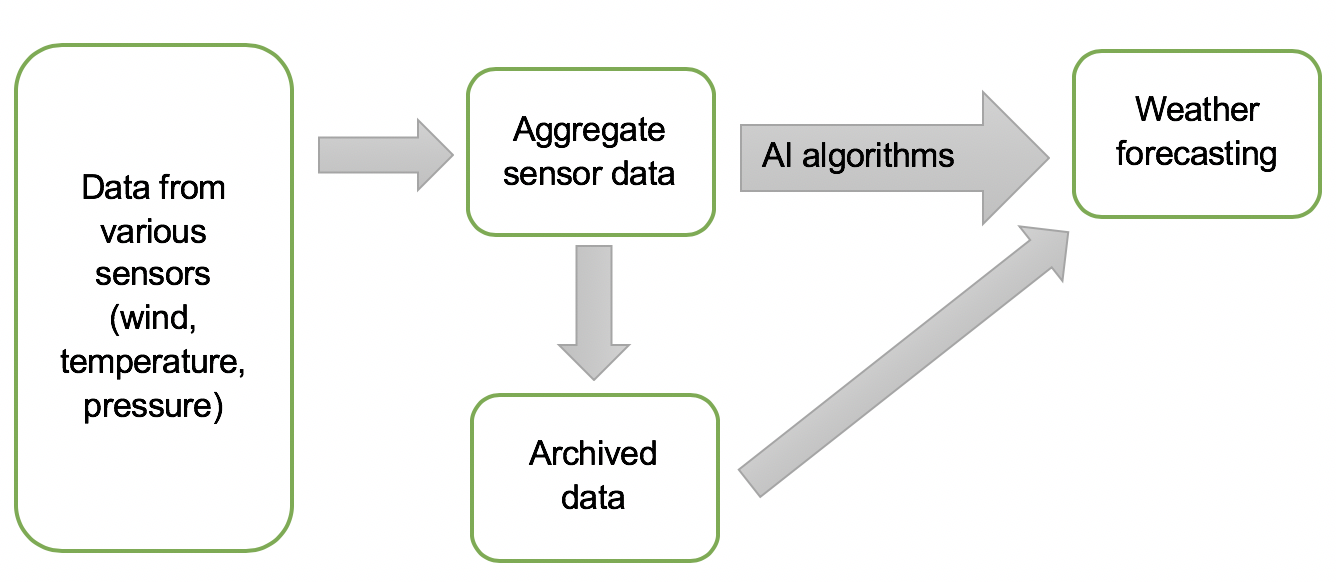 AI employs deep learning mathematical models that can learn from from past weather records. One such popular model is the Numerical Weather Prediction (NWP). The model studies and manipulates vast data sets relayed from weather satellites, relay stations, and radiosondes to deliver short-term weather forecasts or long-term climate predictions.
A lot of companies are already investing in the application of AI for weather prediction.
IBM, for instance, purchased The Weather Company and its properties including weather.com, Weather Underground, the Weather Company Brand, and WSI. IBM, thus, acquired access to the Weather Company’s extensive data set that included weather statistics from all over the world. Coupled with its own AI platform, Watson, IBM achieved great weather forecasting potential with improved accuracy. The result of this acquisition was IBM’s Deep Thunder. Deep thunder offers its customers hyper-local weather forecasts with a 0.2 to 1.2-mile resolution.
Another example of employing AI for weather forecasts is Monsanto’s Climate Corporation. The weather company was acquired by Monsanto and has been used extensively for agricultural weather predictions using AI. It uses satellite imagery and hyperlocal weather data along with machine learning models to optimize weather predictions, especially for the farmers.
Potential problems and shortcomings
No matter how extensive the data set used or how precise the algorithm applied, forecasting the weather can never be cent-percent accurate. The problem with deep learning models is that they need a massive data set to learn form, before they can predict on their own. More the data fed into the system, more precise the results. Thus, with newly programmed weather models, it takes time for the machine to learn and deliver satisfactory results.
However, advancements in the cognitive spectrum of computers aid in improving the efficiency and resolution of weather forecasting by AI. Upcoming weather models and computational algorithms, with data sets from all parts of the world can be shared amongst research organizations, non-profits, governments, weather experty, and AI experts. The idea is to build a robust and thoroughly tested AI weather prediction model that can overcome all existing challenges in the field of weather forecast.