
Organizations have faced considerable losses when they’ve stuck to traditional IT methods for their business processes. On the other hand, the transition to public and private computing has also presented its own set of complications. Therefore, we believe, the integration of in house or traditional IT systems and cloud infrastructure, a concept known as hybrid IT, will prove to be the most profitable approach for businesses.
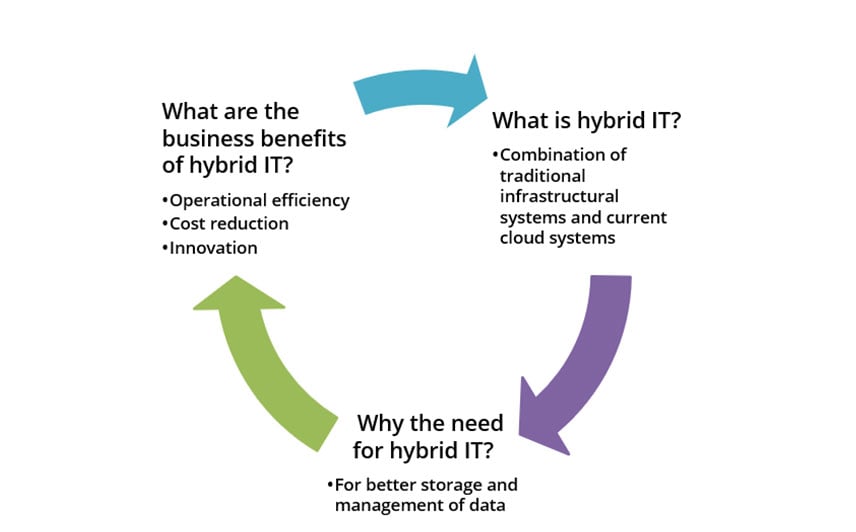
What is hybrid IT?
Gartner’s definition of hybrid IT states that Hybrid IT is the result of combining internal and external services, usually from a combination of internal and public clouds, in support of a business outcome.
Organizations have always felt the need to store their data and information in a safe and secure environment. In the past, a company’s facts, figures, statistics, and other types of data were stored in data warehouses and on the company’s premises. However, with the introduction of cloud, most of this data was shifted to a network of servers for storage and management. This combination of traditional infrastructural and current cloud systems is what is known as hybrid IT.
Why the need for hybrid IT?
A study by IBM states that out of most organizations, “29% believe that an on-premise environment is best.” The main reason for sticking to traditional IT would be unprecedented cost expenditure, while transitioning to modern cloud computing. However, today, most organizations have followed the trend and have shifted their services to the cloud, mainly for an increase in speed and optimization. Each approach has its own set of limitations. Where traditional IT takes up more space, time, and resources, modern cloud servers are accompanied by security and privacy risks. The need for better storage and management of data is why most businesses today are adopting hybrid IT. Combining the two, businesses are now differentiating their data and processes according to their needs – they are either storing them on their premises or on cloud. This synergy has made businesses more agile and efficient and has led to flexibility and scalability.
What is the business benefit of hybrid IT?
Today, organizations are embracing hybrid IT. This is mostly because they are aware of the benefits in store for them. Some of the major advantages of implementing hybrid IT are:
Operational efficiency
When your workload is distributed, it is obvious that there will be an increase in the efficiency of business operations. With cloud infrastructure, businesses will have quick access to data always, while the data that is stored in the house will ensure privacy and security. This way, a business’ confidential information can be safeguarded, while at the same time, anytime access to critical data improves speed and scalability.
Cost reduction
With hybrid IT, businesses will no longer have to worry about unpredictable expenditure and transitional costs. There will be no need to uproot traditional data systems altogether, as the segregation of data according to the business’s needs will reduce the cost of investment and overall expenditure.
Increases innovation
Apart from facilitating customer engagement and boosting business revenues, a hybrid IT approach has helped businesses embrace the diverse facets of technological advancements in a seamless manner. It successfully transcends the industrial and operational barriers in businesses and helps them to grapple with the fast pace of innovation.
To keep up with digital transformation, organizations must strive to implement hybrid IT in their business operations. This will not just provide the perfect balance but will also prepare businesses for current and state-of-the-art opportunities.