
 In March 2016, a televised tournament was held in Seoul, South Korea for Go, a popular Asian board game. Wikipedia describes Go, the oldest known board game in the world, as “abstract” and “strategic.” Go, invented in China more than 2500 years ago, requires players to possess strong strategic and analytical abilities to excel and beat their opponents over the course of a game.
During the event, AlphaGo, a machine learning-based system designed by Google’s AI subsidiary DeepMind, was pitted against Lee Sedol, who had won the Go World Championship title a staggering 18 times up to that point, for five matches. Astonishingly, the machine came out on top, besting Sedol by a score of 4-1. While the western world was almost entirely unaware of this event, the nearly 300 million viewing audience in China got a glimpse of the amazing powers and capabilities of AI, especially when it is used in real-world, daily applications.
In some ways, it was also a precursor to China’s long and fruitful association with AI. It is an association that has simply strengthened even more since then.
Today, China is a dominant AI nation. Once a distant non-rival of the US in AI research and development, China today contributes nearly a third of the world’s published AI research papers. The nation also files more AI-related patents than anyone else on the planet. A 2018 study found that China was second only to the US in terms of the total number of AI firms operating within the country.
Despite taking these giant digital strides, China is not done yet. If the nation continues to grow—from an AI point of view—it is estimated to become the de facto global AI leader by 2030. Already considered to be the world’s first AI superpower by many, China’s prowess in harnessing the technology’s full range of capabilities and applying them for nation-building purposes can serve as an inspiration for countries reluctant to embrace AI.
Here, we will see some of the more significant elements which made China the world’s first AI superpower:
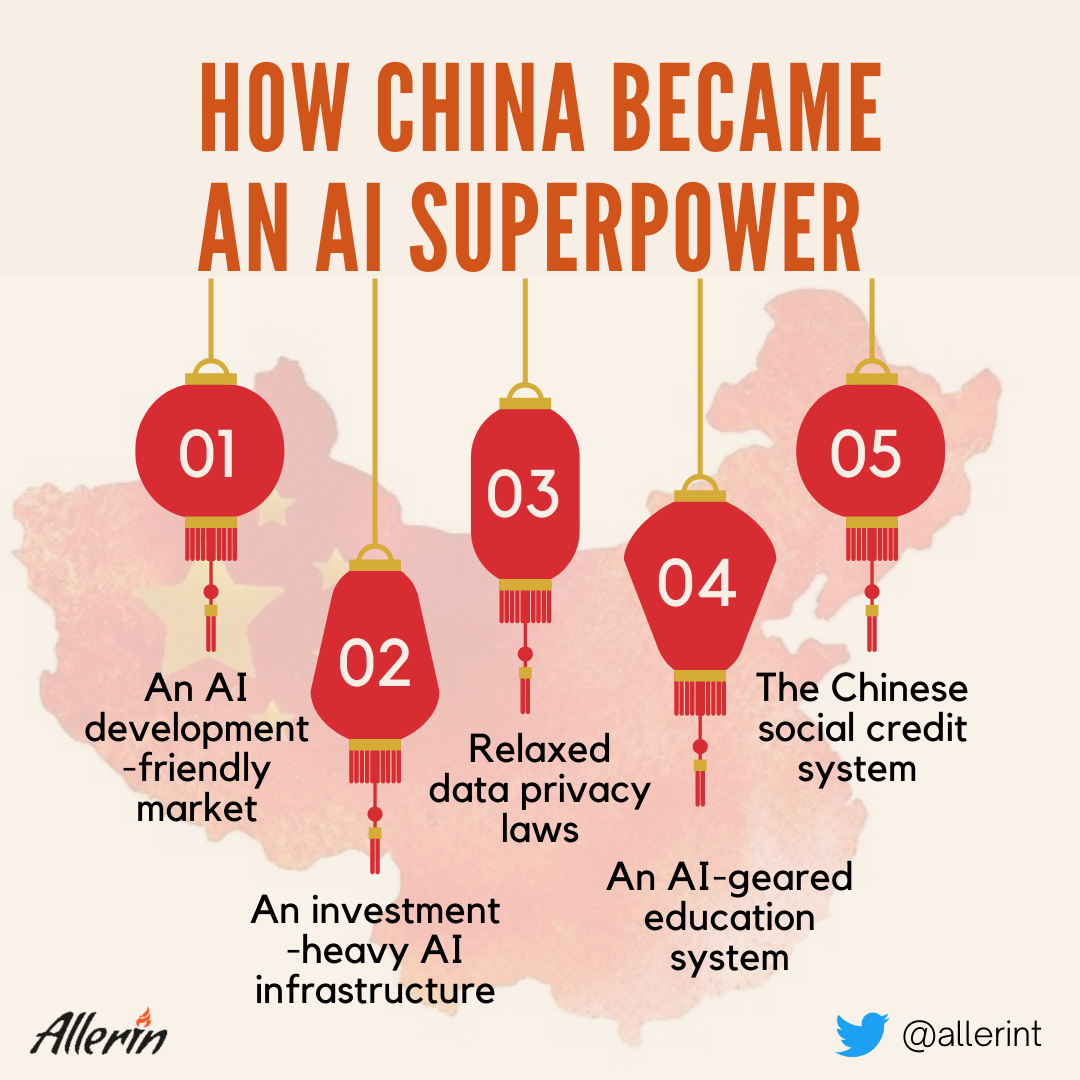
An AI Development-Friendly Market
As we know, the size of datasets is extremely important in determining how effective AI-based systems will be, performance-wise. Quite simply, the larger the dataset size, the better the machine training, and, as a result, the quality of AI implementation will be. China’s massive population and market size are strengths not possessed by many other countries. More importantly, China has the resources to harness the scalability potential of its market size and population. The sheer volume of China’s financial market allows firms to compile massive machine learning datasets to develop AI models. The big data required for AI research and development is constantly bursting at the seams with possibilities and relentless evolution.
Besides big data, the massive market also helps businesses to overcome specific technological shortcomings. For example, if the production of sensors or chipsets is low, causing the overall AI supply chain to lag, individual players along the pathway can pool in investments and personnel to boost the production of such components and fill such gaps.
Apart from the gargantuan size, China’s financial market also exhibits remarkable levels of product and service variety. The diversity provides several opportunities for new as well as established IT firms to develop distinct AI applications for each market segment. The various supply chain players can use such AI applications to create brand-new products and services.
An Investment-Heavy AI Infrastructure
As stated earlier, the uninterrupted availability of data is vital for AI. As we know, AI systems can only use high-level analytics on the data provided to them before formulating decisions, forecasts and other types of output.
To harness, process, transmit and store the big data, China invests heavily in building 5G networks, cloud computing architecture, colocation centers, data centers and IoT networks. As edge AI promises to widen the reach of the technology, heavy investments are also made to bolster endpoint services and solutions. The Chinese government plans to build such and many more infrastructural components by investing millions of dollars every year for the purpose.
As we know, some of the world’s most renowned websites and apps, such as Google, Wikipedia, Facebook, WhatsApp, Instagram, Snapchat, YouTube, amongst others, are banned in China. Knockoff versions of those websites and apps, such as Baidu, Weibo, WeChat, Youku and Sina, have hundreds of millions of users in China. As a result, data generated from the devices of people staying within China is retained and used by national ‘data absorbers.’
China’s heavy investments and long-term digital strategies were made with one objective in mind—transforming the country into an indomitable AI superpower.
Relaxed Data Privacy Laws
Laws like GDPR restrict the amounts of user data that can be collected and retained by organizations and public bodies. While such laws help safeguard user privacy, there are many who may view them as a roadblock standing in the way of AI-related data generation and collection.
China’s privacy regulations are remarkably lax in comparison. Of late, the Chinese government has passed several laws to remove all kinds of blockades in the way of the nation attaining AI superpower status. Policies such as “Made in China 2025” and “Next Generation Artificial Intelligence Development Plan” were created solely by keeping uninterrupted AI development in mind. Such policies and laws offer encouragement to independent entrepreneurs, organizations, investors, AI researchers and data analysts by openly exhibiting the Chinese Communist Party’s AI ambitions.
However, this is also where things get murky from an ethical standpoint, as the privacy of the Chinese citizens is seriously compromised in exchange for ‘the greater good.’ In China, the presence of computer vision-enabled surveillance cameras (almost) everywhere allows governments to capture data with assistance from advanced facial recognition systems and other tools. While such state-sponsored snooping may positively influence China’s AI development, one cannot imagine other ‘big league’ countries, like, say, the US or Germany, allowing their respective governments to do the same to their people.
Ultimately, the weak privacy regulations, coupled with the biggest population in the world, will play a big part in China’s surging clear of its main rivals in the quest for AI supremacy.
An AI-Geared Education System
Having realized that enhanced knowledge and an AI-literate workforce will play a big part in long-term AI dominance, China has made subtle changes to its educational system on a consistent basis recently. The Chinese government has tweaked and introduced AI-related content in the textbooks of elementary school students so that they can have basic knowledge and awareness regarding AI from a very young age.
However, there have been a few issues that have needed overcoming.
Generally, the best colleges and universities for AI-related studies and research are located away from China. Also, while Chinese students studying away from China are incredibly high in number—more than 650,000, almost greater than any other nationality—only a few of them enroll into such universities. Fewer still opt for courses relevant to AI development.
So, in 2018, the Chinese government launched 35 new undergraduate degrees in its nationwide educational revamp for students yearning to learn AI-related subjects in-depth. As a result, students in China can attain specialized bachelor’s degrees in ‘Artificial Intelligence.’
The Chinese Social Credit System
The highly controversial Social Credit System is, in some ways, the culmination of all the investments and strategies created by Chinese authorities for AI development. Using this automated, AI-based system, the Chinese government quite literally rates its citizens based on their behavioral and compliance-related attributes.
So, for instance, if a person living in China breaks a traffic rule, criticizes the CCP-led government, dumps garbage on a public street or does something they are not ‘supposed’ to do, they get negative social score points.
On the other hand, if someone lives the ideal life—paying taxes on time, following traffic rules to the T and similar other actions—they get positive points. The points add up and form an individual’s aggregate social credit score. Such scores change in real-time and are recorded and stored in a giant public database owned and controlled by the government.
Citizens having a positive social score are rewarded in unique ways—faster job promotions and recruitment, lower rates of interest on bank loans and higher priority and visibility on online dating platforms. Those on the other end of the spectrum are blacklisted and face varying levels of issues on a day-to-day basis.
The social credit system is also used to attain data at every instance from Chinese citizens. This data is then used to build and improve new AI applications and systems.
As we can see, China’s ambitions of becoming and remaining an AI superpower are mainly centered around keeping its citizens on a tight leash and playing hardball with other nations. From a technical angle, what the Chinese have achieved is deeply impressive. However, from other vantage points—ethical, humanitarian and others—their relentless chase towards AI nirvana leaves a bad taste in the mouth for the neutrals.