

Healthcare industry handles an immense load of data that is piling up every day. Sooner or later, we will need big data tools to transform healthcare information into relevant insights that can help the development of health services. Most of the digital healthcare data is collected via Electronic Health Records (EHRs). An American Health Association survey quoted that EHR adoption has doubled in hospitals across the US over a couple of years owing to funding received under Health Information Technology for Economic and Clinical Health Act of 2009. EHRs contain quantitative (laboratory records), qualitative (prescriptions and reports), and transactional data (medication records). However, these EHRs are currently created only to comply with norms related to healthcare delivery. These EHRs are a valued resource for analyzing data patterns to improve healthcare in more than one way.
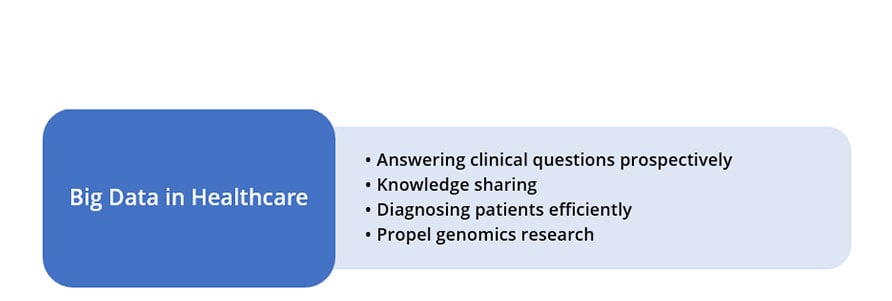
Answering clinical questions prospectively
Big data can be configured to extract structured information from unstructured data sets in EHRs by using machine learning tools like natural language processing. According to a study, such automated structuring of EHR data has proven to be more beneficial in detecting postoperative complications than conventional discharge coding. Random trials on a narrow spectrum of participants are currently questioned for generalization for patients with specific medical characteristics. Big data can be used to present observational evidence gathered from EHR data without raising issues of generalization.
Knowledge sharing for transforming healthcare
Medical knowledge keeps on growing daily, with new research papers and medical breakthroughs making news in medical circles. However, not all physicians can catch up with all the latest developments in medicine and treatments. Making these resources available online will expand outreach but even providing access to all the resources will not ensure that physicians are thorough with the latest developments. Using big data tools, we can provide physicians with a dashboard that can update them with possible new medications or treatments specifically to their existing patients. This system will help with better penetration of new medical treatments and improve healthcare delivery.
Diagnosing patients efficiently
Diagnosis is the first step to effective treatments. Consulting a different physician, either because of relocation or an alternative opinion, is such a hassle today because it takes time for a new doctor to understand a patient’s response to specific drugs apart from other specific patient characteristics. Big data can provide a practitioner with specific insights of a patient that would take some sessions to identify conventionally. Besides, this data can be shared with relevant health initiatives such as those fighting obesity or smoking so that these campaigns are delivered to a focused group of patients. The success of IBM Watson just shows how big data can manage to diagnose patients effectively.
Propel research in genomics
Genomics research can be leveraged if personalized medications could be translated into clinical practice. To streamline research in genomics, big data could be employed to classify the phenotype of a patient by using natural language processing. Analytical techniques could then be used to integrate the EHR data and genomics of a person.
Several other use-cases can be derived from the above-mentioned applications. However, certain moral and ethical concerns continue to loom over the usage big data with EHRs. If privacy issues and anonymity are taken care of, big data has many applications that will help in transforming healthcare.