
 The Internet of Things holds tremendous potential for public-sector leaders and the government to solve problems. IoT offers governments the opportunity to make significant advances in citizen services. IoT has a vast amount of implications in the governance sector. By the end of this decade, billions of devices are expected to join the global network. This interconnected network will bring several opportunities for city planners, policy makers, and regulators. IoT solutions will enhance employee productivity and utilization of public resources. Also, it will reduce operating costs and create new revenue streams for municipal and regional governments. Defence organizations around the globe are expecting huge potential advantages through enhanced connectivity, and next-generation communications systems.
Take an example of an IoT solution that will enable the government to create services that leverage big data and crowdsourcing. This will expand the power of machine-to-machine communications for citizen delivery. Similarly, governments can facilitate the development of mobile technology to develop “smart working” strategies which will help in reducing costs, and positive environmental impact.
A Cisco study has stated that the IoT is envisioned to generate $4.6 trillion in the public sector over the next decade.
Let us take a look at the five primary drivers of the revenue generation. These drivers demonstrate how IoT can impact every aspect of public sector processes.
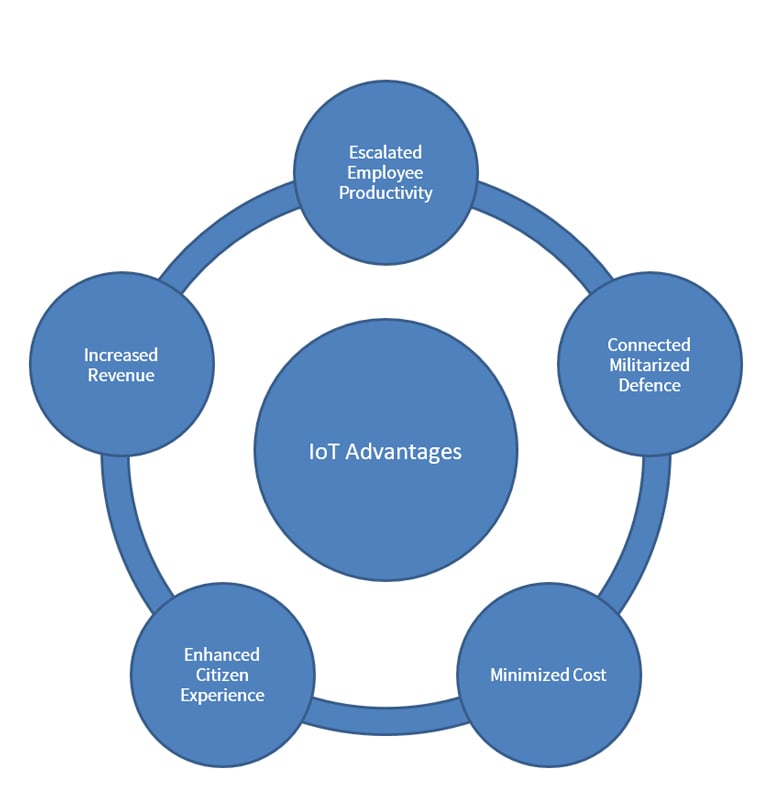
1. Escalated Employee Productivity
Employee productivity is expected to generate $1.8 trillion as IoT will improve labour effectiveness for new and existing services.
2. Connected Militarized Defence
The defence organizations are expected to generate $1.5 trillion as IoT provides improved situational awareness and connected command centers, supplies and vehicles.
3. Minimized Cost
As IoT solutions will enhance labour efficiency and capital expense utilization, there will be a significant reduction in operational costs. This will contribute an expected $740 to the public sector.
4. Enhanced Citizen Experience
IoT produces better health outcomes and employment opportunities which will contribute $412 billion to the public sector.
5. Increased Revenue
IoT will improve the ability to match supply with demand, thus enhancing compliance and monitoring. This will lead to the generation of $125 billion to the public sector.
The government has a responsibility to protect public interest. Hence, public sector organizations must focus on developing a secure IoT. In this secure IoT, private companies must balance profit incentives, and the government’s core mission should be providing safety, security and transparency to all the citizens.
As more of the world’s population moving into urban areas of the nation, government organizations should become more flexible and responsive to citizen needs. Using IoT solutions, governments can transform the way cities deliver its services and can build a strong foundation with its citizens.