

Big data initiative for any organization needs to be a business decision and not an IT decision alone. If you really intend to create value and impact with your big data initiative you need to have a broad understanding of what goes into making such an initiative successful, and what are some of the common blunders to avoid.
Roadmap to a successful big data initiative
The roadmap to any successful Big Data initiative, that marks your progress forward, includes the following five milestones.
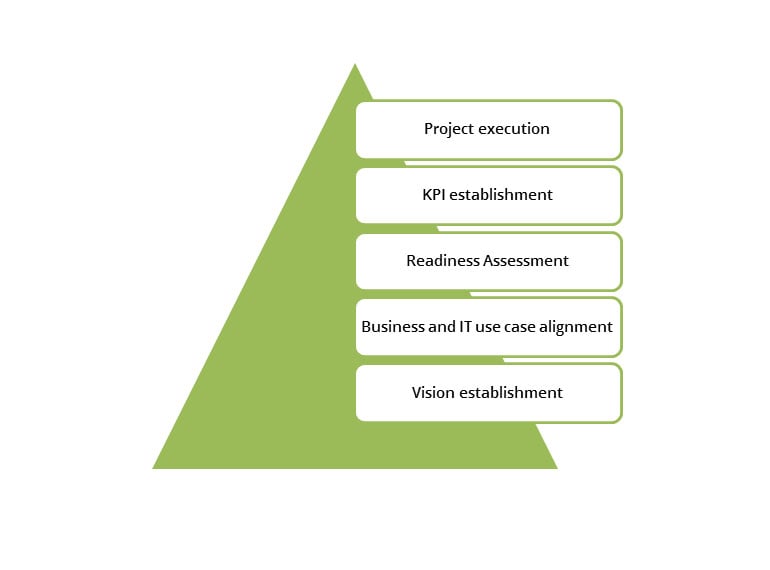
Vision establishment: It all begins with a clear view of what you are trying to accomplish with your Big Data project. Just capturing terabytes of data on a daily basis will be inconsequential. You should ask yourself questions, like what business insights are we trying to drive? What are the use cases? Do we have the correct tool set?
For example, if your top goal is to become a data-driven organization, where information analysis guides corporate strategies and customer relationships, then the vision for your big data initiative should be the ability to provide a steady stream of actionable information, derived from big data, to business executives.
Business and IT use case alignment: Another critical success factor for any big data initiative is the alignment of your business goals and IT use cases. If your IT is not prepared to deploy to maintain big data technologies that require a new skill set, your initiatives will most likely fail. You need to decide on a use case that can help your organization start in a manner that meets the objectives of both business and IT. For example, a log aggregation use case, which continually collects and analyzes log data from different sources in an IT environment, helping IT operators work proactively in the maintenance of the IT system’s health and performance.
Readiness Assessment: The next important success factor is assessing the readiness of your IT environment and the in-house skill sets needed to implement your big data initiative. In order to empower your existing IT team and to put the power of analytics to work, assessing the readiness of your environment is crucial. You may need to assess the preparedness of your technology, people, and processes.
KPI establishment: Regardless of which big data project it is, the Key Performance Indicators (KPIs) are always an essential component. However, there are no one-size-fits-all KPIs; they are a measure of your success and, therefore, unique to your business. In fact, not just business as a whole, KPIs are unique to each use case, each phase, and each step of your big data project.
Project execution: The final milestone on the path of a successful big data initiative is the execution of your first project. The best practice is to start with a pilot project, achieve success at that level, and then expand the pilot into a production environment. In the process of running a pilot, your team will develop its skills and comfort with the technologies involved in big data initiatives. For example, you may start with an ETL offload project and then incorporate predictive and prescriptive analytics technologies for driving better business decisions.
Pitfalls for a big data initiative
Big data is quite a big deal! And this is why most organizations are just blindly following the herd that’s adopting big data initiatives, without thinking through this decision. Most companies simply don’t know what they’re doing. Management resistance, selection of the wrong use cases, insufficient skill set, working in silos, disagreement on enterprise strategy are some of the common pitfalls in the implementation of a big data initiative.
The question isn’t about whether or not your organization should adopt a big data practices; all organizations need to do that in order to offer the best customer experience and stay competitive. The real question is to determine the steps you need to take for implementing a big data initiative successfully.