
Enterprises face several business uncertainties and continuous pressure to optimize IT costs. Many companies often resort to small term cost-cutting measures in response to building pressures to reduce IT spend. However, focusing only on short-term cost-cutting measures without having a robust business strategy will result in higher IT costs in the long term perspective. Also, many companies are not able to explain the increase in expenditure as they are not able to relate IT operational costs to application development activities. This is why CIOs are shifting their focus from pure cost reduction programs towards more strategic cost-saving initiatives. These cost optimization techniques help companies achieve a correct balance between reduced IT expenditure as a percentage of revenue and increased investments in business innovation and IT improvement initiatives. For achieving strategic cost optimization, we recommend you to focus on the pricing models.
Working of pricing models
Pricing models consist of three critical optimization elements:
- Pricing strategy
- Value of the product to both buyer and seller
- Tactics to manage all elements impacting profitability
CIOs must first select the preferred pricing model and determine the required inputs and desired outputs. After this, they can collect the company’s historical data like economic condition, variable cost details, product availability, etc. and then set some strategic rules to guide the modeling process. In the end, CIOs must always monitor the results and upgrade data input to improve the price modeling accuracy.
Let’s take a look at the two major pricing models for application service contracts.
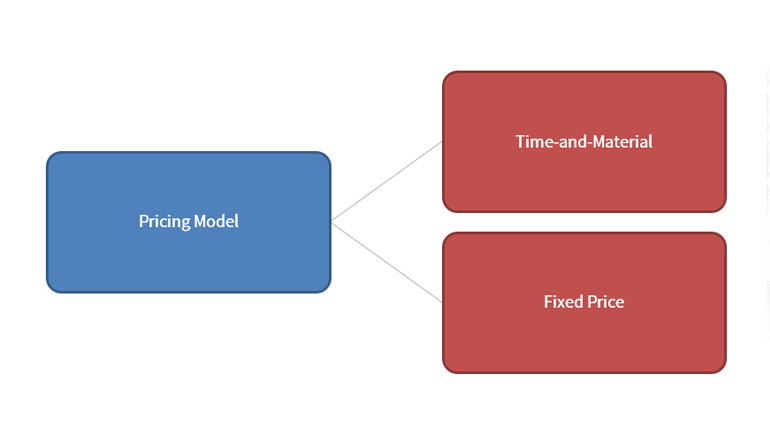
1. Time-and-Materials (T&M)
The main advantage this model provides is flexibility. Moreover, T&M model not only encompasses a client’s evolving requirements, but also it assures that client gets a high quality and well-tested product.
The key points in Time-and-Material pricing model are:
- Gives approximate time estimate
- Facility of adding changes on the go
- Payment depends on the hours spent
2. Fixed Price
This model is appropriate for small software development projects with clear requirements, set specifications and defined timelines. Projects falling under fixed pricing model have well-documented requirements which normally do not change during the course of the project implementation. A fixed price model is also used for short-term software development tasks where close supervision from a client is not necessary.
The key points in Fixed Pricing model are:
- Fixed budget
- Fixed project scope
- Fixed timeframe
Several sourcing executives like the fixed-price model as they can clearly assess their costs to deliver service expectations and service levels. Fixed price also has less management reporting overhead for the providers in tracking and reporting timecards in stable application environments. While other sourcing executives are adopting T&M models as they implement agile development in their organization. T&M model allows them to incorporate the changing requirements and effectively manage the demands.
I would suggest, that when application organizations are immature, they must adopt a fixed price model, as such organizations lack the internal capabilities and historical data to apply formal counting and measurement mechanisms. Thus, they often fall back on T&M.
CIOs must focus on collaborating with IT service managers to ensure that they understand the contract terms of both of these models and incorporate the concept of continuous improvement in cost and service in the provider’s application services agreements. Thus, choosing an appropriate pricing model will definitely assist you in optimizing your IT costs.