

Today, many enterprises are successfully implementing IoT. In a previous blog post, we studied the failure points of IoT. One of the factors that can cause the failure of IoT project is the integration issue. As there is an increase in the availability of various platforms, protocols and numerous APIs, IoT integration is challenging. Also, there is a lot of confusion around the rapidly evolving standards. This has resulted in project delays and missed business opportunities.
In this blog, we will present to you the ways in which you can achieve effective integration delivery.
There is an increase in demand for projects driven by cloud and thus, integrating devices from the Internet of Things is necessary. This puts pressure on a lot of enterprises’ integration teams to deliver a more concurrent stream of works. Thus, the enterprise and its integration teams are needed to take a bimodal approach to integration delivery. Multiple teams are now changing their application development practices to adopt this bimodal approach. Many organizations have started to address the integration problem using different technologies and processes, creating an effective integration solution.
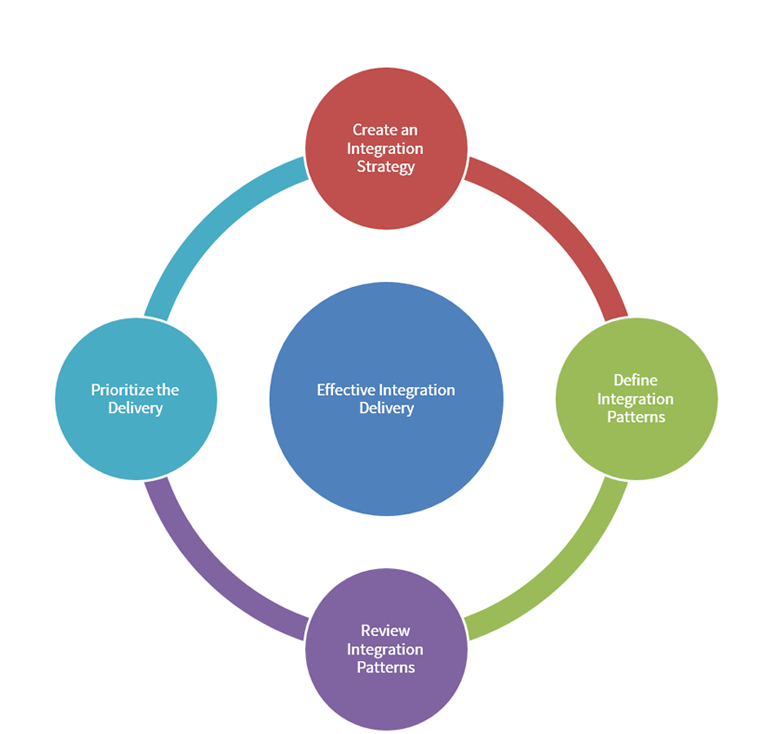
Steps to achieve effective integration delivery
1. Create an IoT Integration Strategy
In this step, companies creating an integrating strategy must understand the short and long-term integration needs of the business. They must also create and coordinate roles, responsibilities, and delivery of those integration needs between the different internal and external teams. Companies have a traditional approach of focusing on application integration driven by ERP and service-oriented architecture initiatives. But, there are several other types of integrations like data integration, cloud service integration, and Business Intelligence, which the company must focus on. Thus, companies must make different instances of integration teams handling each type of integration. These teams must start with a clear goal in mind. But, as they mature, they must be able to overlap their integration capabilities with other functional areas. Once you have captured these capabilities, you can perform a “must have, should have, could have, won’t have” (MoSCoW) principle and list every service against each capability. This will help you in showing which capabilities are important to your organization. You must also list down all these capabilities.
2. Define Integration Patterns
In 2008, Gartner defined three types of integration patterns for application integration. In this step, we recommend you, to use these three types of integration patterns while addressing each of the capabilities from the previous step. This will help you in chalking out more granular patterns for integration.
3. Review Integration Patterns
In this step, you must review how those integration patterns are currently being delivered. The main objective of this step is to document the different ways in which each pattern is implemented and how each integration team delivers it. Once this process is completed, the company will have full visibility of how integration is being delivered inside the organization. This process also helps in removing the duplicate integration patterns delivered by multiple teams. By the end of this process, companies will be able to define a consolidated list of potential integration implementation templates and packages to be created.
4. Prioritize the Delivery
In this step, your company must prioritize which integration templates and packages need to be created and in what order. Many a time it happens that the team wants to focus on improving one particular area, but the business priority can be entirely different. Thus, this step will allow your company and the integration teams to focus their efforts in the right area.