In part 1 of our series on how to develop a smart workspace to gain employee engagement , we discussed about creating scenarios and recognizing gaps while developing a smart workspace. In this blog post, we will discuss the next two methods.
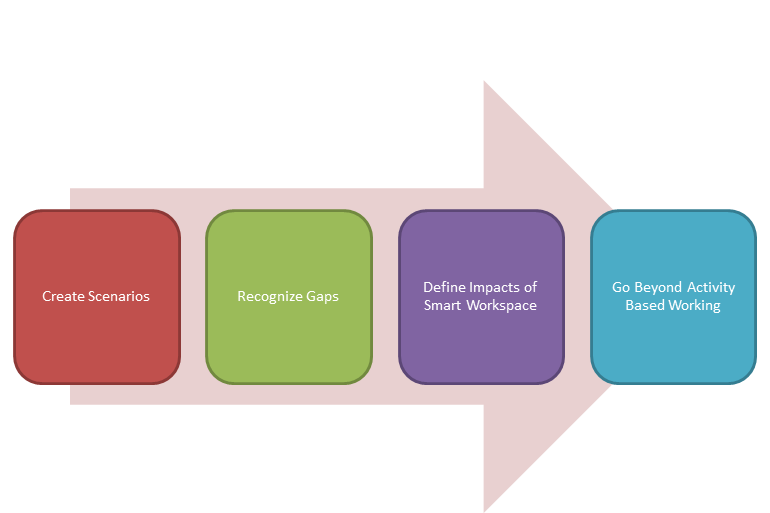
Define Impacts of Smart Workspace
IT leaders must discuss scenarios and illustrate how traditional IT approaches that concentrate on functional needs can be broadened through a smart workspace perspective. These scenarios can be used as a baseline while creating a business proposal that justifies a smart workspace effort. Take a look at the following example:
- Use Case: Continuous recruitment of employees.
- Predicted problem: New hires walk through building spaces where other business departments work, with little idea about what’s going on, how different groups relate to each other, and how it affects their job.
- Functional need: To reduce the time new employees take to get accustomed to their new position. Also, allowing them to learn more about the job and their career-path options.
- Functional approach: Create a virtual learning portal or community where new hires receive mentoring by subject matter experts and coaching by senior staff, and where everyone shares best practices.
- Smart workspace approach: IT leaders can use IoT solutions working in conjunction with a mobile app to deliver an ambient experience that provides learning based on particular content, location of new recruits, and proximity to people, places or things.
This methodology expands a functional view of work activities to include physical surroundings. IT leaders can transform the way an employee organizes, coordinates, shares information and collaborates with others. Thus, IT leaders must create a catalog of use cases that highlight business scenarios where smart workspace technologies can add value.
Go Beyond Activity Based Working
With Activity Based Working (ABW), employees and organizations can utilize their office spaces effectively to fulfill certain activities, rather than working from permanently assigned seating. Organizations like Gartner have come up with new frameworks that build on ABW to help you create a more comprehensive strategy for smart workspaces.
Gartner’s ACME framework enables IT leaders to shift away easily from a functional approach to a smart workspace approach. ACME stands for Activities, Context, Motivation, and Enabling Technology. This framework helps IT leaders to increase the effectiveness of their collaboration initiatives.
1. Activities
Office environments are not designed to be highly adaptive; they are actually designed to maintain the current situation and are structured in a rigid manner. For example, space for people’s personal work area can be assigned based on hierarchy and seniority, rather than being dictated by the needs of different work activities. Using the ACME framework, strategists can examine the purpose of an activity in a physical environment and how that physical environment should best be designed and provisioned.
2. Context
Context can have an enormous impact on physical environments. The ACME framework exploits physical surroundings to give contextual insights to people that certain spaces have certain purposes. Spaces designed as “quiet zones” can become places where employees gather to have deep discussions or provide feedback on strategic documents. Spaces designed as “town squares” promote conversation; they are noisier, by intent, so people choosing to be in this type of space have already acknowledged the need to be in a vibrant atmosphere. For example, let’s say a company is celebrating completion of an employee’s tenure. Such an event cannot be hosted in a space allotted for quiet work.
3. Motivation
In companies, employees must be allowed to move from one place to another based on their work demands. This freedom of movement gives them a sense of ownership over their activities. Effective space design can also encourage a greater sense of belonging; Thus employee engagement and cultural goals of HR makes up a motivation component of the ACME framework.
4. Enabling Technology
Technologies associated with Integrated Workspace Management System (IWMS) often focus on capital project management, real estate/property portfolio management, lease administration, maintenance management, sustainability and energy management, as well as space and facilities management. The ACME framework can digitalize IWMS by incorporating IoT and smart machines into it. Doing so enables the organization to improve the business results coming from IWMS technologies. Thus, IT leaders must include HR strategists as key partners in smart workspace efforts in order to contribute to employee engagement.
Developing a smart workspace helps in increasing employee productivity, reducing real estate costs and creating optimized spaces for collaboration between teams. With the right kind of strategy and technology, smart workspaces can be a reality in your organization too. If you need more ideas on how you can develop smart workspaces in your organization, get in touch with Allerin and we will be happy to help you out.